

Introduction: The Configuration Imperative for Next-Gen Access Networks
The modern telecom landscape is defined by an insatiable demand for bandwidth, driven by 8K video streaming, cloud-based enterprise applications, and the proliferation of IoT devices. For network architects and systems integrators, the Nokia 7360 ISAM FX series represents a pivotal solution in the fiber access domain. However, unlocking its full potential requires more than a cursory understanding of its hardware; it demands a deep, methodological approach to configuration. This manual serves as a definitive guide to navigating the complexities of Nokia 7360 ISAM FX configuration, transforming potential network bottlenecks into streamlined, high-performance data pipelines. We will dissect the architecture, delve into operational parameters, and provide best-practice frameworks to ensure your deployment is not only functional but optimized for carrier-grade reliability and efficiency.

Core Architecture: Dissecting the FX Hardware Topology
To effectively configure the Nokia 7360 ISAM FX, one must first understand its physical and logical hierarchy. The platform is built on a modular, high-density chassis design that supports a variety of interface cards, making it exceptionally versatile for both Central Office (CO) and remote terminal deployments. At its heart lies a robust backplane with a switching capacity that scales to meet the demands of dense subscriber aggregation.
Chassis and Interface Card Overview
The system typically comprises a 6-slot or 12-slot chassis, accommodating a range of line cards. Key components include the Control Processor (CP) cards that run the operating system and manage system-level functions, and the Interface Cards (ICs) which provide the physical layer connectivity. The sophistication of the Nokia 7360 ISAM FX is evident in its support for both GPON and XGS-PON technologies, allowing for a smooth migration path from 2.5Gbps to 10Gbps PON networks. When planning your Nokia 7360 ISAM FX configuration, consider the placement of uplink cards, which often utilize 10GE or 40GE interfaces to connect to the aggregation network, ensuring no single point of congestion.
Logical Hierarchy: Subscriber to Core
From a configuration standpoint, the logical architecture is equally critical. The system operates on a hierarchy of objects: chassis, shelf, slot, and port. Understanding this model is fundamental to efficient CLI scripting and automation. Configuration parameters such as VLAN tagging, Quality of Service (QoS) profiles, and DBA (Dynamic Bandwidth Allocation) profiles are applied at specific levels within this hierarchy. A well-structured Nokia 7360 ISAM FX configuration utilizes this hierarchy to apply global policies efficiently, reducing the administrative overhead of managing thousands of individual subscribers.
Operational Parameter Limits and Configuration Best Practices
Configuring the Nokia 7360 ISAM FX for optimal performance is a delicate balance of resource management. To overcome bottlenecks, you must be intimately familiar with the platform’s parameter limits and how to configure them proactively.
| Key Parameter | Technical Specification | Configuration Impact |
|---|---|---|
| System Switching Capacity | Up to 1.2 Tbps (fully loaded chassis) | Critical for high-density subscriber aggregation; exceeding this limit leads to severe packet drops and bottlenecking. |
| Maximum ONT Subscribers | Up to 16,384 per chassis (dependent on card type) | Determines the scale of the network; careful planning required to manage DBA profiles and traffic shaping policies for this many endpoints. |
| Latency (Store-and-Forward) | Ultra-low latency ensures high performance for real-time applications; configuration of QoS and priority queuing is essential to maintain this. | |
| Mean Time Between Failures (MTBF) | > 600,000 hours (Bellcore SR-332) | A critical metric for carrier-grade reliability; redundancy configuration (CP failover) must be tested against this baseline to ensure uptime. |
| Power Consumption (Typical) | Approx. 300-500W per chassis (loaded) | TCO and environmental impact; configuration of power-saving modes (e.g., port deactivation) is recommended for energy efficiency. |
Optimizing Throughput with DBA and Traffic Shaping
Dynamic Bandwidth Allocation (DBA) is the cornerstone of efficient upstream traffic management in PON networks. The Nokia 7360 ISAM FX supports sophisticated DBA algorithms that dynamically adjust upstream bandwidth allocations to Optical Network Terminals (ONTs). Proper configuration of DBA profiles is essential to prevent upstream bottlenecks, especially in high-density environments with fluctuating traffic loads. Use traffic shaping parameters to enforce Service Level Agreements (SLAs), prioritizing latency-sensitive traffic such as VoIP and video conferencing over best-effort data. Adhering to IEEE 802.1p and ITU-T G.984 standards for QoS marking ensures end-to-end prioritization across the network.
Redundancy and High Availability Configuration
Carrier-grade reliability is non-negotiable. The Nokia 7360 ISAM FX is designed with a dual CP card setup for active/standby failover. Configuration involves setting up stateful synchronization between cards to ensure sub-second switchover times. Additionally, link aggregation (LACP) should be configured on uplink interfaces to provide both load balancing and redundancy. Industry data indicates that proper redundancy configurations can significantly reduce network downtime, approaching the theoretical maximum of 99.999% availability (five nines), a standard crucial for mission-critical enterprise connectivity and a non-negotiable aspect of robust Nokia 7360 ISAM FX configuration.
Field Deployment Topologies and Security Hardening
The versatility of the Nokia 7360 ISAM FX allows it to be deployed across a spectrum of topologies, from centralized COs to distributed remote nodes. However, each topology presents unique configuration challenges and security considerations.
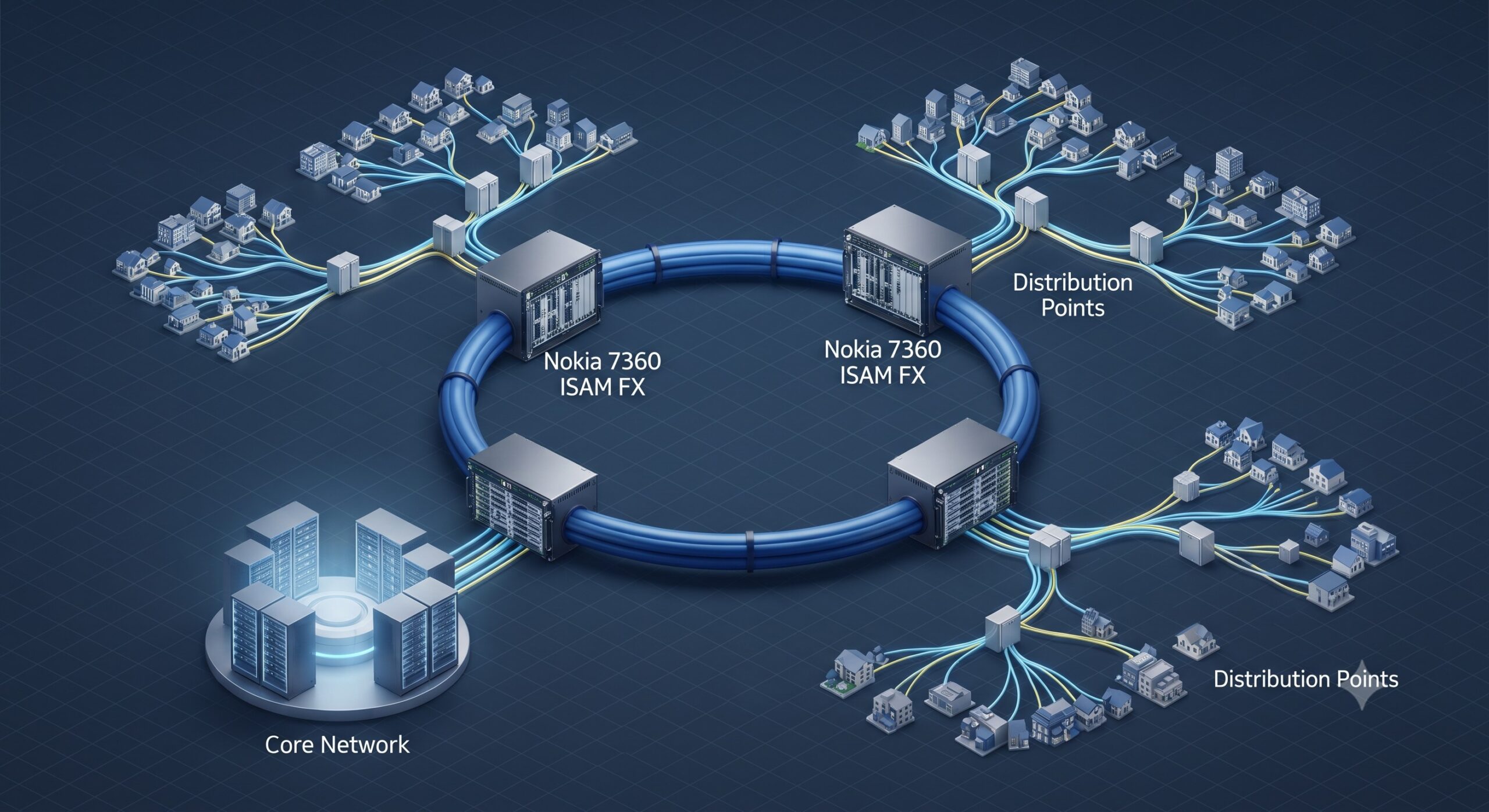
Deployment Scenarios: Centralized vs. Distributed
In a centralized topology, all chassis are housed in a single CO, simplifying management but requiring more extensive backhaul infrastructure. Configuration in this model often focuses on efficient uplink aggregation and subscriber management. Conversely, a distributed topology places ISAM FX nodes closer to the end-users, saving fiber and enabling faster service delivery. Configuration in this scenario is more complex, requiring careful planning of the optical distribution network (ODN) and robust remote management capabilities, often involving the creation of management VLANs and OAM (Operations, Administration, and Maintenance) protocols per ITU-T G.988 standards.
Hardening the Access Layer: MAC and Security Features
Security in the access network is paramount. The Nokia 7360 ISAM FX includes a suite of features to harden the infrastructure. At the MAC layer, implement port security to limit the number of MAC addresses learned on a port, preventing MAC flooding attacks. DHCP snooping and Dynamic ARP Inspection (DAI) are critical to validate traffic and prevent man-in-the-middle attacks. Furthermore, the ability to configure line-rate encryption ensures that data traversing the PON network is secured against physical eavesdropping. Each of these features must be methodically enabled as part of any comprehensive Nokia 7360 ISAM FX configuration to meet modern security compliance requirements and protect the integrity of the network.
Conclusion: Mastering the FX for Operational Excellence
Mastering the Nokia 7360 ISAM FX configuration is not merely a technical exercise; it is a strategic endeavor that directly impacts network performance, reliability, and operational expenditure. By internalizing the architecture, adhering to best practices in parameter management, and applying robust security and redundancy measures, network engineers can transform their access networks into agile, high-performance assets. This guide has provided the foundational knowledge and strategic framework to navigate the configuration process, ensuring that the hidden potential of the Nokia 7360 ISAM FX is fully realized, delivering quantifiable operational gains and an unparalleled subscriber experience.

Leave a comment