

The High-Stakes Demand for Carrier-Grade Reliability
In the modern telecom landscape, network downtime is measured not in minutes, but in fractions of a percentage point. For network architects and systems integrators, the selection of core and distribution hardware hinges on a singular, non-negotiable criterion: carrier-grade reliability. This evaluation extends far beyond basic throughput, diving deep into the architecture of redundancy, the granularity of Mean Time Between Failures (MTBF) metrics, and the failover capabilities of hardware. This post provides a technical analysis of ZTE ZXR10 Switch Specifications, focusing on the architectural decisions and engineering data that underpin their suitability for mission-critical environments.

Architectural Foundations for High Availability
The cornerstone of any carrier-grade switch is its physical and logical architecture. ZTE’s ZXR10 series, particularly the chassis-based systems, are engineered to eliminate single points of failure through rigorous hardware redundancy.
Dual-Engine and Redundant Component Design
High-availability begins with the control plane. The ZXR10 8900E series core switches, for instance, utilize a non-blocking switching architecture with separate control and data planes . In modular chassis like the ZXR10 S600E-8, critical components are fully redundant. Specifications explicitly list support for redundant 主控板槽位数 (Main Control Board Slots) and 交换网槽位数 (Switch Fabric Slots), typically configured in a 1:1 or N+1 active-standby model . This is complemented by redundant, hot-swappable power supply modules supporting DC, AC, and HVDC input, ensuring operational continuity even during power subsystem maintenance .
Intelligent Thermal Management
Thermal stress is a primary contributor to hardware failure. ZTE addresses this with advanced cooling designs. High-end models like the ZXR10 9900 series feature independent, redundant fan trays and dedicated airflow channels for control, data, and monitoring planes . The ZXR10 5960X-HK, designed for high-density data centers, employs strict front-to-back airflow and an intelligent fan system that dynamically adjusts speed based on real-time temperature sensors, optimizing both cooling efficiency and acoustic noise .
| Reliability Metric & Architecture | ZXR10 S600E-8 / 9900 Series Specification |
|---|---|
| System MTBF | >250,000 hours |
| Mean Time To Repair (MTTR) | |
| Redundancy Architecture | N+1/1+1 Redundant Power, Fans, Main Control Boards |
| Virtual Cluster (VSC2.0) Bandwidth | Up to 320 Gbps |
| Operating Temperature Range | -5°C to 45°C (Long-term) |
Quantifying Reliability: MTBF and Operational Parameters
Reliability is not just a design principle; it is a quantifiable metric. For the ZXR10 S600E-8, ZTE publishes a system MTBF of >250,000 hours with a Mean Time To Repair (MTTR) of less than 30 minutes, demonstrating a commitment to extreme uptime . This high MTBF value is a testament to the rigorous component selection and stress testing inherent in the design lifecycle. Furthermore, the operating parameters define the operational envelope within which this reliability is guaranteed. For example, the S600E-8 operates within a long-term temperature range of 0°C to 45°C and a short-term range of -5°C to 50°C, with an operational altitude of up to 4000 meters . The ZXR10 8900E series extends this environmental tolerance to a working temperature of -5°C to 45°C .
Advanced High-Availability Features: VSC and Fault Tolerance
Beyond hardware redundancy, the software stack is crucial for maintaining service continuity during failures.
Virtual Switching Cluster 2.0 (VSC2.0)
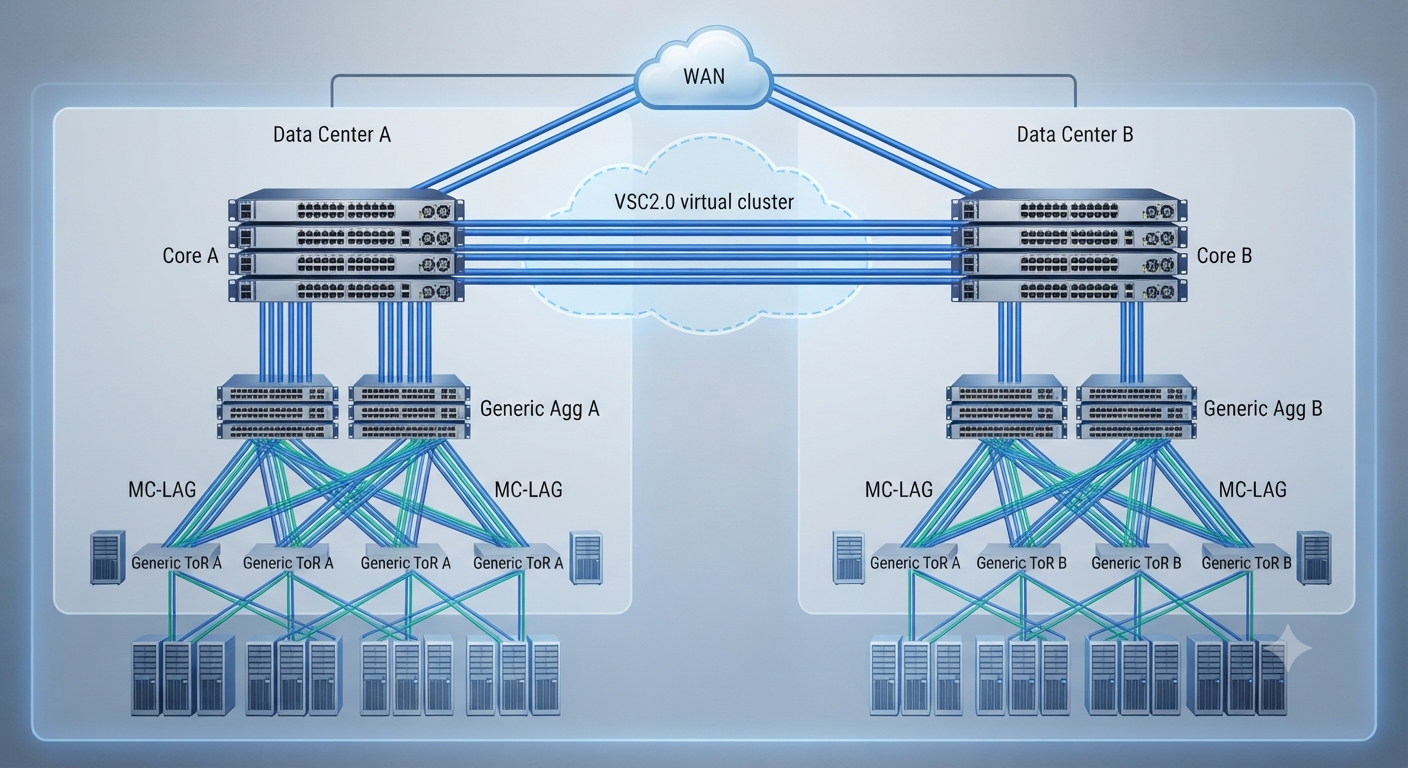
ZTE’s proprietary VSC2.0 technology is a critical enabler for network resilience. It virtualizes multiple physical switches into a single logical entity, facilitating cross-device link aggregation and simplified management. Crucially for reliability, VSC2.0 supports geographic redundancy, allowing for 异地容灾 (Geo-redundancy) across different physical locations . This capability is central to building highly resilient metro and data center core networks. The technology offers a dedicated stacking bandwidth of up to 320 Gbps to ensure seamless synchronization between cluster members .
Link and Device-Level Redundancy
On the network edge, protocols like MC-LAG (Multi-Chassis Link Aggregation) provide device-level redundancy, allowing two separate switches to appear as a single link aggregation group to a downstream device . This eliminates the reliance on spanning-tree protocols for loop prevention in specific scenarios, reducing failover times to sub-second levels. For ring topologies, protocols like ZESR (ZTE Ethernet Smart Ring) provide rapid sub-50ms protection switching, essential for maintaining service quality in carrier access networks .
Application in Mission-Critical Deployments
The robust architecture of the ZXR10 series makes it suitable for a wide array of mission-critical applications. The ZXR10 9900X series, for instance, supports high-density 400GE and 800GE interfaces and is designed for high-performance data centers and intelligent computing clusters, supporting lossless Ethernet features like PFC, ECN, and AI-optimized load balancing for RoCEv2 traffic, demanding extreme reliability for AI/ML workloads . The design includes support for advanced redundancy features like NSF (Non-Stop Forwarding) and ISSU (In-Service Software Upgrade), which ensure data plane continuity even during control plane or software upgrades . The focus on In-band OAM and Telemetry also allows for proactive network monitoring, enabling operators to identify and mitigate issues before they lead to service impact .
Final Assessment: A Reliability-Centric Design Philosophy
Analyzing the ZTE ZXR10 Switch Specifications through the lens of carrier-grade reliability reveals a deliberate, comprehensive engineering philosophy. The series is not defined by a single high-availability feature but by a multi-layered strategy spanning hardware architecture, component selection, and advanced software protocols. From the redundant hardware paths and high MTBF ratings to the VSC2.0 geo-redundancy and MC-LAG capabilities, ZTE has built a portfolio that offers network architects the tools to meet the most stringent service-level agreements, ensuring that the network remains a resilient foundation for digital transformation.

Leave a comment