
STRATEGIC MIGRATION OVERVIEW
The Cisco Catalyst 2960-X Series, a mainstay of enterprise access networks since its introduction in 2013, has officially entered its End-of-Life (EoL) phase, with the End-of-Support (EoSL) date set for October 31, 2027 . This definitive transition compels organizations to develop and execute a strategic migration plan to maintain network security, operational continuity, and compliance with evolving industry standards.
This guide serves as a comprehensive technical reference for network architects and engineers tasked with migrating from the legacy Catalyst 2960-X platform. It provides a detailed comparison with its primary successor, the Catalyst 9200 Series, and outlines the critical technical, operational, and procedural considerations for a successful hardware refresh.
ARCHITECTURAL EVOLUTION & PLATFORM OVERVIEW
The original Cisco Catalyst 2960-X series was designed as a fixed-configuration, enterprise-class access switch for campus and branch applications, providing robust port security, Quality of Service (QoS), and Power over Ethernet (PoE) for endpoints like IP phones, wireless access points, and security cameras . The portfolio included a wide range of models, from 24 to 48 ports, supporting both SFP and SFP+ uplink modules and running LAN Base or LAN Lite software images .
The successor, the Catalyst 9200 Series, is not merely a replacement but a generational upgrade. It is built on the modern Cisco IOS XE operating system, offering a modular, containerized architecture that supports advanced programmability, automation, and security features . The Catalyst 9200 represents a strategic investment for organizations looking to modernize their network infrastructure.
HARDWARE COMPARISON & TECHNICAL SPECIFICATIONS
A clear understanding of the physical and technical differences between the platforms is essential for accurate planning and procurement.
| Parameter | Cisco Catalyst 2960-X | Cisco Catalyst 9200 |
|---|---|---|
| Form Factor | Fixed 1RU Chassis | Fixed 1RU Chassis |
| PoE Power Delivery | Partial 30W (Limited overall budget) | Full 30W PoE+ on all ports |
| Max Fiber Uplinks | Fixed 1G (SFP) or 10G (SFP+) | Modular 10G / 25G (SFP/SFP+) |
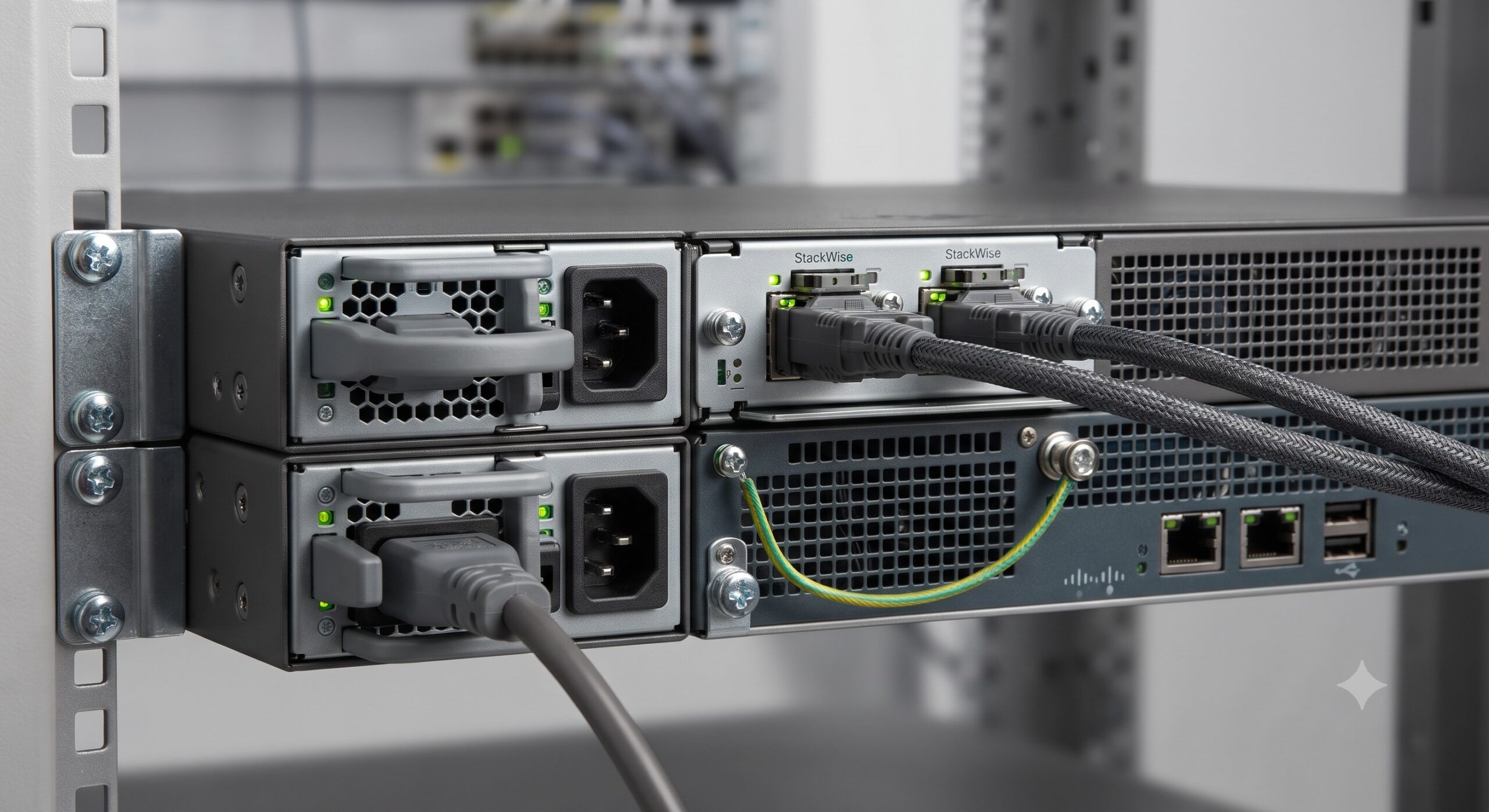
| Stacking Technology | FlexStack-Plus (Flat module) | StackWise-160 (Dedicated rear cables) |
| Max Stacking Bandwidth | 80 Gbps | 160 Gbps |
| Software Model | Perpetual LAN Base (Buy once) | Mandatory DNA Subscription |
| Operating System | Classic Cisco IOS | Modern Cisco IOS XE |
As detailed in the specifications table, the Catalyst 9200 series delivers significant enhancements over the 2960-X: full 30W PoE+ availability across all ports , modular uplinks supporting up to 25G speeds , and a doubling of stacking bandwidth from 80 Gbps to 160 Gbps .
The software model has also fundamentally shifted. The perpetual LAN Base license on the 2960-X is replaced by a mandatory subscription-based model (Cisco DNA Essentials or Advantage) on the 9200, a critical factor in lifecycle cost analysis .
SYSTEM HARDWARE TOPOLOGY & MIGRATION ARCHITECTURE
The most critical hardware constraint during migration is the incompatibility of the stacking infrastructure. The Catalyst 2960-X utilizes FlexStack-Plus modules and cables, while the Catalyst 9200 uses a physically incompatible StackWise-160 architecture .
**Critical Deployment Note:** Catalyst 2960-X and Catalyst 9200 switches **cannot be mixed within a single stack**. The migration cutover necessitates a ‘rip and replace’ approach for any stacked environment. The existing stack must be completely powered down and removed, and the new Catalyst 9200 stack must be built and brought up independently .
DATA & CONTROL PLANE CAPABILITIES
The migration process is supported by a high degree of configuration continuity, as both platforms operate on a Cisco-based command-line interface (CLI). The classic Cisco IOS of the 2960-X and the newer IOS XE of the 9200 share a ~95% identical CLI structure. This allows for a direct copy and paste of the majority of existing configurations, including VLANs, trunk ports, and spanning-tree parameters .
However, engineers must be prepared for critical operational differences:
– **Licensing:** The Catalyst 9200 operates on Cisco Smart Licensing. The new switch must be configured to communicate with a Smart Account or an on-premise Smart Licensing Satellite to register the mandatory DNA subscription. Failure to do so will result in licensing errors .
– **Boot Modes:** The Catalyst 2960-X supports only the traditional ‘bundle’ boot mode. The Catalyst 9200 defaults to the more advanced and recommended ‘install’ mode, which provides faster boot times and more robust software management .
– **Quality of Service (QoS):** There are fundamental differences in QoS behavior. The 2960-X uses the legacy MLS QoS paradigm, whereas the 9200 uses the more advanced Modular QoS CLI (MQC). Key differences include trust interface configuration (disabled by default on 2960-X, enabled on 9200), port ingress defaults (trust none vs. trust all), and the addition of advanced features like Hierarchical QoS and Weighted Random Early Detection (WRED) on the 9200 .
– **Switch Reset:** While the 2960-X relies on the traditional `write erase` command, the Catalyst 9200 provides an `exec factory-reset` command, which removes all customer-specific data, configurations, and credentials and resets the device to a clean state .
– **Device Tracking:** The legacy `ip device tracking` commands on the 2960-X are replaced with a new, unified SISF-based device-tracking policy framework on the 9200. Existing scripts or configurations using the legacy syntax will require remediation .
ORDERING & PROCUREMENT GUIDANCE
The product identification (PID) mapping for a successful migration is as follows, ensuring a direct functional replacement :
| Legacy 2960-X PID | Recommended Replacement 9200 PID |
| :— | :— |
| WS-C2960X-24TS-L | C9200L-24T-4G |
| WS-C2960X-48FPS-L | C9200-48P-4X |
| WS-C2960X-48LPS-L | C9200L-48P-4G |
| WS-C2960X-24PD-L | C9200-24P-4X |
| WS-C2960XR-48FPD-I | C9200-48P-4X |
**Note on Optics:** As a cost-saving measure, most standard 1G copper and 1G/10G fiber SFP modules that are functional in a 2960-X are typically compatible with the Catalyst 9200 .
RECOMMENDED MIGRATION FRAMEWORK
To mitigate risk and ensure a seamless transition, the following phased framework is recommended :
1. **Comprehensive Inventory:** Conduct a thorough audit of all network switches. Document all affected models (including 2960-X variants), current IOS versions, connected devices, PoE budgets per switch, and critical network locations. This granular inventory serves as the foundation for all subsequent decisions .
2. **Risk Assessment:** Identify and evaluate the risks of maintaining EoL equipment. This includes the operational risk of a switch failure without TAC support , the security risk of unpatched vulnerabilities, and the compliance risk of failing audits .
3. **Platform Selection:** While the Catalyst 9200 is the recommended replacement for the 2960-X , a mixed-scenario approach can be adopted: using Catalyst 9200 in core and critical areas, and the simpler Catalyst 1300 series (for simple, non-IOS XE networks) for non-critical branch offices or low-complexity environments .
📥 Download Technical Specification
Click the button below to view or download the full official PDF datasheet.

Leave a comment