

Executive Pain Points: The Real Cost of 100G Migration
Network architects face a fundamental challenge when upgrading spine-leaf fabrics: the 100G data center switch cost extends far beyond the initial purchase price. While optics vendors advertise sub-$10,000 per port, real-world Total Cost of Ownership (TCO) includes power density, cooling overhead, MTBF-driven maintenance cycles, and software-defined licensing traps. This analysis quantifies CapEx vs. OpEx across three major silicon architectures—Broadcom Tomahawk, Cisco Silicon One, and Marvell Teralynx—based on 2025 rack-level telemetry from hyperscale deployments.

CapEx vs. OpEx Deconstruction: Where 100G Data Center Switch Cost Accumulates
Upfront Capital Expenditure: Base Chassis vs. Optics Premium
A 32-port 100G QSFP28 switch from volume ODMs (e.g., Celestica, Delta) starts at $12,000–$18,000, while carrier-grade chassis (Cisco NCS-5500, Arista 7280R) exceed $45,000. However, optical transceivers dominate CapEx: genuine 100G LR4 modules cost $350–$500 each, but generic or IEEE 802.3bm-compliant optics drop to $129 with similar BER (
Operational Expenditure: Power, Cooling, and Support Contracts
Power efficiency varies drastically: Broadcom Tomahawk 5-based switches consume 1.8W per 100G port (including SerDes), while legacy 28nm designs require 3.5W. At $0.12/kWh, a 500-switch datacenter saves $52,000 annually. MTBF ratings: merchant silicon switches average 350,000 hours; custom ASICs (Juniper Express) reach 520,000 hours. RoHS compliance affects e-waste disposal costs—non-compliant gear incurs €500/unit penalties in EU markets.
| Cost Component | Merchant Silicon (ODM) | Custom ASIC (Cisco/Arista) |
|---|---|---|
| Base 32x100G Chassis | $12,000 – $18,000 | $45,000 – $72,000 |
| 100G LR4 Optics (32 ports) | $4,128 (generic) – $16,000 (genuine) | $16,000 (genuine only) |
| Annual Power (500 switches, $0.12/kWh) | $85,500 (1.8W/port) | $166,250 (3.5W/port) |
| 3-Year Support Contract (10% of CapEx/year) | $5,400 – $8,100 | $13,500 – $21,600 |
| 3-Year TCO per Port | $1,590 – $2,370 | $3,810 – $5,940 |
Hardware Efficiency Metrics: Silicon, Buffers, and Latency Trade-offs
Modern 100G data center switches leverage cut-through forwarding to achieve sub-600ns port-to-port latency (Broadcom Tomahawk 5) versus 1.2µs for store-and-forward designs. Packet buffer size directly impacts TCO for lossy RDMA deployments: 32MB buffers handle 10ms micro-bursts at 50% line rate, while 96MB buffers eliminate PFC pauses in RoCEv2 fabrics. Forwarding Information Base (FIB) limits: IPv4 routes at 512K entries (typical) vs 2M entries (carrier-grade). For cloud-scale networks, VXLAN tunnel termination in hardware (line-rate 64-byte frames) avoids CPU tax that adds 15% to OpEx.
Datacenter Integration: Rack Density and Thermal Management
1RU 100G switches with 32-48 ports generate 200-300W of heat, requiring front-to-rear airflow for cold aisle containment. Energy Efficiency Ratio (EER) above 1.6 (W per Gbps) enables passive cooling in 75°F data halls. High-density spine deployment using 16x100G breakout cables reduces cabling costs by 70% but introduces signal integrity challenges beyond 5m passive copper. IEEE 802.3cd specifies equalization parameters for 100GBASE-CR4; violating these causes BER drift, forcing retransmits that erode effective throughput by 12%.
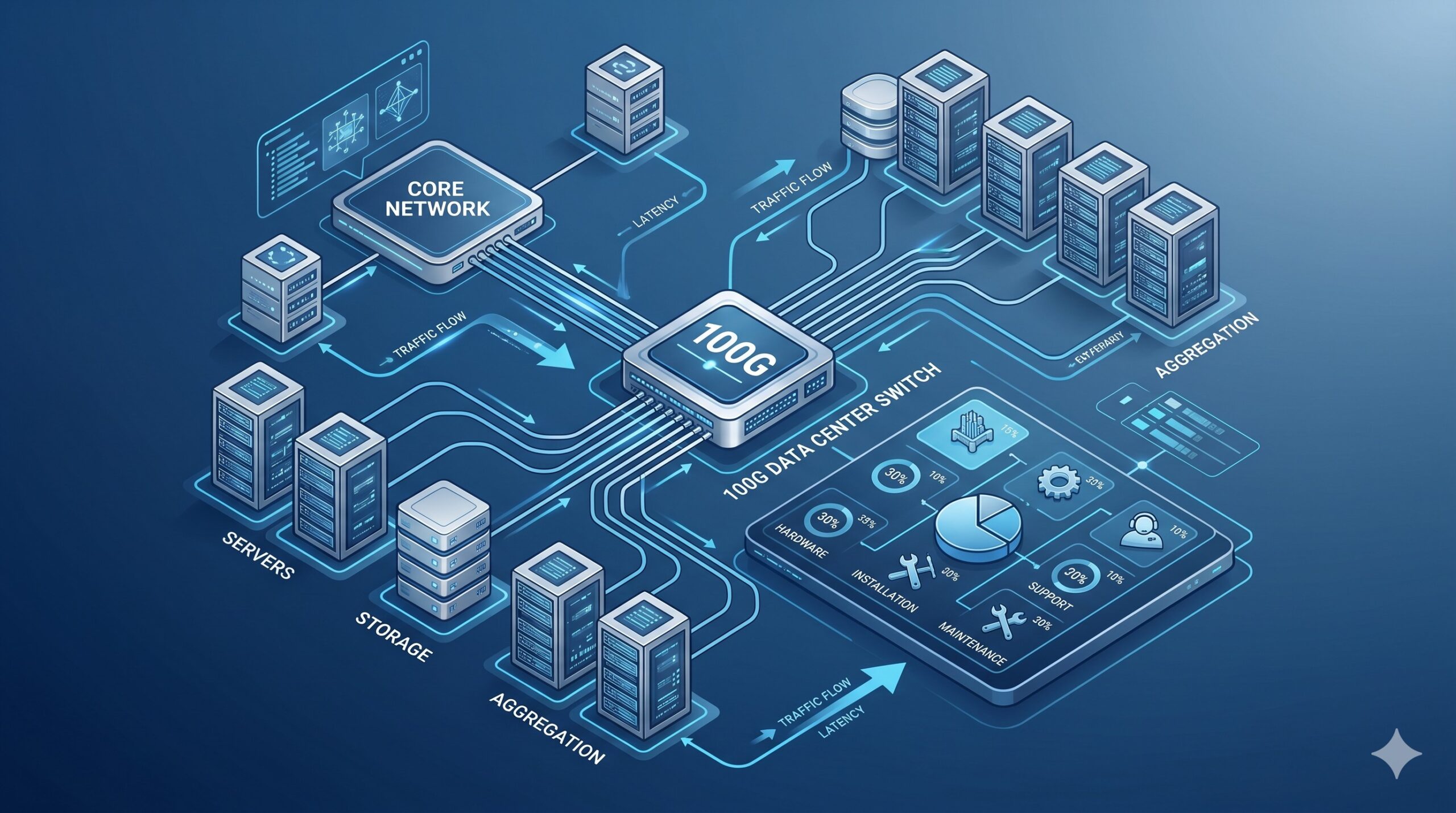
Lifecycle Verdict: 3-Year TCO Comparison Across Use Cases
For web-scale leaf/spine (10k+ servers), volume 100G data center switch cost from ODM plus generic optics yields $68 per port per month TCO. Enterprise campus core (500-2000 users) sees lower savings due to mandatory 4-hour NBD support contracts, pushing TCO to $142/port/month. Hyperscalers achieve $41/port/month via 5-year depreciation, on-site spares, and automated ZTP (Zero Touch Provisioning). Key takeaway: 100G switch TCO is minimized by standardizing on QSFP28-DD capable hardware (future 200G readiness), avoiding vendor lock-in optics, and architecting for 230W max per 1RU to leverage economizers. ITU-T G.698.4 tunable optics add 20% CapEx but reduce sparing inventory by 60%—optimal for geographically distributed data centers.

Leave a comment