

The Ultra-Low Latency Mandate in Modern Telecom
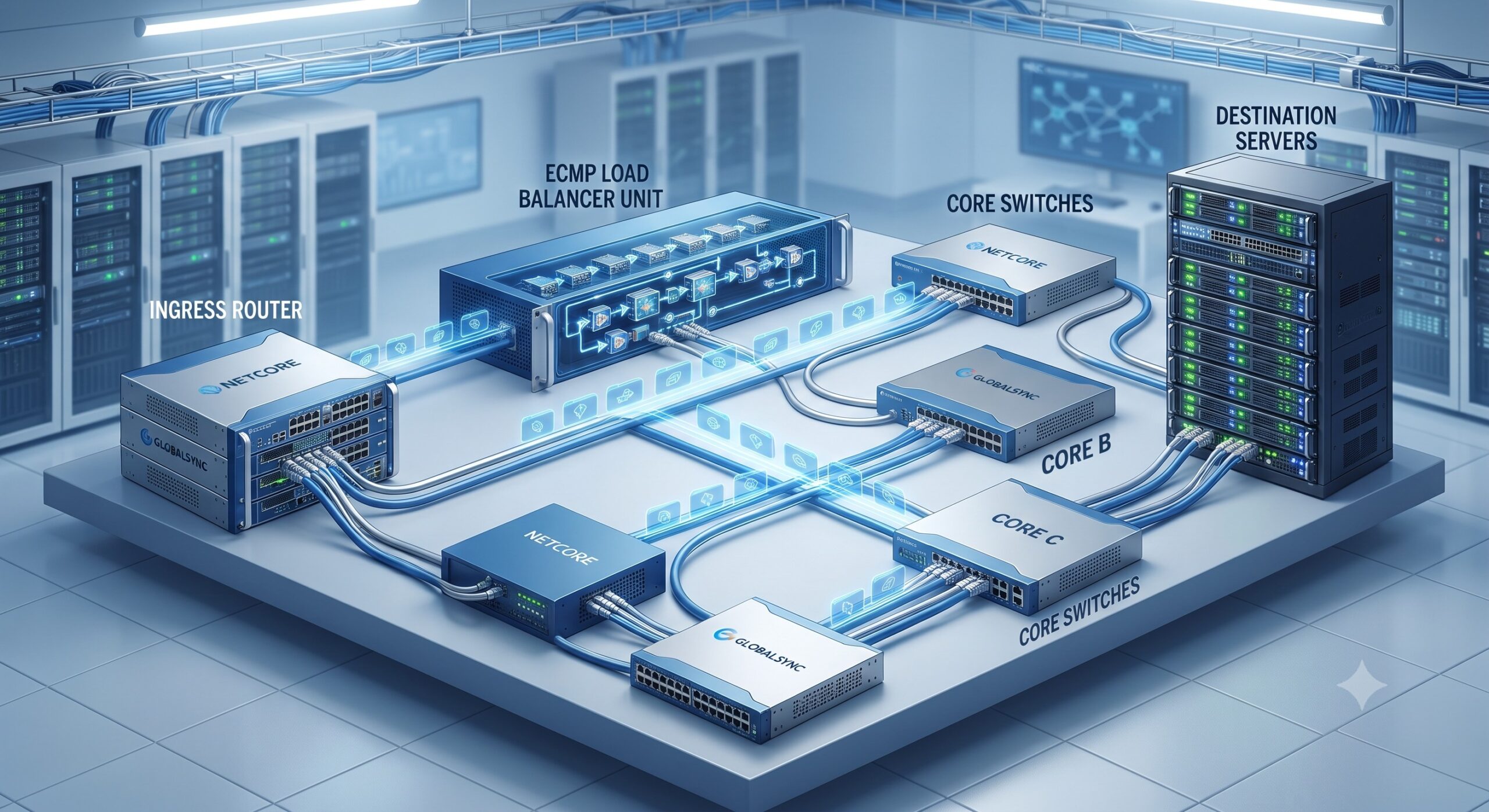
In an era where high-frequency trading, 5G Open RAN, and AI-driven datacenter interconnects dominate the telecom landscape, the demand for deterministic, ultra-low latency networking has transcended mere performance metrics to become a critical business imperative. According to industry benchmarks, a mere millisecond of added latency can translate into millions in lost revenue for financial institutions and degraded Quality of Experience (QoE) for carrier-grade streaming services . This is where the sophistication of router load balancing transitions from a basic redundancy feature to a high-stakes engineering discipline. Modern core routing architectures are engineered to deliver sub-microsecond forwarding, but these gains are often negated by inefficient load distribution algorithms that cause packet reordering or suboptimal path selection. This deep technical review dissects the internal packet pipeline of load-balancing routers, specifically analyzing the Application-Specific Integrated Circuit (ASIC) logic, hash-based forwarding mechanisms, and the Equal-Cost Multipath (ECMP) frameworks that define the performance envelope of enterprise-grade hardware .

Packet Pipeline Deep Dive: From ASIC to Egress
The Hardware Foundation: ASIC and NPU Roles
At the heart of any high-performance router lies a complex silicon architecture. The data plane, typically governed by a programmable Network Processor Unit (NPU) or fixed-function ASIC, is responsible for executing the load-balancing logic at line rate. The forwarding decision is not merely a software look-up; it is an intricate hardware state machine. When a packet arrives, the ASIC extracts the 5-tuple (Source IP, Destination IP, Source Port, Destination Port, and Protocol) to classify the flow . In ECMP environments, which are standard for BGP and OSPF routing, the ASIC utilizes a hash algorithm to map this flow to one of several outgoing next-hops. A critical architectural distinction lies in the hash computation method. Legacy systems often rely on a simple XOR operation on the IP addresses, leading to hash polarization where traffic clusters on a single link. High-end systems, however, employ symmetric hashing with randomized seeds and CRC-32 algorithms to ensure uniform distribution across a port density of up to 400 Gbps interfaces.
Latency Sources within the Pipeline
The packet pipeline introduces latency at several stages. The primary contributors include the serialization delay on the physical medium, the internal fabric scheduling delay, and, crucially, the processing latency of the load-balancing logic. In a standard store-and-forward architecture, the router buffers the frame entirely before reading headers for hash computation. However, cut-through switching modes, increasingly supported in modern silicon, begin forwarding the packet while the header is still being processed, reducing overall latency to less than 500 ns for 100G links. The choice of load-balancing mode directly influences pipeline efficiency. For instance, per-packet load balancing can lead to significant delays due to the need for per-packet route cache updates and can disrupt flow integrity, whereas per-flow (or per-destination) load balancing maintains packet ordering and allows for efficient fast-switching via Cisco Express Forwarding (CEF) or equivalent forwarding tables .
| Pipeline Stage | Hardware Component | Typical Latency (Microseconds) | Forwarding Behavior |
|---|---|---|---|
| Header Parsing | ASIC/NPU | 0.5 – 1.0 | Extract 5-tuple for flow classification |
| Hash Computation | TCAM | 0.3 – 0.8 | ECMP/UCMP bucket selection, CRC32/CRC64 |
| Internal Fabric Switching | Crossbar/Switch Fabric | 0.8 – 3.0 | Store-and-forward vs. Cut-through |
| Egress Scheduling | Queues (CoS) | 0.5 – 2.0 | Traffic shaping and priority queuing |
Algorithmic Efficiency: ECMP, UCMP, and PCC
ECMP vs. UCMP Architectures
Traditionally, routers relied on Equal-Cost Multipath (ECMP) to distribute traffic among links that have identical metrics and cost. This is the foundation of route diversity in IP networks. However, modern networks are heterogeneous, featuring a mix of high-bandwidth fiber and lower-capacity links like LTE or ADSL. This has given rise to Unequal-Cost Multipath (UCMP) or Weighted ECMP, where traffic is distributed based on a configured bandwidth ratio . In UCMP, the hardware hash algorithm is modified to assign flows to buckets proportionally to the interface weight. For example, a 3:1 ratio requires the ASIC to maintain a virtual bucketing system where three times as many hash buckets are assigned to the faster link, ensuring that the Gbps capacity of the primary link is fully utilized without starving the secondary.
Per-Connection Classifier (PCC) in Advanced Routing
Moving beyond standard ECMP, advanced operating systems like MikroTik RouterOS implement Per-Connection Classifier (PCC) load balancing. PCC is an advanced load-balancing technique that looks at the 5-tuple to split traffic across multiple WAN connections, but with a specific focus on keeping connection state intact. It uses a hash algorithm (typically both-addresses) to ensure that all packets belonging to the same connection traverse the same link, eliminating packet reordering issues seen in older per-packet modes . This is crucial for TCP performance, where out-of-order packets trigger retransmission requests, effectively halving throughput. In a high-density datacenter deployment, PCC allows for granular control, enabling network architects to designate specific source IP ranges or VLANs to specific WAN uplinks, providing deterministic latency paths for prioritized traffic such as VoIP or storage replication .
Quantifying Performance: The Metrics Matrix
To validate performance claims, we must look at specific benchmarks. When deploying router load balancing, the focus is often on three core metrics: Forwarding Rate (PPS), Latency, and Jitter. The maximum switching capacity of a system is often quoted in Tbps, but real-world load balancing tests reveal bottlenecks. For instance, testing a fully populated 24-port 10G load-balancing router reveals that while the backplane supports 480 Gbps, enabling per-packet load balancing may force the CPU to handle process switching, dropping throughput to under 1 Gbps due to CPU saturation . Conversely, utilizing hardware-accelerated CEF or equivalent Ternary Content-Addressable Memory (TCAM) for load balancing allows the system to maintain line-rate performance across all ports, with latency figures often cited at 5-10 microseconds for store-and-forward and sub-1 microsecond for cut-through. Additionally, the MTBF (Mean Time Between Failures) of these switching components is critical for carrier-grade deployments, where redundancy and failover times (often sub-50ms) are governed by ITU-T G.8032 recommendations.
Optimizing Traffic Distribution in Mission-Critical Topologies
Multi-WAN Aggregation and ISP Routing
In enterprise edge deployments, load balancing often involves aggregating links from multiple ISPs. Here, the algorithm must account for bandwidth proportions to prevent the ‘fast lane idle, slow lane congested’ scenario. A 200M fiber link and a 100M backup link, when set to an equal distribution or 1:1 ratio, would lead to the backup link being oversaturated and dropping packets. Using the ip load-balance hash command, an engineer can enforce a 2:1 ratio to maximize throughput . Furthermore, advanced policy-based routing allows for the separation of traffic. For example, streaming or high-priority sessions can be pinned to the primary WAN via a routing rule, while bulk downloads are shifted to the secondary WAN . This ensures that session reliability is maintained even when overall link utilization spikes, directly impacting the OpEx (Operational Expenditure) by reducing the need for expensive bandwidth upgrades .
Redundancy and Failover Mechanisms
The load balancing framework is often paired with route backup mechanisms. While load balancing ensures optimal use of resources, the integration of a hot-standby path is essential. When a primary link fails, the router’s failover logic kicks in. This is typically handled by Dynamic Routing Protocols like BGP which facilitate fast convergence. However, hardware-level link detection via BFD (Bidirectional Forwarding Detection) can trigger failover in as little as 15 milliseconds, shifting the routing table to an alternate path . In such high-availability architectures, the load-balancing state (hash buckets) must be reset or redistributed to avoid blackholing traffic, a process that requires careful tuning of the maximum-paths parameter to ensure zero packet loss during the convergence window .
Architectural Verdict and Future Outlook
The evolution from simple ECMP to intelligent, state-aware load balancing marks a significant shift in telecom hardware design. The integration of high-speed ASIC processing with robust hashing algorithms now allows carriers to achieve the five-nines availability and sub-10ms latency requirements demanded by modern applications . However, the choice between per-flow and per-packet algorithms remains a trade-off between CPU utilization and link efficiency. As Programmable ASICs and P4 languages become more prevalent, the flexibility to deploy custom load-balancing logic on the fly is set to disrupt the market, allowing for real-time adaptation to traffic bursts without sacrificing line-rate performance. Network architects must shift their focus from merely aggregate bandwidth to granular performance tuning. Ultimately, the success of a load-balancing strategy lies not in the hardware specifications alone but in the intelligence of the traffic engineering applied to the packet pipeline.
Conclusion
Router load balancing is a critical function that directly dictates network efficiency, reliability, and latency. By understanding the intricacies of the ASIC pipeline, the nuances of ECMP/UCMP hashing, and the operational parameters of failover mechanisms, enterprises can harness the full potential of their infrastructure. The data-driven approach—evaluating switching capacity, packet per second (PPS) throughput, and mean time between failures (MTBF)—is essential for selecting hardware that aligns with business objectives. While the technology is robust, the complexity of implementation requires high-level expertise, particularly when integrating multi-vendor environments. By adhering to protocols like IEEE 802.3ad for link aggregation and ITU-T standards for carrier-grade resiliency, network engineers can ensure a scalable, high-performance network that meets the demands of the next generation of digital services.

Leave a comment