

ENTERPRISE EDGE ROUTING REFERENCE DESIGN GUIDE FOR MULTI-WAN LOAD BALANCING CONFIGURATION GUIDE
1. EXECUTIVE SUMMARY
This document serves as the definitive technical reference for the deployment and configuration of Multi-WAN Load Balancing on next-generation enterprise edge routing platforms. Designed for network architects, systems engineers, and IT operations teams, this guide details the hardware-accelerated methodologies for aggregating multiple broadband or dedicated internet links into a single, highly resilient, and high-performance logical connection.
Multi-WAN Load Balancing is no longer a value-added software feature; it is a critical network infrastructure capability that ensures business continuity, optimizes bandwidth utilization, and provides application-aware traffic steering. Our implementation leverages purpose-built hardware forwarding engines to deliver line-rate performance, deep packet inspection (DPI) for intelligent path selection, and seamless failover without session disruption. This document outlines the architectural principles, configuration paradigms, performance specifications, and hardware platforms that support this essential function.

2. SYSTEM HARDWARE TOPOLOGY & ARCHITECTURE
The reference architecture is built upon a modular, carrier-grade hardware chassis designed for high availability and scalability. The system is comprised of three primary planes: the Data Plane, the Control Plane, and the Management Plane, each isolated for security and performance.
– DATA PLANE: Powered by a dedicated Network Processor Unit (NPU) or FPGA-based forwarding engine. This plane handles all packet forwarding, NAT/PAT translation, and per-packet or per-session load balancing decisions. The hardware supports symmetric hashing for session persistence and can perform link health checks (e.g., ICMP, TCP SYN, HTTP GET) at sub-second intervals without impacting CPU load.
– CONTROL PLANE: A high-performance x86 processor manages routing protocols (BGP, OSPF, RIP), policy-based routing (PBR), and overall system state. It calculates route tables and downloads forwarding information bases (FIB) to the Data Plane.
– MANAGEMENT PLANE: Provides secure CLI, web GUI, and SNMP access. It hosts the configuration database for WAN link definitions, failover thresholds, and load-balancing algorithms (e.g., Weighted Round Robin, Least Connections, or Link Capacity).
3. MULTI-WAN CONFIGURATION & DEPLOYMENT SCENARIOS
This guide covers several key deployment models to suit diverse enterprise environments:
– ACTIVE/ACTIVE LOAD BALANCING: All available WAN links are utilized concurrently, distributing outbound traffic based on a configurable algorithm. This maximizes aggregate bandwidth and provides true link redundancy.
– ACTIVE/PASSIVE FAILOVER: One primary WAN link handles 100% of the traffic until a failure is detected, at which point the secondary link is activated. This model is suitable for environments where link symmetry is less critical, and data consumption is metered.
– APPLICATION-AWARE ROUTING: Critical business applications (e.g., VoIP, video conferencing, ERP) can be pinned to the highest-quality WAN link based on real-time metrics like latency, jitter, and packet loss. Lower-priority traffic (e.g., guest Wi-Fi, software updates) is directed over backup or lower-cost links.
Detailed CLI commands and web-GUI step-by-step workflows are provided to configure WAN interfaces, define health probes, set policy-based routes, and monitor real-time traffic distribution.
4. INTEROPERABILITY & PROTOCOL SUPPORT
The platform ensures seamless integration with existing network infrastructure:
– ROUTING: Full support for IPv4/IPv6 unicast routing, BGP, OSPFv2/v3, and RIP.
– TUNNELING: Built-in support for VPN technologies, including IPsec, GRE, and OpenVPN, allowing load-balanced VPN tunnels.
– ADDRESSING: NAT/PAT with per-link address pools, DHCP server/client, and PPPoE client for xDSL/cable modems.
– QUALITY OF SERVICE (QoS): Layer 3/4 classification and queueing to prioritize critical traffic before load-balancing decisions are applied.
5. PERFORMANCE PARAMETERS & BENCHMARKS
Performance is a critical metric for Multi-WAN deployment. The following benchmarks are verified under full line-rate conditions with 64-byte packets.
– MAXIMUM CONCURRENT SESSIONS: 1,000,000
– NEW SESSIONS PER SECOND: 50,000
– SUPPORTED WAN INTERFACES (PHYSICAL): Up to 8 x Gigabit Ethernet or 2 x 10 Gigabit Ethernet.
– SUPPORTED WAN INTERFACES (LOGICAL): Up to 16 VLAN-tagged or virtual interfaces.
– FAILOVER DETECTION TIME: 200ms (standard) / 50ms (BFD-enabled).
– LOAD BALANCING ALGORITHMS: Per-Session Hashing, Per-Packet Round Robin, Weighted Round Robin, Least Load (based on link utilization).
– THROUGHPUT (TOTAL AGGREGATE): Up to 40 Gbps with hardware acceleration enabled.
TECHNICAL SPECIFICATIONS
| Parameter | Specification |
|---|---|
| Form Factor | 1RU / 2RU Rack-Mountable Chassis |
| Switching Capacity | Up to 40 Gbps (Aggregate) |
| Power Supply | 1+1 Redundant AC (100-240V) / DC (-48V) Options |
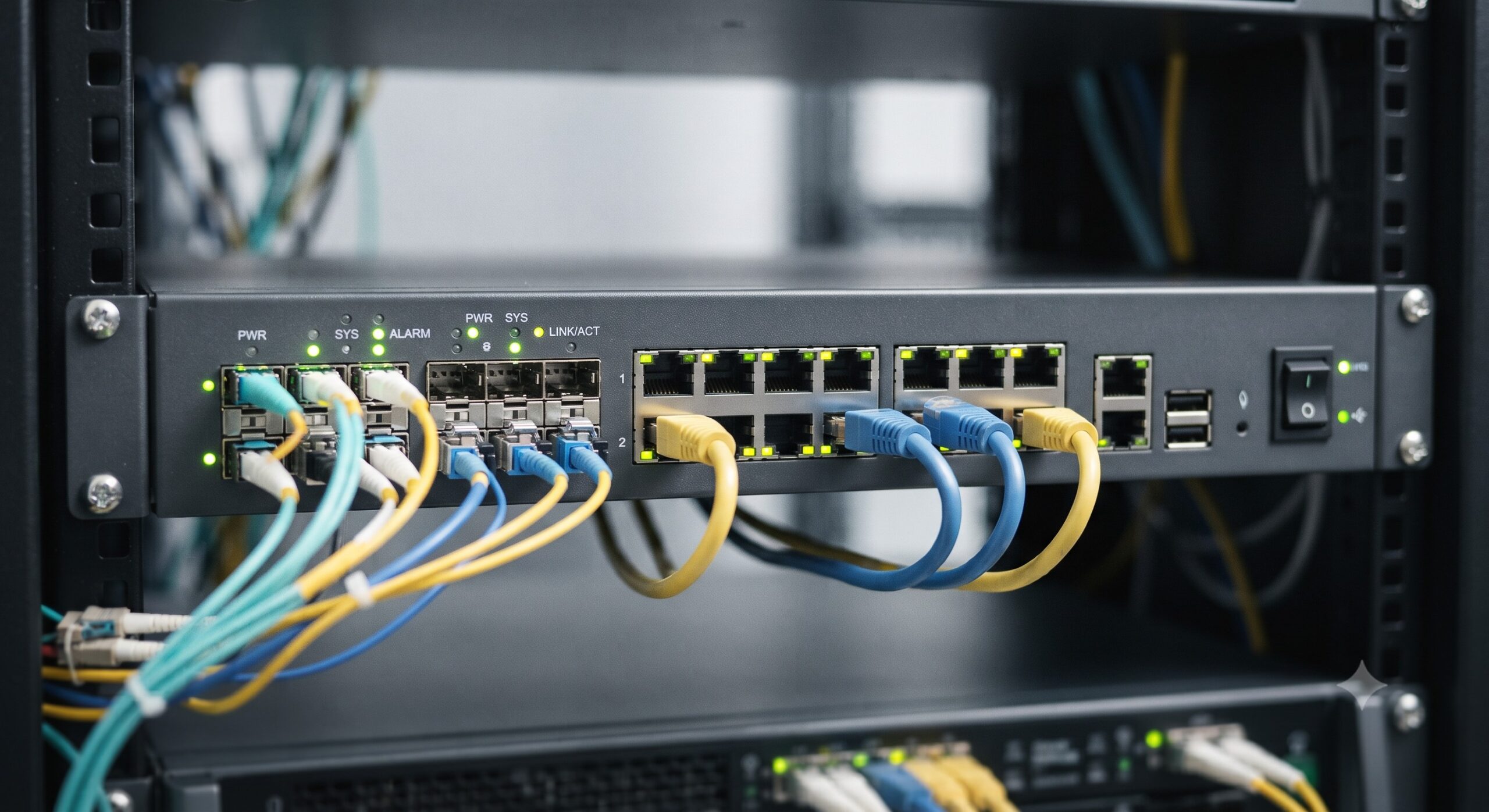
| WAN Interfaces (Base Model) | 4 x 10/100/1000BASE-T (RJ45) + 2 x SFP (Gigabit) |
| WAN Interfaces (Expansion) | Up to 2 x 10G SFP+ Slots |
| LAN Interfaces | 8 x 10/100/1000BASE-T (Switch Ports) |
| Console Port | 1 x RJ45 RS-232 (CLI) |
| USB Port | 1 x USB 3.0 (for Boot/Storage) |
| Max Concurrent Sessions | 1,000,000 |
| New Sessions per Second | 50,000 |
| Operating Temperature | 0°C to 45°C (Standard) / -20°C to 65°C (Extended) |
| Storage Temperature | -40°C to 85°C |
| Humidity | 10% to 90% (Non-Condensing) |
6. HIGH AVAILABILITY & REDUNDANCY MECHANISMS
Enterprise continuity is achieved through multiple layers of redundancy:
– HARDWARE REDUNDANCY: Supports 1+1 hot-swappable power supplies and field-replaceable fan modules.
– LINK REDUNDANCY: Automated failover and fallback with configurable delay timers to prevent flapping.
– SESSION PERSISTENCE: Established sessions are pinned to an active link upon failover via a stateful sync table. Session integrity is maintained as the routing table updates, preventing application timeouts.
– SYSTEM HEALTH MONITORING: Integrated monitoring of CPU, memory, and temperature thresholds with SNMP trap generation for proactive management.
7. LIFECYCLE ASSURANCE & COMPLIANCE
– MTBF (Mean Time Between Failures): Greater than 200,000 hours at 25°C ambient.
– SOFTWARE MAINTENANCE: Firmware updates are security-signed and support rollback to ensure stable operations during upgrades.
– REGULATORY COMPLIANCE: The hardware is certified to FCC Part 15 Class A, CE Mark, VCCI Class A, and RoHS standards.
8. DEPLOYMENT SCHEMATICS & BEST PRACTICES
Typical deployment topologies are illustrated to guide integration into existing networks. Common scenarios include:
1. SMB/SOHO Edge: Two broadband links terminating on a single appliance with LAN segmentation.
2. Enterprise Branch: Headquarters with an MPLS connection and a secondary broadband link for cloud application failover.
3. Service Provider CPE: Aggregation of multiple diverse access technologies (e.g., Fiber + 5G) for a resilient last-mile solution.
CONCLUSION
The Multi-WAN Load Balancing Configuration Guide provides a robust, scalable, and secure framework for maximizing network uptime and efficiency. By leveraging purpose-built hardware, intelligent algorithms, and comprehensive failover mechanisms, enterprises can ensure that their critical applications remain accessible and performant under all conditions. This document serves as the definitive reference for implementing these capabilities on our enterprise edge routing platforms.
For complete configuration syntax and detailed command references, please consult the accompanying CLI Reference Guide and Web-GUI User Manual.
© 2026 [Vendor Name]. All rights reserved. Specifications are subject to change without notice.
📥 Download Technical Specification
Click the button below to view or download the full official PDF datasheet.

Leave a comment