
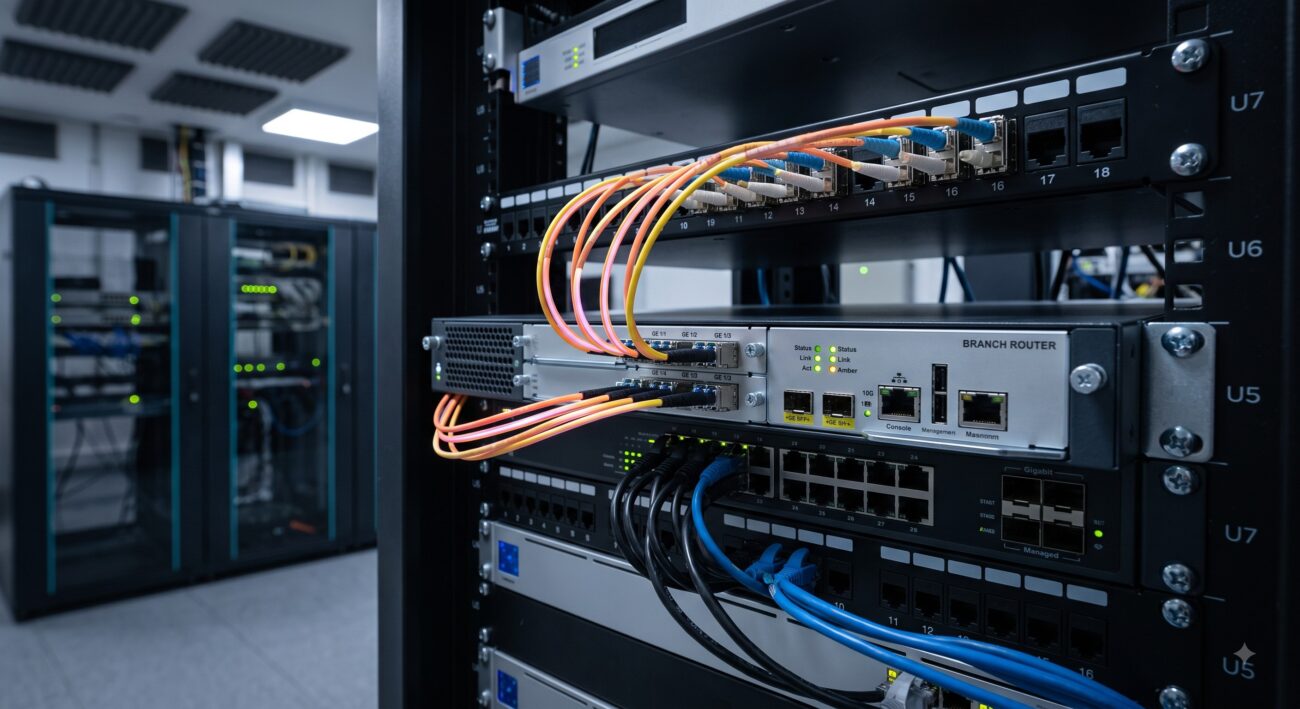
The State of the Modern Branch: Why Hardware Choice Matters
The branch office is no longer a simple spoke in a hub-and-spoke network. With the proliferation of SaaS applications, unified communications, and the need for secure, high-speed access to cloud resources, the branch office router has evolved into a critical, multi-function edge device. Selecting the right branch office router is a strategic decision that directly impacts operational efficiency, security posture, and total cost of ownership. This guide provides a technical framework for network architects and IT decision-makers to navigate this complex landscape, grounded in industry standards and data-driven analysis.
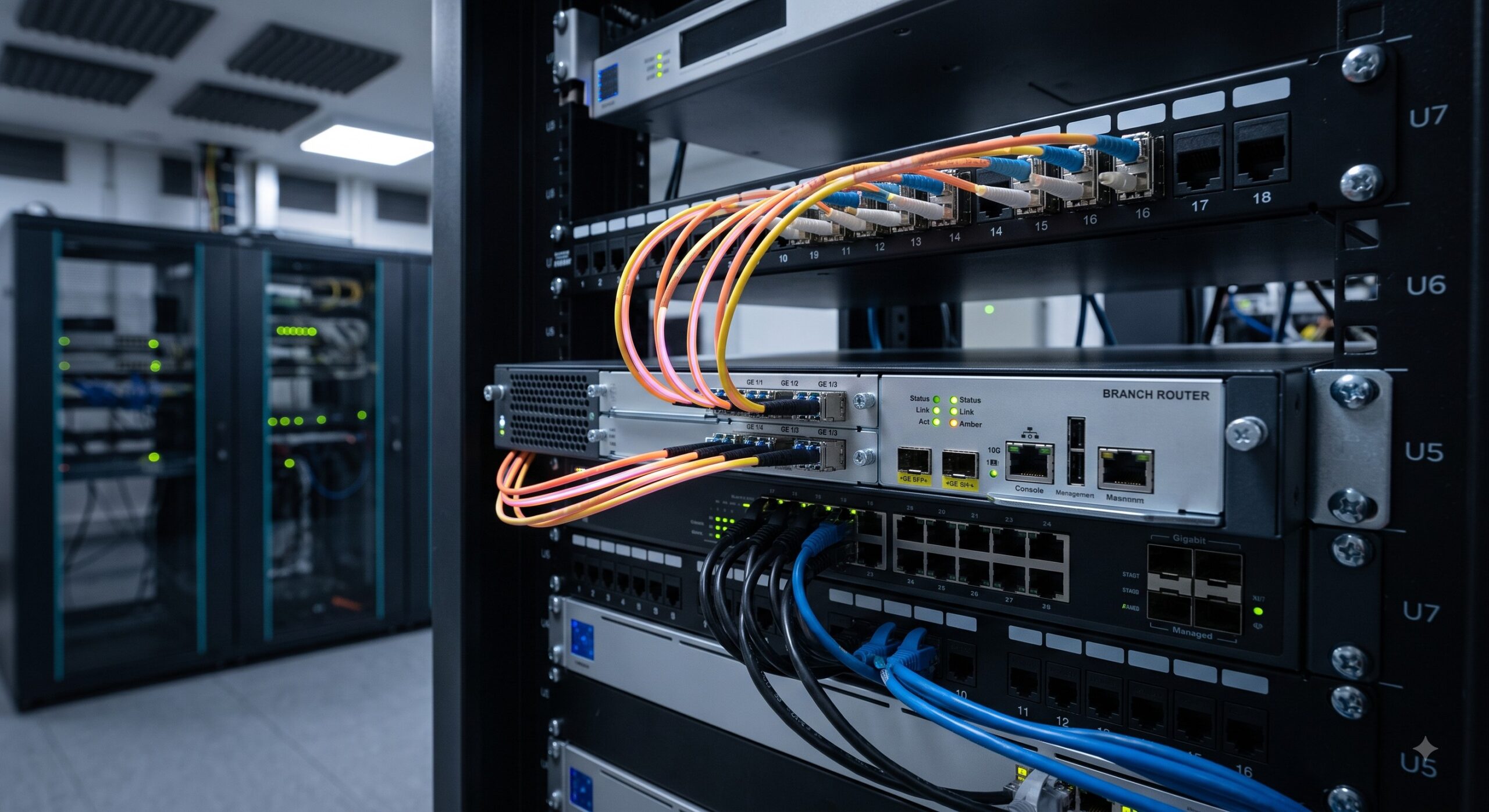
Core Architecture & Hardware Topology: A Deep Dive into Modern Hardware
Modern branch routers are sophisticated systems-on-a-chip. They have moved beyond simple packet forwarding to become integrated services gateways. At the heart of a carrier-grade branch office router lies a powerful network processor or ASIC (Application-Specific Integrated Circuit) that handles data plane operations at line rate, while a general-purpose CPU manages the control plane and complex services . This architecture enables features like hardware-accelerated encryption, which is vital for maintaining performance. For instance, a router like the Teldat M2, designed for the edge, can achieve an aggregated encrypted performance exceeding 1 Gbps, thanks to its onboard hardware encryption engine . The modularity and slot capacity are equally critical, as outlined in Cisco’s design guides, where the number of available Network Modules (NMs) and Advanced Integration Modules (AIMs) dictates the platform’s ability to host services like voice, VPN, and intrusion detection modules .
Processor Architecture and Packet Forwarding
The selection between an ASIC and a general-purpose CPU has significant performance implications. Branch office router solutions using ASICs can achieve very high throughput with deterministic latency, as they process packets in hardware. For example, the Cisco ISR 4461 is designed for high-end branches, supporting multi-Gbps throughput and integrating advanced security capabilities, making it suitable for large-scale deployments . On the other hand, routers with powerful CPUs, like the Huawei AR6280, offer flexibility for running complex applications and SD-WAN functions, also achieving 10 Gbps of performance . The choice here defines the router’s primary function: a hardened, high-speed forwarding engine or a versatile, service-rich platform.
| Key Parameter | Technical Specification | Metric / Data |
|---|---|---|
| Aggregate IMIX Performance | Indicates the router’s ability to handle mixed packet sizes in switching/routing scenarios. | Up to 2 Gbps (e.g., Teldat M2) |
| Integrated Security | On-board hardware encryption and NGFW features for line-rate security. | Firepower/Umbrella (Cisco), NGFW/IPS (Huawei) |
| WAN Interface Flexibility | Support for diverse WAN links, including fiber, Ethernet, and LTE/5G. | 2.5GbE, GbE/SFP, LTE/5G modules |
| SD-WAN Capability | Integrated SD-WAN fabric for intelligent path control and application optimization. | DNA/Meraki (Cisco), Agile Controller (Huawei) |
| Modularity / Scalability | Number of slots (NMs, AIMs) for future expansion and services. | Up to 4+ slots (e.g., Cisco 3845) |
Technical Specifications and Performance Metrics
When evaluating a branch office router, focusing on key technical specifications is paramount. The table below provides a framework for comparing essential parameters against current market leaders and standards. Modern routers must support high throughput (Gbps), low latency, and a comprehensive suite of security and routing protocols compliant with IEEE and ITU-T standards.
ISP Case Study: The 46-User Branch
A classic deployment scenario illustrates the practical application of these selection criteria. Consider a branch office with 46 users, as detailed in Cisco’s reference design . The requirements include dual IPSec VPN tunnels back to HQ, local internet access with a firewall and PAT, intrusion detection, and a 3:1 oversubscription of phones to PSTN lines . This scenario demands a platform with sufficient slot capacity for two T1 WAN modules, a PSTN T1, a VPN accelerator, and an IDS module . The architect must choose a platform that not only meets the current slot requirements but also offers room for growth, such as the Cisco 2800 or 3800 series routers, which are available through third-party vendors to optimize TCO .

Feature Comparison and Systems Integration
Feature support is a primary differentiator in branch office router selection. The ability to function as a robust SD-WAN edge, integrate a next-generation firewall (NGFW), and provide seamless LAN and WLAN services is now table stakes. For instance, solutions like the Teldat M2 integrate a Wi-Fi 6 access point and a 4-port Gigabit switch, consolidating multiple devices into a single platform and reducing both CapEx and OpEx . Meanwhile, routers like the Cisco ISR 4331 and Huawei AR2240 offer mature SD-WAN solutions via DNA Center/Meraki and Agile Controller, respectively, with integrated security features like Firepower/Umbrella or NGFW/IPS . This integration simplifies the branch network and is a key consideration for systems integrators looking to reduce points of failure and streamline management .
Conclusion
The selection of a branch office router is a multi-faceted engineering decision. It requires a careful analysis of the required services, performance targets, and long-term growth strategy. By focusing on core architectural elements—ASIC vs. CPU, hardware acceleration, and modular capacity—and leveraging a structured evaluation framework, network architects can choose a platform that not only meets today’s demands but is also future-proofed for the evolving edge. Whether it’s the cost-effective modularity of the Huawei AR series, the feature-rich integration of the Teldat M2, or the ecosystem maturity of the Cisco ISR series , the right choice delivers a resilient, high-performance, and secure branch network.

Leave a comment