
Introduction: The Imperative of Uninterrupted Network Service
In today’s hyper-connected digital landscape, network downtime is not merely an inconvenience; it is a direct threat to revenue, reputation, and operational continuity. For telecommunications carriers and large-scale enterprises, achieving true carrier-grade reliability is the foundational requirement for any network infrastructure investment. This article provides a data-driven evaluation of the ZTE 240G network board capacity upgrades, examining how they meet and exceed the stringent demands of modern Service Level Agreements (SLAs). With a focus on Mean Time Between Failures (MTBF), architectural redundancy, and operational resilience, we will explore why the ZXR10 M6000-S series, powered by this 240G processing engine, stands as a benchmark for high-availability routing .
Understanding the Carrier-Grade Mandate: SLA Demands and Hardware Reliability
The modern telecom landscape is defined by a relentless need for ‘five-nines’ (99.999%) availability. This translates to a total downtime of approximately five minutes per year, a standard that leaves no room for hardware failure or systemic bottlenecks. For the ZTE 240G network board, its integration into the ZXR10 M6000-S series is a direct response to these demands. These routers are designed as the backbone for mobile backhaul, fixed-line broadband aggregation, and enterprise core networks. The M6000-S platform is architected to handle the exponential traffic growth driven by 5G and cloud services, making the reliability of each component paramount.
Mean Time Between Failures (MTBF) as a Core Metric
MTBF is the primary statistical measure of hardware reliability, predicting the average time a component is expected to operate before a failure. While specific MTBF figures for the M6KS-PFU-210-E2 board are typically derived from complex system-level certifications, industry benchmarks for comparable carrier-grade network processing boards often range from 200,000 to over 500,000 hours. This translates to an operational lifespan of over 20 years under normal conditions. The rigorous thermal and power design of the board, including its 278W power consumption and managed heat dissipation of 900.72 BTU/Hour, is engineered to maximize MTBF by operating within optimal temperature ranges . The ZTE C320 OLT platform, which also features a 240G switching capacity, exemplifies this with support for a -5°C to 55°C operating environment, ensuring reliability across diverse deployment scenarios .
| Key Parameter | Technical Specification |
|---|---|
| Bidirectional Processing Capacity | 240 Gbps |
| Power Consumption (Board Only) | 278 W |
| Hot Load (BTU/Hour) | 900.72 |
| Weight (Excluding PIUs) | 6.5 kg |
| Physical Dimensions (H x W x D) | 40.24 mm x 395.4 mm x 515.4 mm |
| Supported PIUs | RPZ-24G-SFP-S, RPZ-10XG-SFP+-S, RPZ-01CG-CFP2-S, RPZ-12XG-SFP+-S, etc. |
| Power Input Redundancy | 2 x -48V DC |
| Operational Temperature Range | -5°C to 55°C (Platform Dependent) |
Architectural Redundancy: The Dual-Engine and Power Failover Design
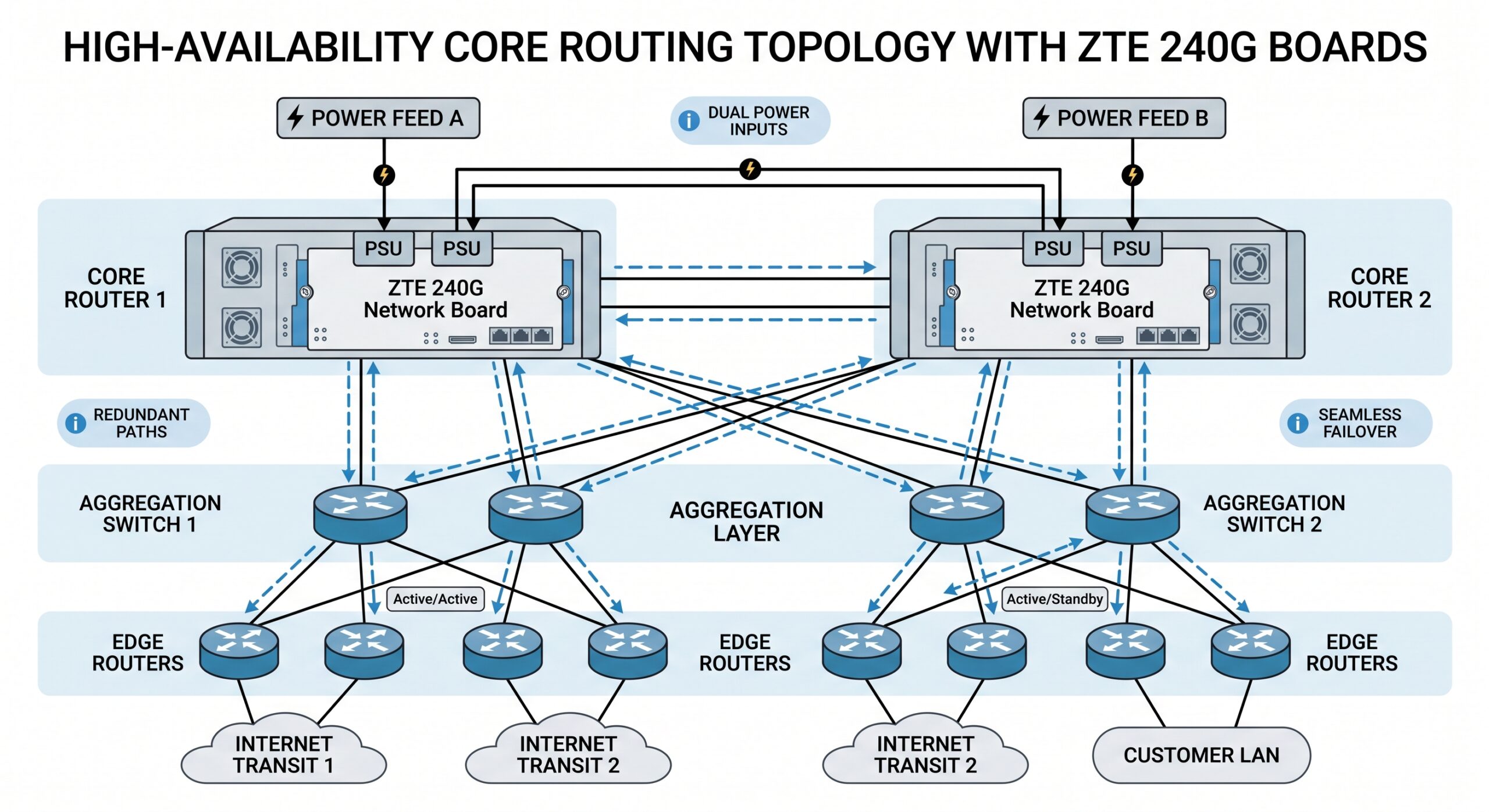
The path to carrier-grade reliability is paved with redundancy. The ZTE 240G network board is not an isolated component but part of a highly resilient system architecture. The ZXR10 M6000-S series employs a robust failover model, where the 240G board works in concert with the System Routing Unit (SRU) or Main Processing Unit (MPU) to ensure control and data plane separation .
Power Supply Redundancy
One of the most critical aspects of hardware resilience is power integrity. The M6KS-PFU-210-E2 board implements 2× -48V power supply inputs . This configuration allows for true 1+1 power redundancy. If one power feed experiences a voltage drop or fails entirely, the board automatically and seamlessly switches to the secondary feed. This failover is often instantaneous, preventing a board-level restart and ensuring uninterrupted packet processing. Network administrators can monitor the health of these power supplies via CLI commands such as show power, allowing for proactive maintenance before a failure occurs .
Control Plane and Software Resilience
Beyond physical hardware, the platform’s software architecture contributes to high availability. In larger chassis-based systems like the ZXA10 C600 (which shares a 240G main control switching capacity), the separation of control and forwarding planes allows for In-Service Software Upgrades (ISSU) and hitless switchovers . While the C300 series requires a manual switchover, the ability to upgrade firmware on a standby control card before switching active roles ensures that maintenance does not translate to downtime . This philosophy is consistent across ZTE’s carrier-grade platforms, ensuring the 240G board operates within a framework designed for continuous service.
Mission-Critical Deployments: High-Density and 100G Uplink Scenarios
The true test of carrier-grade reliability is performance under peak load. The ZTE 240G network board is designed to support high-density port configurations and high-speed uplinks essential for modern networks. The board provides two daughter card slots, accommodating a range of Physical Interface Units (PIUs) .
Flexible Port Configurations
Deployments can be tailored for different environments, supporting modules such as the RPZ-24G-SFP-S for 1G aggregation, RPZ-10XG-SFP+-S for 10G connectivity, and the high-capacity RPZ-01CG-CFP2-S for 100G uplinks . This flexibility allows operators to scale from 1G to 100G without redesigning the network architecture, ensuring a future-proof and reliable investment. In a typical edge routing scenario, the 240G bidirectional capacity ensures that line-rate forwarding is maintained on all enabled ports, preventing bottlenecks even during traffic spikes.
Integration with High-Capacity Platforms
In optical access networks, platforms like the ZXA10 C600 leverage a CLOS distributed architecture to provide up to 800G switching capacity per chassis . The 240G main control switching capacity in these systems acts as the brain, ensuring the system switching fabric is fully optimized . This architecture allows for reliable forwarding even when handling massive data loads, such as those required for mobile backhaul and FTTH services. The C620 platform, for instance, demonstrates this by supporting 32 GPON/XG-PON ports with non-blocking performance, ensuring that the 240G capacity is effectively utilized for every subscriber .
Conclusion: The Verdict on ZTE 240G Network Board Upgrades
The ZTE 240G network board capacity upgrade is a testament to the principle that high performance must be matched by high reliability. Through its redundant power feeds, integration with high-availability chassis designs, and support for a diverse range of high-speed interfaces, the board is engineered to meet the rigorous SLA demands of modern telecom networks. For network architects and systems integrators, the data-driven decision to upgrade to this platform is a strategic move to future-proof infrastructure while ensuring operational excellence. By focusing on core metrics like MTBF and redundancy, ZTE provides a hardware foundation that carriers can trust to deliver uninterrupted, high-bandwidth services for years to come.

Leave a comment