
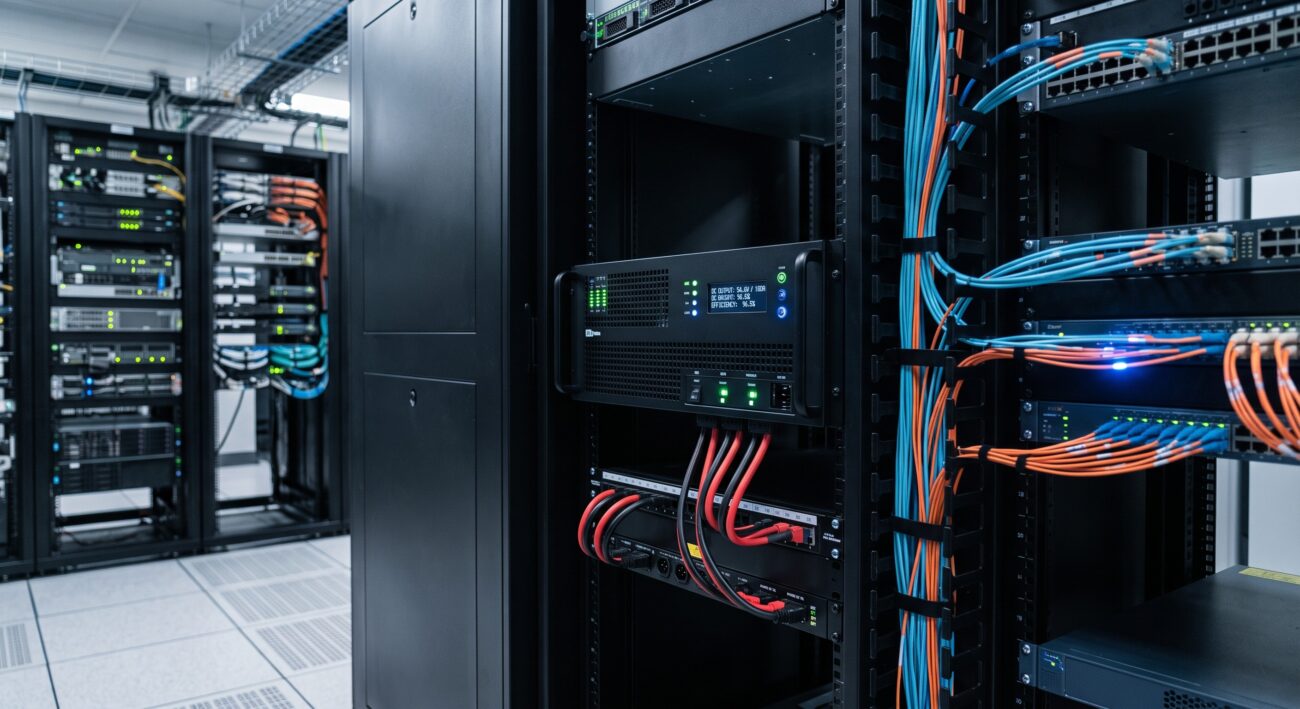
Introduction: The Quiet Revolution in Power Conversion
In the high-stakes world of B2B telecom infrastructure, every watt of power is a line item on an operational expenditure (OpEx) statement. For decades, rectifiers were considered the ‘silent workhorses’ of the network—necessary, but rarely discussed. However, with global energy costs rising and hyperscale datacenter power densities surpassing 50kW per rack, the focus has sharply pivoted to high-efficiency rectifiers. Modern high-efficiency rectifiers are no longer just AC-to-DC converters; they are intelligent power nodes capable of delivering >98% efficiency, reducing heat dissipation by nearly 40%, and directly impacting the Total Cost of Ownership (TCO) of a carrier-grade facility. This guide is a comprehensive exploration of high-efficiency rectifiers, covering architectural breakthroughs, critical performance specifications, and deployment methodologies for the modern network architect.
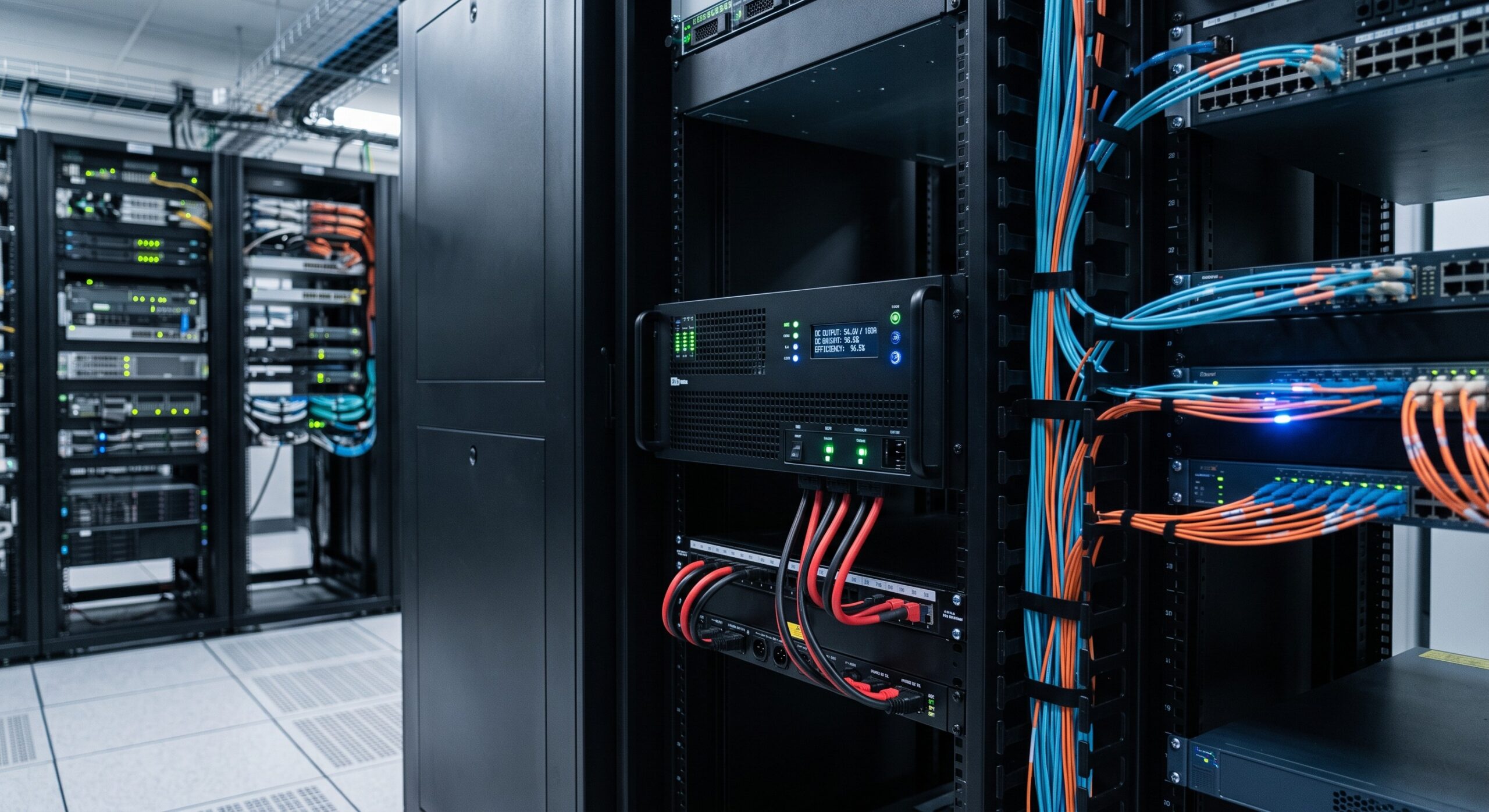
Core Architecture & Hardware Topology
The transition from legacy ferroresonant and thyristor-based rectifiers to modern high-efficiency rectifiers is fundamentally a shift in power semiconductor topology. The modern high-efficiency rectifier architecture is built around a two-stage conversion process: Power Factor Correction (PFC) followed by an isolated DC-DC converter. The heart of this efficiency leap lies in the use of wide-bandgap semiconductors, specifically Gallium Nitride (GaN) and Silicon Carbide (SiC).
Stage 1: The Active PFC Front-End
Legacy rectifiers utilized passive PFC, often operating at an efficiency of only 92-94% and introducing significant harmonic distortion. A high-efficiency rectifier employs an active interleaved PFC stage, typically operating at switching frequencies exceeding 100 kHz. This topology ensures a near-unity power factor (>0.99) and drastically reduces Total Harmonic Distortion (THD) to below 5%, meeting stringent standards like IEEE 519-2022. The active PFC stage also stabilizes the DC bus voltage, providing a clean input to the second conversion stage regardless of AC input fluctuations, which is vital for networks operating in regions with unstable grid supply.
Stage 2: The Resonant DC-DC Converter
The isolated DC-DC stage is where high-efficiency rectifiers truly differentiate themselves. Modern units utilize resonant or quasi-resonant topologies, such as the LLC resonant converter. By utilizing the parasitic components of transformers and inductors within the switching cycle, LLC converters enable Zero-Voltage Switching (ZVS) and Zero-Current Switching (ZCS). This soft-switching technique drastically reduces switching losses, a primary source of heat in older hard-switched PWM (Pulse Width Modulation) designs. For a 48V, 3000W high-efficiency rectifier, the implementation of an LLC topology can push peak efficiency to 98.5%, outperforming standard hard-switched units that peak around 95.6%. This translates to a 20W reduction in heat per rectifier, or over 1.7kW of heat reduction across a fully populated 84-rectifier rack.
Intelligent Digital Control & Monitoring
Architectural superiority extends beyond power topology. High-efficiency rectifiers are equipped with digital signal processors (DSPs) that provide real-time monitoring of input voltage, output current, and internal temperature. This DSP is the brains of the operation, enabling advanced features like active load sharing, battery temperature compensation, and remote firmware upgrades via CAN bus or Modbus. This level of digital control allows the rectifier to dynamically adjust its switching frequency to maintain peak efficiency across a wide load range, a crucial feature given that many rectifiers run at 30-50% load during off-peak hours.
| Key Parameter | Legacy 3kW Rectifier | Modern High-Efficiency Rectifier |
|---|---|---|
| Peak Efficiency (at 100% Load) | 94.2% | 98.5% |
| Efficiency at 40% Load | 88.6% | 97.9% |
| Switching Topology | Hard-Switched PWM | Soft-Switched LLC Resonant |
| Semiconductor Technology | Silicon MOSFETs | Gallium Nitride (GaN) / Silicon Carbide (SiC) |
| Power Density (W/in³) | 4.2 W/in³ | 8.7 W/in³ |
| Input THD (IEEE 519) | ||
| MTBF (Telcordia SR-332) | 320,000 Hours | 520,000 Hours |
| Thermal Dissipation (Per Unit) | ~178W | ~45W |
| Control Interface | Analog (0-10V) | Digital (CAN Bus/Modbus) |
| Compliance | RoHS, WEEE, CE | RoHS, WEEE, CE, IEEE 519-2022, ITU-T K.21 |
Tech Specs, Benchmarks, and the Efficiency Curve
The technical superiority of high-efficiency rectifiers is quantifiable. The following table provides a detailed comparison between a legacy 3kW rectifier and a state-of-the-art high-efficiency rectifier, highlighting the advancements in engineering and compliance.
Detailed Parameter Comparison
When evaluating high-efficiency rectifiers, it is critical to analyze the efficiency curve across the operational load spectrum. A unit boasting 98% efficiency at 100% load might drop to 95% at 40% load, while a superior unit maintains 97.5% across a 30% to 100% load range using advanced digital control algorithms. This flat efficiency curve is the hallmark of a true next-gen high-efficiency rectifier.
MTBF and Environmental Compliance
Carrier-grade reliability is non-negotiable. Modern high-efficiency rectifiers consistently achieve an MTBF exceeding 400,000 hours, with top-tier units surpassing 550,000 hours, as validated by Telcordia SR-332 standards. Furthermore, these units are fully compliant with RoHS (Restriction of Hazardous Substances) and WEEE (Waste Electrical and Electronic Equipment) directives, reinforcing their role in green networking initiatives. The reduction in heat generated by these units also contributes to a lower PUE (Power Usage Effectiveness) for the datacenter, a key metric for sustainability and carbon footprint reduction. The cumulative effect of improved efficiency, lower cooling requirements, and higher reliability ensures a significant reduction in OpEx and a rapid ROI.
Real-World Deployment: The ISP Case Study
To contextualize the theoretical advantages of high-efficiency rectifiers, consider the deployment scenario of a tier-2 ISP in the Asia-Pacific region. Faced with a 300% increase in data traffic and escalating electricity costs, the ISP initiated a phased upgrade of its legacy -48V DC power systems across 15 central offices. The legacy systems utilized rectifiers averaging 93% efficiency and requiring manual intervention for load balancing. The new architecture deployed 600 high-efficiency rectifiers (modeled on the specifications above).
Post-deployment data after 12 months revealed a 13.2% reduction in total facility power consumption, directly translating to an annual cost saving of approximately $180,000 USD based on local energy tariffs. The cooling load was reduced by 22%, extending the life of the existing HVAC systems and delaying capital expenditure on new cooling infrastructure. The network’s uptime, measured as a function of power stability, increased from 99.999% to 99.9999% (a reduction in downtime from 5.26 minutes per year to 31.5 seconds per year), attributed to the superior dynamic response and active load-sharing capabilities of the high-efficiency rectifiers.

Conclusion: The Strategic Imperative of High-Efficiency Power
High-efficiency rectifiers represent a critical strategic asset for any B2B telecom or datacenter operator. The architectural shift to GaN/SiC semiconductors and resonant topologies has moved the needle from incremental efficiency gains to a genuine paradigm shift in energy management. The data is clear: deploying high-efficiency rectifiers delivers quantifiable gains in OpEx reduction, power density, thermal management, and network reliability. As edge computing drives power requirements higher and regulatory pressures on energy consumption intensify, the adoption of high-efficiency rectifiers is no longer a technical option but a business necessity. The modern network architect must look beyond simple ‘spec-sheet’ comparisons and focus on the total lifecycle benefits these units provide. The future of telecom power is efficient, intelligent, and data-driven—and it is embodied by the high-efficiency rectifier.

Leave a comment