

EXECUTIVE SUMMARY
The Cisco ASR 9000 Series Route Switch Processor (RSP) serves as the central control and switching fabric intelligence for the ASR 9000 aggregation portfolio. Engineered for carrier-grade service provider and large enterprise edge deployments, the RSP family—encompassing RSP440, RSP880, and the fifth-generation RSP5—delivers distributed forwarding plane architecture, hardware-based fabric signaling, and comprehensive timing synchronization. These components are designed to support high-density 10/100/400 Gigabit Ethernet aggregation while maintaining non-stop forwarding and zero packet loss during switchover events. This datasheet provides a technical overview of the RSP hardware family, covering architectural principles, component specifications, and deployment considerations for network planners and systems engineers.

ARCHITECTURE & CHASSIS DESIGN
The ASR 9000 Series RSP is a modular system processor that occupies a dedicated slot within compatible chassis, including the ASR 9904, ASR 9906, ASR 9010, ASR 9910, and ASR 9006 platforms. The architecture emphasizes hardware redundancy and distributed processing: dual RSPs can be deployed in a 1:1 redundant configuration, with the active RSP performing control plane functions while the standby maintains synchronization for rapid failover. The integrated switch fabric resides physically on the RSP blade and operates independently of the RSP software state, ensuring that fabric operations continue uninterrupted even during RSP reloads or crashes. This separation is achieved through hardware-level signaling over the backplane, utilizing short-pin detection for fabric switchover and long-pin data paths to drain in-flight packets during transitions. The RSP also supplies centralized clocking functions to all line cards, consolidating timing distribution and recovery across the system.
HARDWARE FEATURES
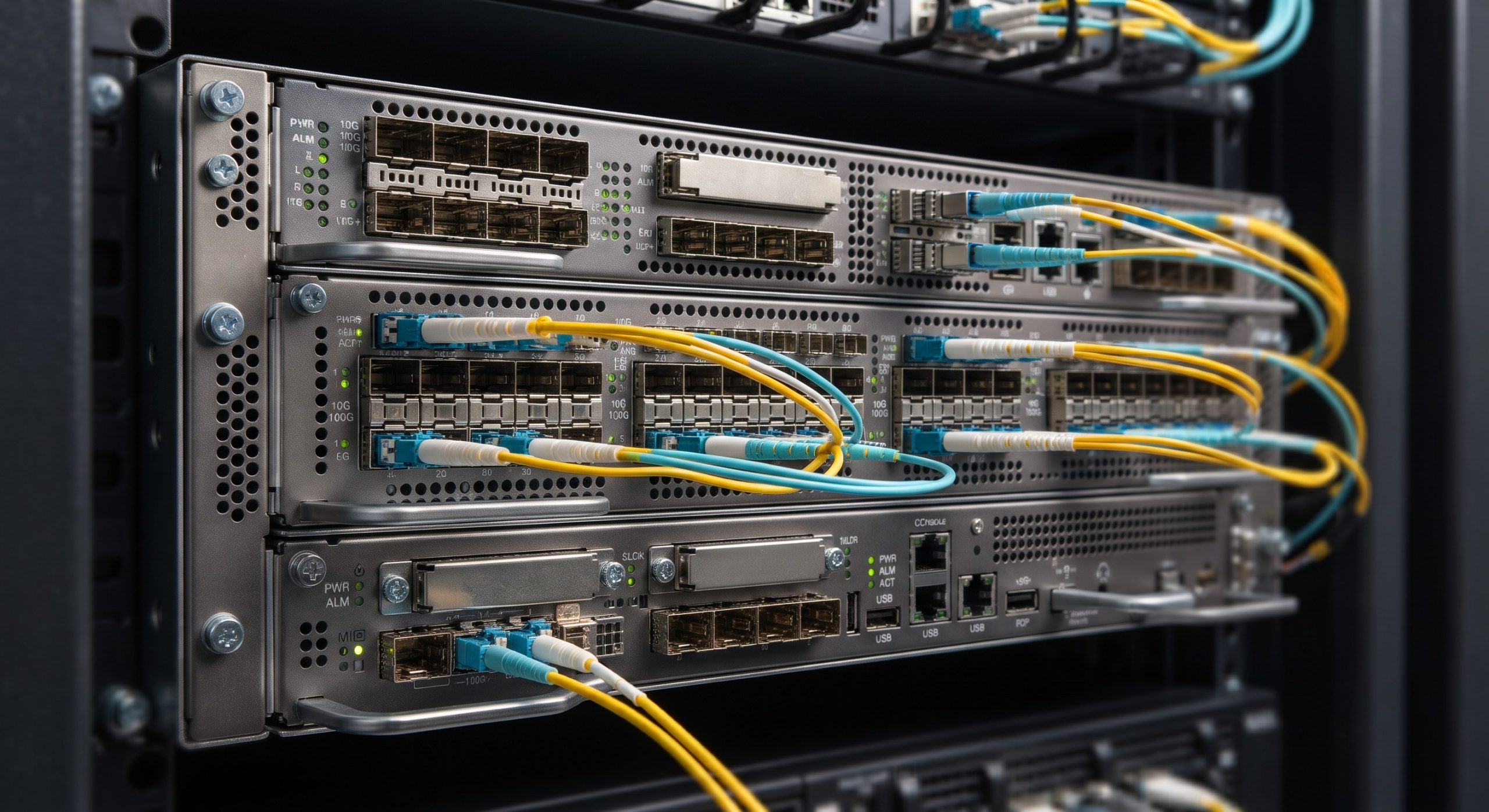
The RSP family provides a comprehensive set of control plane and management interfaces. Front panel connectivity includes dual out-of-band 10/100/1000 management ports, console and auxiliary serial ports, USB interfaces for external storage, and compact flash slots for additional boot or diagnostic images. Timing interfaces include Building Integrated Timing Supply (BITS), DOCSIS Timing Interface (DTI), GPS via Time of Day (ToD) with 10 MHz and 1-PPS signaling, and Precision Time Protocol (PTP) per IEEE 1588-2008. The RSP supports distributed route processing, where each routing protocol can run in protected memory, and multiple instances of control, data, and management planes are supported. Service Edge (SE) optimized variants provide higher memory capacity for large-scale service deployments, while Transport (TR) optimized variants prioritize forwarding efficiency for packet transport applications.
COMPLIANCE & STANDARDS
The Cisco ASR 9000 Series RSP is designed to meet carrier-class requirements for reliability, environmental tolerance, and electromagnetic compatibility. The platform adheres to industry standards for timing synchronization (IEEE 1588, SyncE), network management (SNMP, Syslog, Smart Call Home), and redundancy protocols (Nonstop Forwarding, Nonstop Routing, MPLS TE-FRR). Hardware components are qualified under Cisco’s rigorous reliability testing regimes, including thermal cycling, vibration, and power transient immunity, suitable for deployment in controlled central office and data center environments.
TECHNICAL SPECIFICATIONS
The following table summarizes key hardware parameters across the RSP family. Specific capacities vary by model and chassis configuration; consult Cisco ordering documentation for exact SKU-level metrics.
| Parameter | Specification |
|---|---|
| Form Factor | Occupies one RSP slot per chassis; dual RSPs supported for 1:1 redundancy |
| Supported Chassis | ASR 9904, ASR 9906, ASR 9010, ASR 9910, ASR 9006 (variant-dependent) |
| Switch Fabric Capacity (RSP5) | Up to 33.6 Tbps non-redundant per router (ASR 9910); 600 Gbps bidirectional per RSP5 to each line card slot |
| Switch Fabric Capacity (RSP880) | 880 Gbps non-redundant / 440 Gbps redundant (ASR 9904/9010/9006); 230 Gbps per RSP on ASR 9910/9906 |
| Memory (RSP5) | 24 GB (TR variant); 40 GB (SE variant) |
| Timing Interfaces | BITS, DTI, GPS (ToD, 10 MHz, 1-PPS), IEEE 1588 PTPv2 |
| Management Ports | Dual 10/100/1000 out-of-band Ethernet; console and auxiliary serial |
| Storage | Internal HDD, compact flash slots, USB interfaces |
| Redundancy Support | RSP 1:1, fabric redundancy, power supply redundancy, software redundancy |
| Forwarding Architecture | Distributed forwarding plane; memoryless switch fabric with virtual output queuing |
ORDERING OPTIONS
RSP variants are differentiated by generation and optimization profile. The RSP440 is available in SE and TR models (A9K-RSP440-SE, A9K-RSP440-TR). The RSP880 family includes standard and low-throughput variants (A9K-RSP880-SE, A9K-RSP880-TR, A9K-RSP880-LT-SE, A9K-RSP880-LT-TR), with the LT variants supporting additional chassis types including the ASR 9910 and ASR 9906. The fifth-generation RSP5 is offered as A9K-RSP5-SE and A9K-RSP5-TR, supporting the highest fabric capacities and the latest line card generations. SE variants should be selected for deployments requiring extensive service scale (VRF, BFD, BGP NSR sessions), while TR variants are appropriate for packet transport and high-throughput forwarding applications.
📥 Download Technical Specification
Click the button below to view or download the full official PDF datasheet.

Leave a comment