
Rack Space & Thermal Challenges at the Telecom Edge
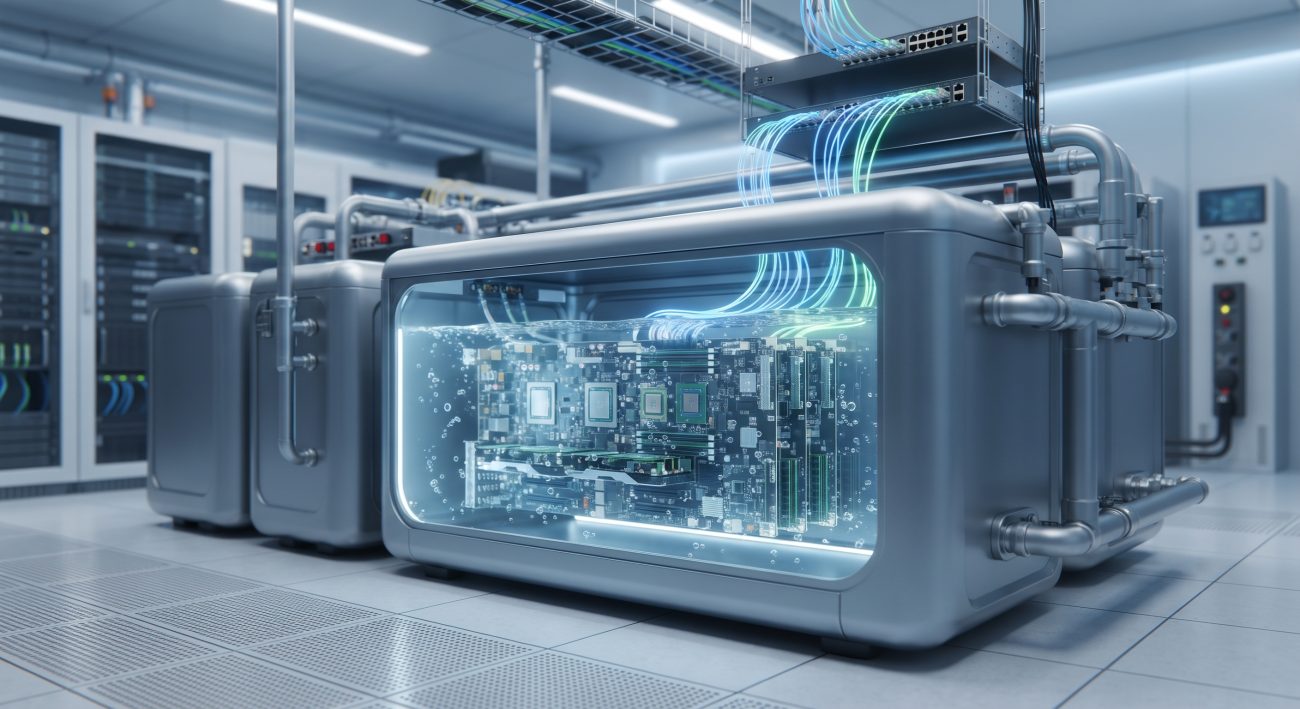
Edge compute deployments for 5G User Plane Function (UPF) and AI inference workloads are pushing conventional air-cooled telecom enclosures to their physical limits. A standard 42U rack optimized for air cooling typically maxes out at 8–12 kW of usable IT load due to airflow constraints and CRAC dependency. When integrating high-density compute modules with Thermal Design Power (TDP) exceeding 400 W per ASIC or 600 W per GPU, air cooling becomes physically unviable—not merely inefficient . The consequences are measurable: fan noise exceeding 85 dBA in unmanned edge shelters, mechanical vibration degrading HDD reliability, and PUE values plateauing around 1.6 . Immersion liquid cooling compute modules address these constraints not through incremental airflow improvements, but through a fundamental thermodynamic substitution: replacing air with a dielectric fluid that conducts heat over 1,000 times more effectively .
Chassis Design & Acoustic Damping Mechanism
Fanless Thermal Architecture and Vibration Attenuation
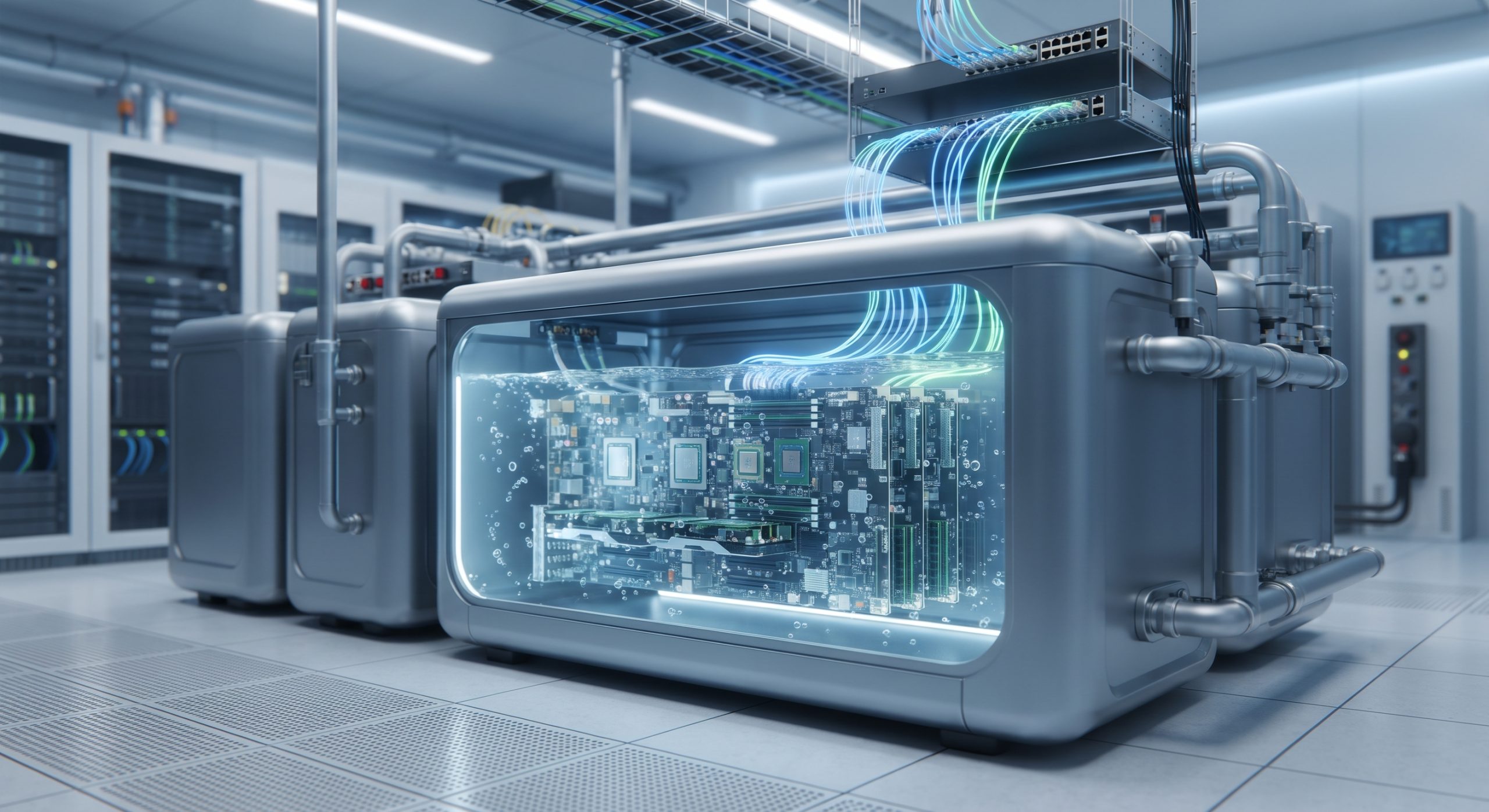
The acoustic benefit of immersion cooling is not a secondary byproduct—it is an architectural determinant for edge feasibility. In a conventional air-cooled switch or compute module, high-static-pressure fans generate broadband noise in the 500–2,000 Hz range while simultaneously transmitting mechanical vibration through the chassis to sensitive components such as HDDs and optical transceivers . Immersion cooling eliminates server fans entirely. Heat is transferred directly from the die surface to the dielectric fluid via natural convection in single-phase systems or phase-change boiling in two-phase implementations . The acoustic profile shifts from continuous high-frequency airflow noise to low-level pump and fluid-movement sounds, typically below 35 dBA in optimized enclosures . More critically for telecom reliability, the liquid medium damps mechanical vibration. Research on rack-mounted immersion baths confirms that submerging storage devices in dielectric fluid reduces acoustic vibration transmission that otherwise causes off-track errors in high-capacity HDDs . For edge modules housing both compute and storage, this translates to improved MTBF for rotating media and reduced packet loss from connector micro-fretting.
Rack-Level Density Multiplication
Single-phase immersion tanks designed for standard 19-inch or 21-inch rack integration enable power densities that air cooling cannot approach. Commercial deployments report single-cabinet power density reaching 30 kW to 120 kW depending on tank configuration and fluid circulation design . The physical footprint reduction is equally significant: one immersion solution reports a 66% reduction in total floor area compared to equivalent air-cooled capacity . For telecom operators deploying compute modules in space-constrained street cabinets or remote huts, this density multiplication directly determines whether edge AI services are economically deployable at all.
Interface Deep Dive: Optical and Power Delivery Considerations
Immersion-compatible compute modules require careful component selection beyond the ASIC itself. Optical transceivers must withstand prolonged dielectric fluid exposure without degradation of the optical subassembly or connector interface. Industry validation programs now test molded inductors and passive components under Soxhlet extraction protocols to confirm material compatibility with hydrocarbon and synthetic ester fluids . Power delivery design shifts as well: the absence of forced airflow means VRM stages must rely on conduction and natural convection to the surrounding fluid, requiring derating calculations that differ fundamentally from air-cooled reference designs. For telecom-grade deployments, RoHS compliance extends to the fluid itself, and IEEE 802.3 optical interface specifications remain unchanged—the immersion environment affects thermal management, not protocol logic.
| Key Parameter | Technical Specification |
|---|---|
| Power Density per Rack | 30 kW to 120 kW (single-phase immersion) |
| PUE (Partial) | ≤ 1.1 (vs. ~1.6 air-cooled baseline) |
| Acoustic Emission | |
| Max Ambient Operating Temp | > 50°C (outdoor autonomous systems) |
| Coolant Thermal Conductivity | ~1,000× greater than air |
| Floor Space Reduction | Up to 66% vs. equivalent air cooling |
| Component Compatibility | Dielectric-validated inductors, optical cages, RoHS fluid |
| Maintenance Access | Sliding shelf with fluid-level management |
High-Density Edge Topologies for Telecom Operators
Field deployments in telecom edge environments demonstrate the operational envelope of immersion-cooled compute modules. An outdoor autonomous immersion-cooled edge data center developed for Indian telecom operators specifies operation at ambient temperatures exceeding 50°C, resistance to dust-heavy and flood-prone conditions, and zero water consumption—critical for regions where water-stressed infrastructure cannot support evaporative cooling . The system achieves PUE below 1.1, compared to approximately 1.6 for conventional air-cooled edge deployments, yielding 30–35% total infrastructure energy reduction . In northern China, a deployment of immersion-cooled 5G BBU equipment maintained core temperatures at 38°C under extreme summer conditions, reduced device operating temperature by 35% versus air cooling, and achieved single-cabinet PUE as low as 1.1 while freeing 80% of legacy cooling redundancy for reallocation . These metrics are not laboratory projections; they represent validated field data from operational telecom infrastructure.
Deployment Checklist for Systems Integrators
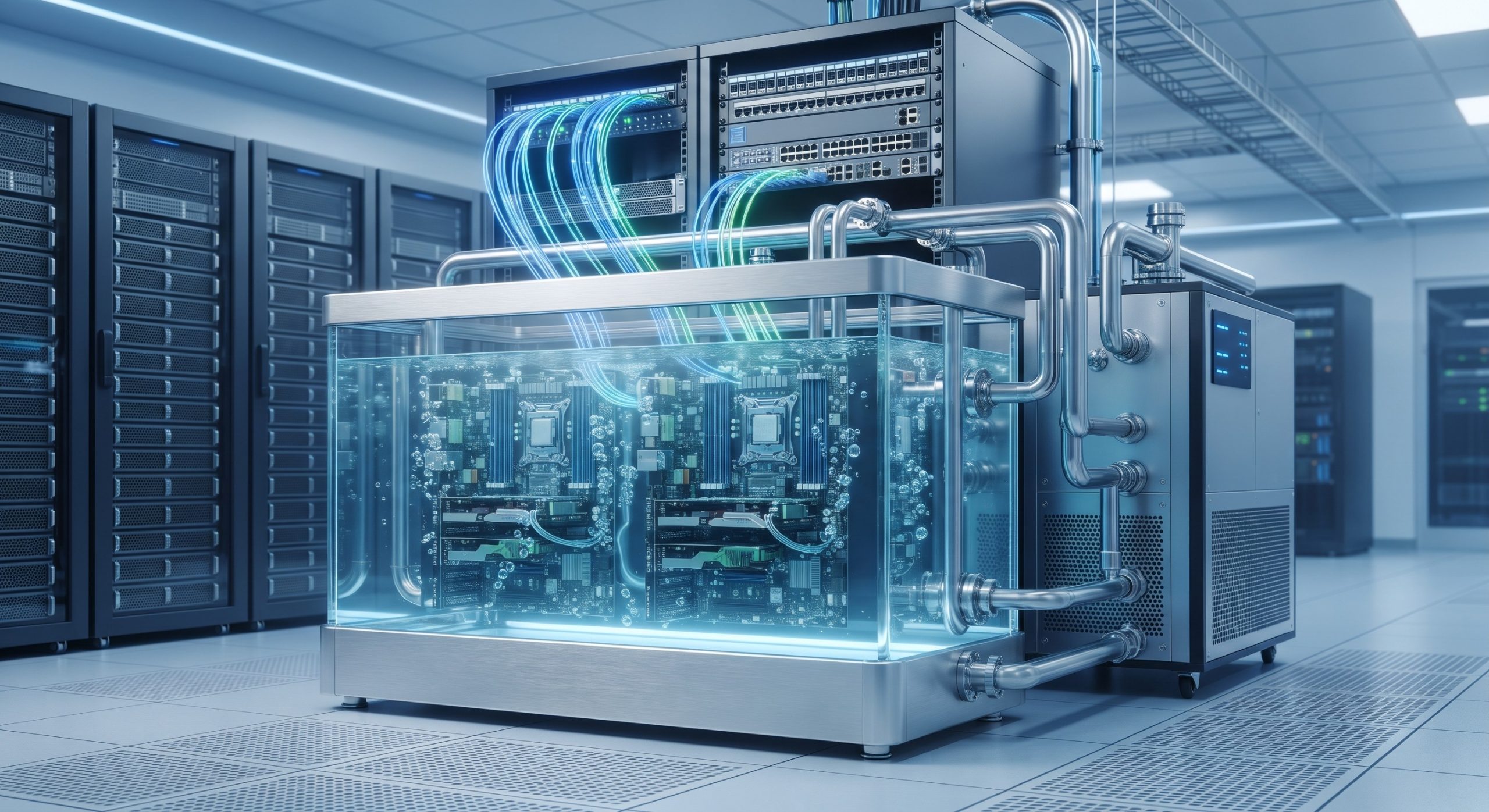
- Fluid compatibility verification: Confirm all module components—optical cages, VRM inductors, connector housings—are rated for continuous dielectric immersion per vendor validation reports.
- Maintenance access design: Specify sliding-shelf or lift-assisted tank configurations. Fluid-level management systems that lower dielectric levels during service windows reduce technician exposure and enable robotic access .
- Heat rejection path: For edge sites without facility water loops, select water-free immersion systems with integrated dry coolers or sealed condenser circuits rated for local ambient extremes .
- Acoustic specification: Measure dBA at 1 meter from the enclosure under full IT load. Target below 40 dBA for unmanned shelters and below 55 dBA for co-located equipment rooms.
- Monitoring integration: Immersion tanks require fluid temperature, level, and conductivity sensors integrated into the existing DCIM or telecom NMS via SNMPv3 or NETCONF.
Checklist Summary
Immersion liquid cooling compute modules deliver their high-density benefit not through a single specification improvement, but through the elimination of the fan as a thermal, acoustic, and reliability bottleneck. For telecom operators facing edge density demands that air cooling cannot satisfy within existing shelter footprints, the technology provides a validated path to 30–120 kW per rack, PUE below 1.1, and acoustic environments compatible with populated and unmanned sites alike. The remaining engineering work lies in component qualification, maintenance workflow design, and systems integration—tasks well within the scope of experienced telecom hardware teams.

Leave a comment