

EXECUTIVE SUMMARY
The Juniper MX Series Universal Routing Platform represents the carrier-grade standard for service provider, cloud, and enterprise edge routing. At the heart of this platform’s adaptability lies the Modular Port Concentrator (MPC) line card ecosystem, which delivers the packet forwarding services required for high-density, multi-service environments . The MPC family spans legacy investment protection from the MPC1/2/3 generations through to the high-capacity MPC10E series, offering a diverse range of interfaces including 10GbE, 40GbE, 100GbE, and 400GbE. This datasheet provides a comprehensive technical overview of the MPC line card interfaces, detailing the architectural principles, hardware specifications, and deployment capabilities that enable network operators to scale bandwidth, subscribers, and services without compromising reliability or performance.

SYSTEM HARDWARE TOPOLOGY
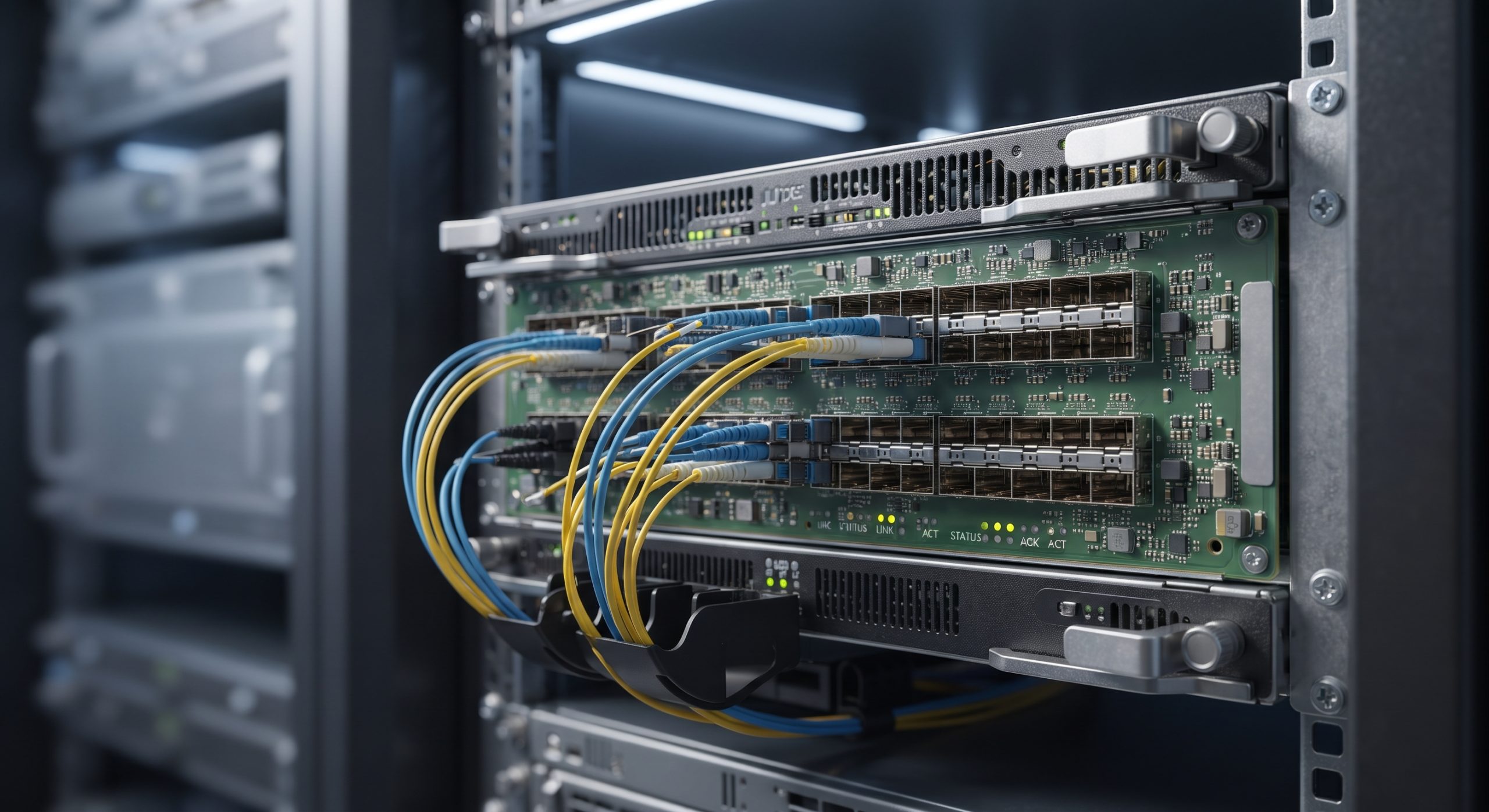
The MX Series architecture separates the control plane from the forwarding plane, with MPCs serving as the primary engines for packet forwarding and interface termination. Each MPC inserts into a dedicated slot on the MX240, MX480, MX960, or the larger MX2000 series chassis, interacting with the Switch Control Board (SCB) or Switch Fabric Board (SFB) for data plane connectivity . The modular design distinguishes between two primary configurations: Modular MPCs (which feature slots for Modular Interface Cards, or MICs, to provide physical media flexibility) and Fixed-Configuration MPCs (which integrate the Ethernet interfaces directly onto the line card for higher density and deterministic performance) . This topology allows for a mix of interface types within a single chassis, optimizing the platform for diverse edge, core, and aggregation roles.
DATA & CONTROL PLANE CAPABILITIES
The forwarding intelligence of the MPC line cards is driven by the Junos Trio chipset family (and its evolved iterations like Trio 5 in the MPC10E). These programmable ASICs deliver line-rate throughput and enable inline services without the need for separate service cards . The architecture supports a rich set of data plane features including full-scale Layer 2 and Layer 2.5 switching, comprehensive IPv4 and IPv6 routing, and MPLS capabilities. For advanced service delivery, specific MPC models (such as the EQ variants) provide Hierarchical Quality of Service (HQoS) with support for up to 1 million queues per slot, enabling granular traffic shaping and subscriber management . Control plane functions, including protocol processing and chassis management, are handled by the Routing Engine, while the MPCs focus exclusively on high-speed packet manipulation, ensuring that throughput is not degraded by complex service activation.
COMPONENT BREAKDOWN
The MPC portfolio is structured to address specific interface density and speed requirements. The MPC3E and MPC4E generations established the foundation for 100GbE readiness, with the MPC4E supporting configurations such as 2x100GE + 8x10GE, delivering up to 260 Gbps of line-rate throughput . The MPC5E series introduced enhanced queuing and scalability, while the MPC10E line represents the current pinnacle of density and efficiency for the MX240/480/960 platforms, offering up to 1.5 Tbps per slot with 400GbE readiness through the Trio 5 silicon . For the MX2000 series, the MPC8E and MPC9E provide massive scale, while the MX2K-MPC11E supports 400GbE interfaces for the most demanding core applications. Each MPC utilizes front-panel accessible ports (QSFP28, QSFP56-DD, SFP+, or CFP) and connects to the chassis midplane via high-speed connectors, facilitating hot-swappable maintenance and upgrade procedures.
OPERATIONAL SPECS MATRIX
The operational characteristics of the MPC line cards are tightly coupled with the chassis power and cooling infrastructure. High-capacity MPCs typically require high-capacity power supplies and fan trays to maintain optimal operating temperatures. For instance, the MPC4E draws approximately 610 W under full load, while the MPC5E and MPC10E families have varying power profiles based on the port configuration and ambient temperature . Environmental constraints, such as NEBS compliance and operating temperature ranges, must be observed, particularly when utilizing specific optical transceivers (e.g., certain ZR or ER optics may have commercial temperature ratings) . The MPCs support Junos Continuity and Unified ISSU (In-Service Software Upgrade) capabilities, allowing for software updates with minimal traffic disruption on supported platforms .
TECHNICAL SPECIFICATIONS
The following table summarizes the key technical parameters across representative MPC families for the MX Series Universal Routing Platforms. Note that specific capabilities vary by exact model number and Junos OS release.
| Parameter | Specification |
|---|---|
| Form Factor | Line card (MPC) for MX240/MX480/MX960/MX2000 series chassis |
| Forwarding Capacity | Up to 1.5 Tbps per slot (MPC10E); Legacy MPC4E up to 260 Gbps |
| Interface Options | 10GbE (SFP+), 40GbE (QSFP+), 100GbE (QSFP28), 400GbE (QSFP56-DD) depending on model |
| Modularity | Modular (MIC-based) or Fixed-configuration (high-density) |
| Queuing / QoS | Up to 1 million queues per slot (MPC5EQ); HQoS support on select models |
| Power Requirement | Typical 460 W to 610 W depending on model (e.g., MPC4E: 610 W; MPC5EQ: ~460 W typical) |
| Switching Capacity | Non-blocking line-rate forwarding with Junos Trio chipset |
REGULATORY COMPLIANCE
Juniper MX Series MPCs are designed to meet stringent industry standards for safety, electromagnetic compatibility (EMC), and environmental durability. Compliance certifications typically include NEBS Level 3 (for many models, subject to specific optic and chassis configuration), UL/CSA 60950-1, IEC 60950-1, EN 60825-1 (laser safety), and ETSI/EN 300 386 for EMC. Network operators should consult the specific Hardware Guide for the installed chassis and MPC combination to confirm compliance with regional directives (e.g., FCC, CE) and to verify the suitability of selected pluggable optics for the intended environmental conditions.
📥 Download Technical Specification
Click the button below to view or download the full official PDF datasheet.
Leave a comment