

EXECUTIVE SUMMARY
The Huawei FusionServer Pro 2288H V5 is a 2U rack server engineered for enterprise-class workloads requiring a balance of compute density, expandability, and thermal reliability. Central to its operational stability is the thermal dissipation architecture, which employs a zoned fan strategy governed by the iBMC management engine. This document provides a technical overview of the 2288H V5 thermal design, fan zoning principles, and the mechanisms that ensure sustained performance across diverse environmental conditions. The platform supports up to two Intel Xeon Scalable processors, 24 DDR4 DIMMs, and a flexible array of storage and PCIe configurations, all within a thermally managed chassis that prioritizes component longevity and acoustic predictability .

ARCHITECTURE & CHASSIS DESIGN
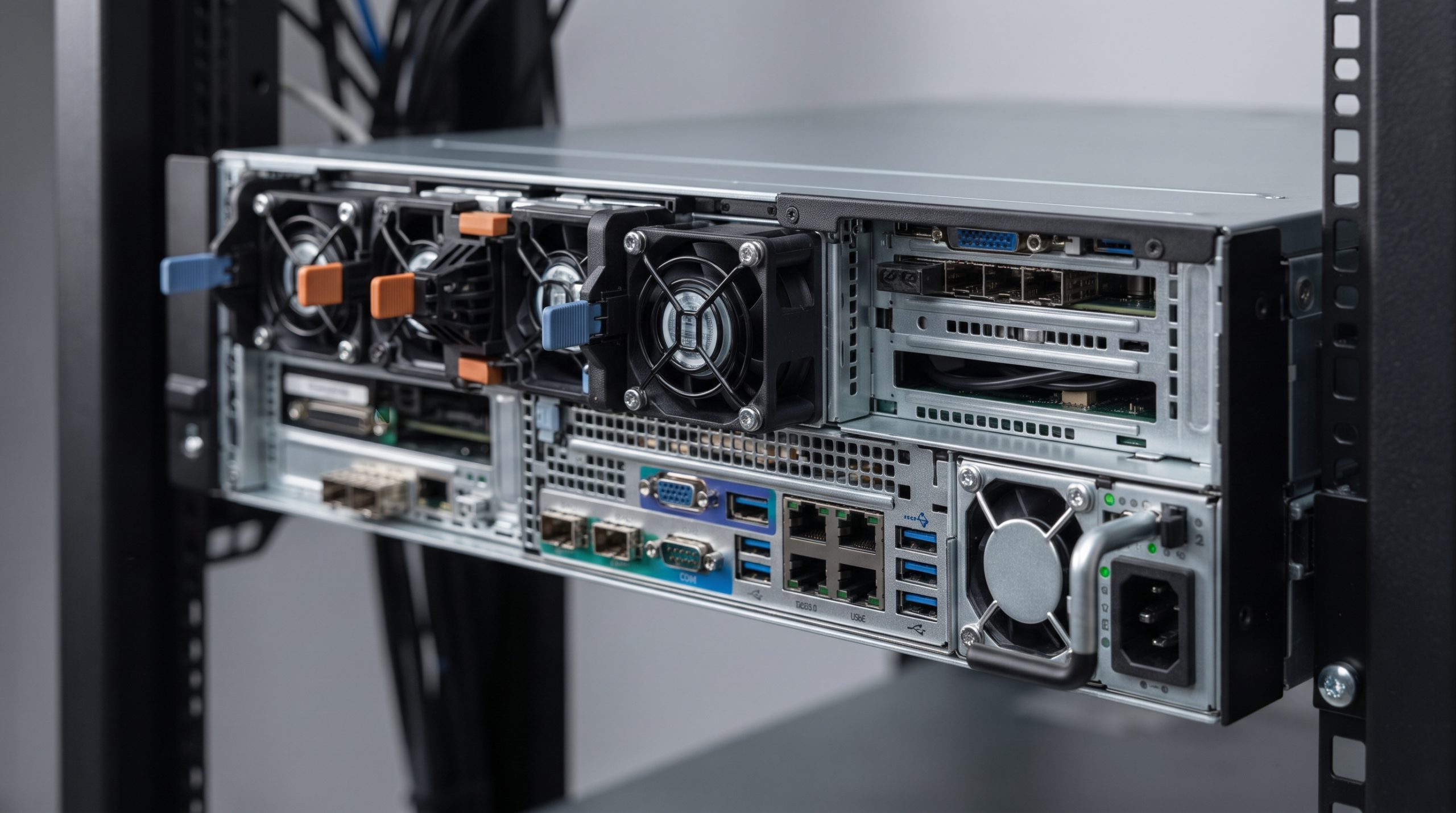
The 2288H V5 is housed in a standard 2U rack-mount chassis with dimensions of 86.1 mm (H) x 447 mm (W) x 748 mm (D) and a maximum weight of 33 kg . The thermal architecture is built around a multi-fan module array that provides N+1 redundancy, ensuring continued operation in the event of a single fan failure . The chassis airflow path is designed to draw cool air from the front intake across the CPU, memory, and PCIe zones, and exhaust heated air through the rear. The fan modules are hot-swappable, allowing for field replacement without powering down the system. The mainboard integrates four fan connectors (Fan 1 through Fan 4), with the 2U configuration utilizing a 4-fan topology that supports N+1 cooling redundancy .
HARDWARE FEATURES
THERMAL DISSIPATION AND FAN ZONING
The thermal management subsystem of the 2288H V5 is not a monolithic control loop but a zoned cooling architecture that dynamically adjusts fan speeds based on localized thermal telemetry. The iBMC (Huawei Intelligent Baseboard Management Controller) serves as the central thermal governor, continuously polling temperature sensors distributed across critical components including the CPUs, DIMM slots, PCIe cards, and drive backplanes.
FAN SPEED ADJUSTMENT LOGIC
Under normal operating conditions, the fan modules run at their minimum speed to minimize acoustic output and power consumption. As the temperature within specific thermal zones rises, the iBMC incrementally increases the speed of the fans associated with those zones . This zoning approach prevents unnecessary global fan ramping, thereby reducing overall system noise when only a single component (such as a high-power PCIe card) is generating heat. The fan speed adjustment policy is influenced by multiple factors, including the intake air temperature at the front of the chassis. For configurations utilizing the SM252 management module, the fan speed is calibrated according to the intake vent temperature: below 25°C, fans operate at 70% of full speed; between 25°C and 30°C, at 80%; between 30°C and 35°C, at 90%; and at or above 35°C, at full speed .
HIGH-POWER PCIE CARD CONSIDERATIONS
Certain high-power PCIe cards, such as the MCX354, MCX353, MCX455, and MCX456, are known to trigger elevated fan speeds even at normal ambient temperatures. These cards can increase fan speed by 5% to approximately 40%, resulting in an acoustic increase of roughly 3 dBA . This behavior is a deliberate thermal protection mechanism rather than a fault condition. By contrast, Huawei-developed SP351 and SP350 cards utilize component-level temperature sensing to modulate fan behavior more precisely, reducing unnecessary acoustic penalties.
FAN MODULE CONFIGURATION GUIDELINES
For chassis configurations that house compute nodes (such as in multi-node deployments), fan module population must follow strict guidelines to ensure adequate heat dissipation. If a chassis houses eight or fewer half-width compute nodes or four or fewer full-width compute nodes, all fan modules except modules 5, 6, 11, and 12 should be installed. If the chassis houses more than eight half-width compute nodes or more than four full-width compute nodes, all fan modules must be installed . Failure to adhere to these population rules can result in compute node power-off events due to insufficient heat dissipation.
COMPLIANCE & STANDARDS
The 2288H V5 complies with major international safety and environmental standards, including CE, UL, FCC, CCC, and RoHS . The platform is certified for operation within a temperature range of 5°C to 45°C, accommodating standard enterprise datacenter environments as well as less stringently controlled edge locations .
TECHNICAL SPECIFICATIONS
| Parameter | Specification |
|---|---|
| Form Factor | 2U Rack Server |
| Dimensions (H x W x D) | 86.1 mm x 447 mm x 748 mm |
| Maximum Weight | 33 kg |
| Fan Configuration | 4 x Hot-swappable Fan Modules, N+1 Redundant |
| Fan Speed Control | iBMC-managed, Zone-based Dynamic Adjustment |
| Intake Temp-Based Fan Policy (SM252) | |
| PCIe Card Acoustic Impact | High-power cards (e.g., MCX354) may increase fan speed by 5-40% and noise by ~3 dBA |
| Operating Temperature | 5°C to 45°C |
| Power Supply | Platinum AC PSU, 1+1 Redundant (e.g., 550W) |
| Management Controller | Huawei iBMC (Hi1710 chip) |
| Compliance | CE, UL, FCC, CCC, RoHS |
ORDERING OPTIONS
Fan modules for the 2288H V5 are available as field-replaceable units. When specifying replacement or expansion parts, the specific fan module part number should be referenced against the server’s bill of materials to ensure compatibility with the chassis revision and iBMC firmware version. The platform supports 550W and higher-rated platinum power supplies in 1+1 redundant configurations, which complement the thermal design by providing stable power delivery with minimal heat generation .
📥 Download Technical Specification
Click the button below to view or download the full official PDF datasheet.

Leave a comment