

Introduction: The Critical Choice in FTTH Architecture
In the rapidly evolving landscape of Fiber-to-the-Home (FTTH) and enterprise access networks, the choice of Passive Optical Network (PON) technology is a foundational decision that impacts operational expenditure (OPEX), service velocity, and long-term scalability for the next decade. For network architects, system integrators, and CTOs, the debate between Gigabit-capable Passive Optical Network (GPON) and Ethernet Passive Optical Network (EPON) is not merely a technical specification comparison—it is a strategic business decision. Both technologies enable point-to-multipoint fiber connectivity using passive splitters, eliminating the need for active electronics in the field and thereby reducing maintenance complexity . However, the underlying protocols, performance metrics, and use-case optimizations differ significantly.
This ultimate guide provides a comprehensive, data-driven evaluation of GPON vs EPON. We will dissect their core architectures, analyze throughput efficiencies, compare Quality of Service (QoS) mechanisms, and provide a roadmap for deployment based on subscriber density and service requirements. Leveraging industry standards from the IEEE and ITU-T, this analysis is designed to equip senior engineers with the necessary insights to maximize network ROI.

Core Architecture & Hardware Topology
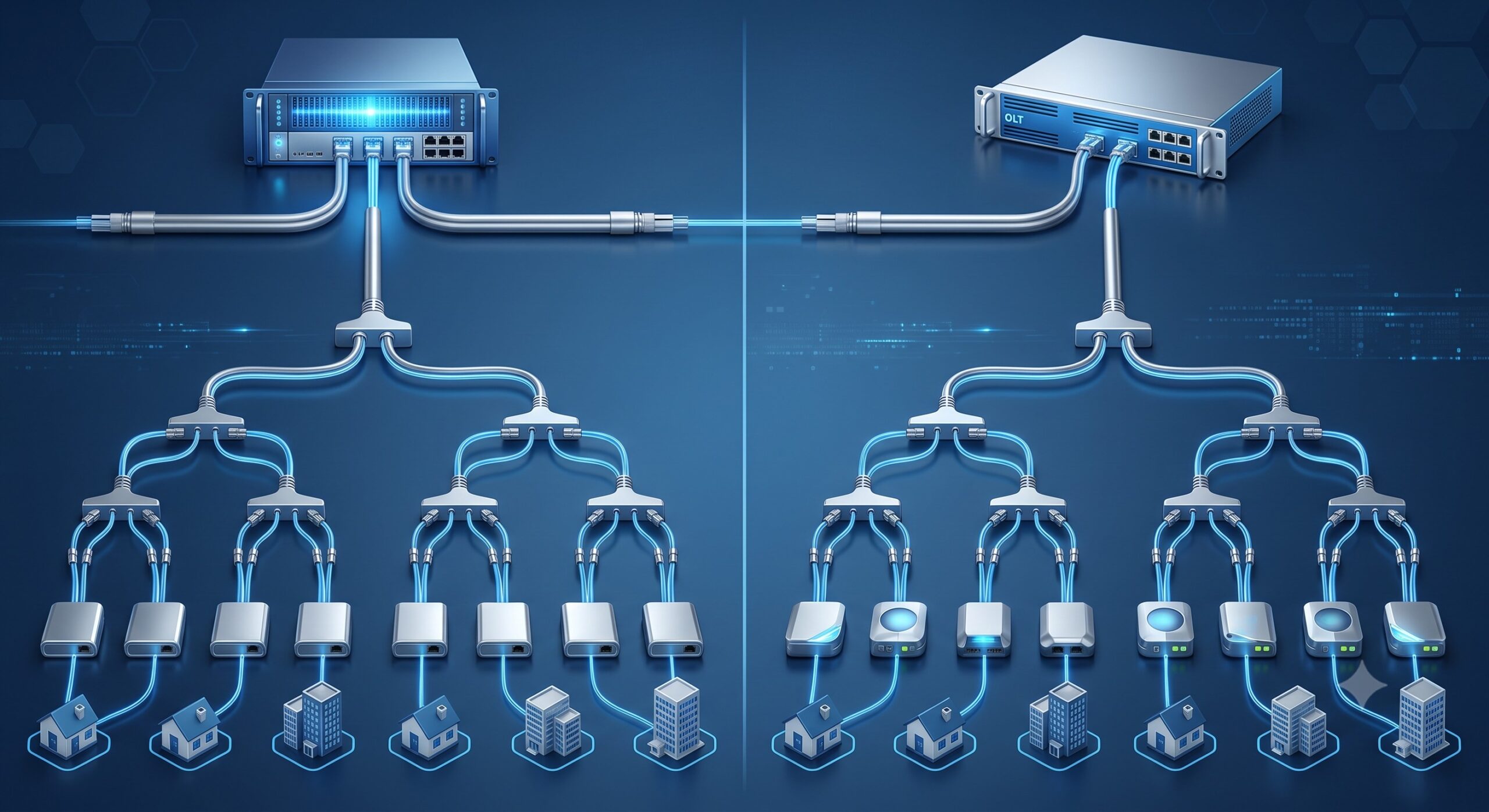
At the physical layer, both GPON and EPON share a similar topology consisting of an Optical Line Terminal (OLT) at the central office, an Optical Distribution Network (ODN) utilizing passive splitters, and Optical Network Units (ONUs) or Optical Network Terminals (ONTs) at the subscriber premises . The fundamental divergence occurs at the data link layer and above.
The Ethernet-Centric Approach of EPON
EPON, standardized under IEEE 802.3ah, is essentially an extension of Ethernet into the first mile . By utilizing standard Ethernet frames with a multipoint control protocol (MPCP), EPON offers a high degree of simplicity and seamless integration with existing IP/Ethernet networks. This inherent compatibility often translates to lower operational complexity and reduced capital expenditure (CAPEX) for network operators who are already heavily invested in Ethernet infrastructure .
The Telecom-Grade Protocol of GPON
Conversely, GPON, defined by the ITU-T G.984 series standards, was engineered as a multi-service transport platform. Its architecture utilizes the GPON Encapsulation Method (GEM) to efficiently encapsulate not just Ethernet, but also native Time-Division Multiplexing (TDM) traffic, making it inherently suited for legacy voice (T1/E1) and video distribution services without requiring complex adaptations . The protocol stack is more sophisticated, employing a 125-microsecond synchronous frame structure that supports end-to-end timing, a feature critical for mobile backhaul and circuit emulation services .
Performance Benchmarking: Speed and Efficiency
When evaluating raw performance, it is essential to distinguish between line rates and usable throughput, as protocol overhead plays a significant role in the GPON vs EPON comparison.
- Line Rate vs. Usable Bandwidth: GPON provides a downstream line rate of 2.488 Gbps and upstream of 1.244 Gbps . In contrast, EPON offers symmetrical line rates of 1.25 Gbps . However, due to 8B/10B line coding, EPON experiences a 20% overhead, resulting in a usable payload of approximately 1 Gbps. GPON utilizes more efficient NRZ coding, achieving a protocol efficiency of roughly 92%, delivering nearly 2.4 Gbps of usable downstream bandwidth .
- Split Ratios and Reach: GPON supports higher split ratios, up to 1:128, allowing a single OLT port to serve more subscribers without signal degradation, provided the optical budget is sufficient . While EPON can also support similar split ratios, it typically faces higher insertion losses at maximum scale, often limiting practical deployments to 1:32 or 1:64 to maintain reach of up to 20 km .
| Key Parameter | EPON (IEEE 802.3ah) | GPON (ITU-T G.984) |
|---|---|---|
| Standards Body | IEEE | ITU-T |
| Downstream Line Rate | 1.25 Gbps (Symmetrical) | 2.488 Gbps |
| Upstream Line Rate | 1.25 Gbps (Symmetrical) | 1.244 Gbps |
| Usable Throughput (Efficiency) | ~1 Gbps (~85%) | ~2.4 Gbps (~92%) |
| Max Split Ratio | Typically 1:32 (Up to 1:128) | Up to 1:128 |
| Encapsulation | Standard Ethernet / MPCP | GEM (GPON Encapsulation Method) |
| Native Multi-Service (TDM) | Requires Adaptations (VoIP) | Native Support |
| QoS Mechanism | VLAN Tagging / DBA (Simplified) | T-CONT / 5 Priority Types |
| Management Protocol | IEEE 802.3ah OAM, SNMP | PLOAM, OMCI |
QoS and Dynamic Bandwidth Allocation (DBA)
The disparity in Quality of Service (QoS) capabilities is a decisive factor for carriers offering premium Triple-Play (Voice, Video, Data) packages. GPON features an advanced and integrated DBA mechanism, defining traffic containers (T-CONT) with five distinct types . These types allow operators to assign specific bandwidth allocations—Fixed, Assured, Non-Assured, and Best Effort—guaranteeing low latency for voice and video streams while efficiently utilizing spare capacity for data traffic .
EPON leverages Ethernet’s inherent capabilities, relying on Virtual Local Area Network (VLAN) tagging and proprietary overlays to approximate QoS. However, these mechanisms often require manual configuration and lack the granularity of GPON’s T-CONT model, which presents a challenge for large-scale networks requiring automated service-level agreements (SLAs) .
Operations, Administration, and Maintenance (OAM)
OAM is critical for reducing OPEX. GPON provides a robust OAM framework that includes PLOAM (Physical Layer OAM) for discovery and encryption management, and OMCI (ONT Management and Control Interface) for advanced remote provisioning, performance monitoring, and fault isolation . This hierarchical approach simplifies the management of large, dense networks.
EPON relies on the standard IEEE 802.3ah OAM protocol, which provides basic functions like link monitoring and loopback. When combined with SNMP, it can scale, but it typically lacks the plug-and-play provisioning and advanced traffic management capabilities found in GPON, often leading to higher configuration overheads .
TCO and Market Analysis
The economic profile of each technology varies significantly based on deployment density and required features.
- Capital Expenditure (CAPEX): EPON traditionally holds a 20-30% advantage in CAPEX. The use of standard Ethernet MAC chips and less stringent optical components generally makes OLT and ONU hardware cheaper. Historically, GPON ASICs (often FPGA-based in the early stages) and GPON optical transceivers have been more expensive .
- Total Cost of Ownership (TCO): In high-density scenarios where bandwidth efficiency and advanced management lower operational costs, GPON often offers a superior TCO. The ability to support more subscribers per OLT port (1:128) reduces the number of central office ports required, and the efficient DBA reduces wasted bandwidth. For cost-sensitive, low-density deployments, EPON remains highly competitive.
Migration Path: Evolution to 10G and 50G PON
Future-proofing is a key consideration for modern architectures. Both technologies have evolved to support 10G speeds: 10G-EPON (IEEE 802.3av) and XGS-PON (10G Symmetrical GPON). However, the migration to future 50G PON presents distinct challenges. GPON networks benefit from a smoother evolutionary path via wavelength isolation (Multi-Power Mode), allowing GPON, XGS-PON, and 50G-PON to coexist on the same ODN . EPON faces potential wavelength overlap issues with 50G PON’s upstream band, requiring the gradual phase-out of legacy broad-frequency ONUs or adoption of non-standard solutions, which may complicate upgrades .
Conclusion and Selection Criteria
In summary, the choice between GPON and EPON is a balance between technical capability, cost, and service goals. GPON is the optimal choice for large-scale, high-density metropolitan networks, carriers deploying premium triple-play services, and environments requiring absolute QoS guarantees and future-proof migration paths. Its superior downstream bandwidth, protocol efficiency, and management capabilities justify the higher initial hardware investment .
EPON remains a compelling solution for enterprise campus networks, cost-sensitive projects, and deployments where symmetrical bandwidth is prioritized over raw download speed. Its simplicity and lower entry cost make it ideal for small-to-medium community broadband or environments where Ethernet integration is paramount . As the industry moves toward a converged 50G PON future, understanding these fundamental architectural differences ensures your network is built on the right foundation for the coming decade.

Leave a comment