
Executive Overview: The Connectivity Imperative for Modern SMBs
For the contemporary small-to-medium business (SMB), a single broadband link represents a single point of failure. Downtime directly correlates to lost revenue, with the ITIC 2023 report citing that 98% of organizations say a single hour of downtime costs over $100,000. A small business multi-WAN load balancing router transcends mere failover; it is a strategic edge device that aggregates diverse ISP links—cable, fiber, 5G, DSL—into a resilient, high-throughput logical pipe. This guide provides a carrier-grade analysis of architecture, forwarding plane metrics, and deployment blueprints tailored for the distributed enterprise edge.
Core Architecture & Hardware Topology
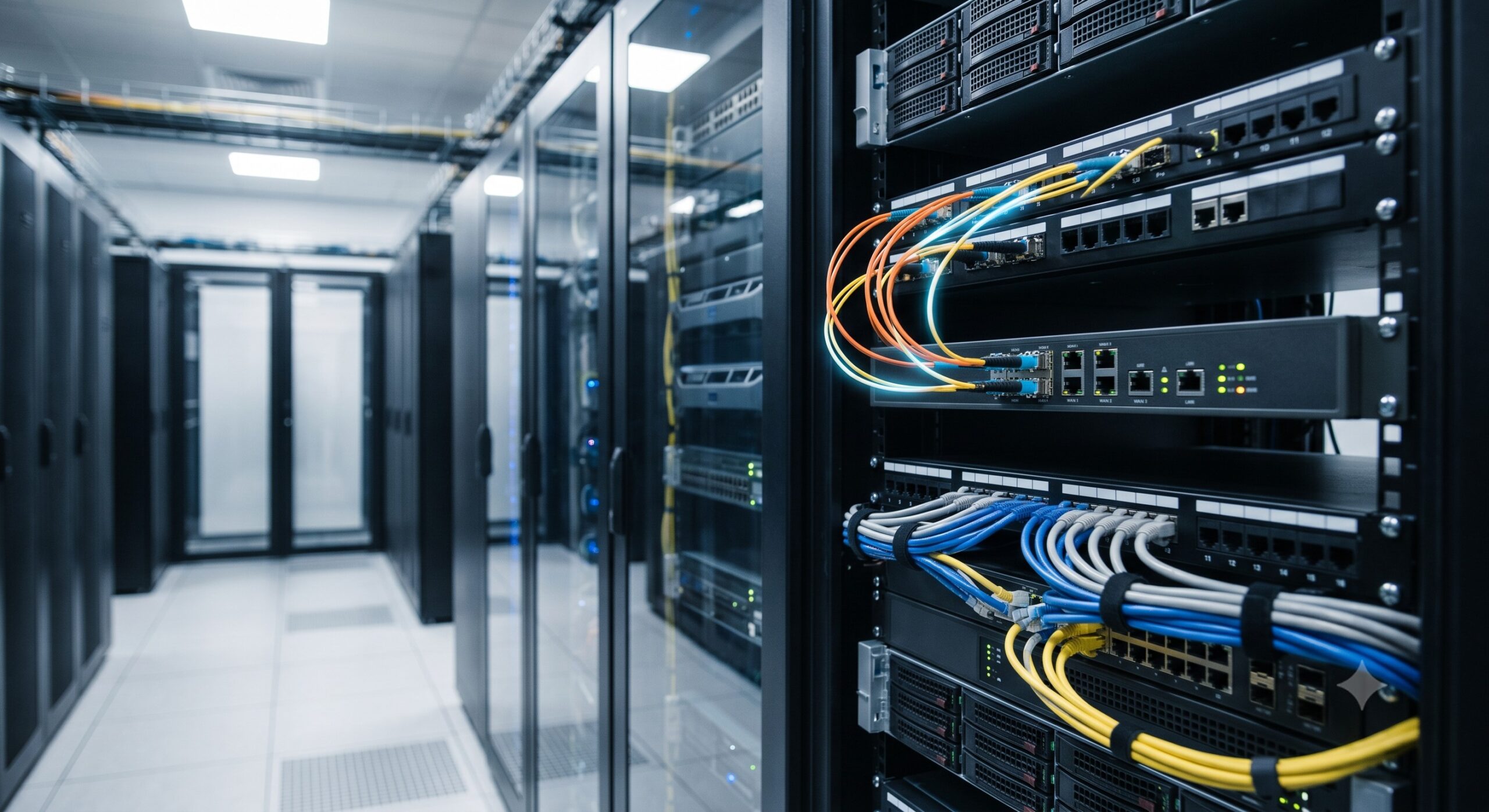
Unlike consumer-grade routers employing software-based NAT, purpose-built multi-WAN appliances leverage a dedicated Network Processing Unit (NPU) or a multi-core x86/ARM SoC with hardware acceleration. The critical distinction lies in the flow-based vs. packet-based load balancer architecture. Enterprise-grade units utilize a session hash (e.g., 5-tuple hash: Source IP, Destination IP, Source Port, Destination Port, Protocol) to maintain application state integrity. The backplane must support full-duplex, non-blocking forwarding. A minimum requirement for an SMB aggregating 1 Gbps total links is a backplane capacity exceeding 2 Gbps and a forwarding rate of 1.5 Mpps (million packets per second) at 64-byte frame size per IEEE 802.3 standards.
Logic Layer Deep Dive: Load Balancing Algorithms
The intelligence hinges on the configured algorithm. Deploy Weighted Round Robin (WRR) for unequal bandwidth links (e.g., 500 Mbps fiber vs. 100 Mbps cable) to proportionally distribute egress traffic. For latency-sensitive VoIP or video conferencing, implement Lowest Latency or Lowest Jitter algorithms. Advanced units support Persistence (Sticky Sessions) to bind a source IP to a single WAN interface, preventing SSL/TLS session renegotiation errors on financial or CRM portals. A key operational metric is the failover failback time; sub-second failover (under 300 ms) requires Bidirectional Forwarding Detection (BFD) protocol support, whereas standard ICMP ping-based detection typically takes 3-5 seconds, which may drop active VPN tunnels.
| Key Parameter | Technical Specification | SMB Recommended Value |
|---|---|---|
| Max Aggregated Throughput | Forwarding rate (Mpps) / Gbps | 1.5 Mpps / 1.5 Gbps |
| Session Table Size | Concurrent sessions | 100,000+ entries |
| Failover Detection | BFD vs ICMP | BFD sub-300ms |
| WAN Interface Types | RJ45, SFP, USB (LTE/5G) | Minimum 3x Gigabit RJ45 |
| Load Balancing Modes | Algorithm support | WRR, Least Latency, Persistence |
| Power Consumption (Max) | Wattage under full load | 15W (Passive cooled) |
IEEE & ITU-T Compliance Masterclass: Engineering Specs
A defensible procurement decision mandates verifying specific standards. For carrier interconnect, the router must support IEEE 802.1Q VLAN tagging for multi-tenant or VoIP segregation, and IEEE 802.3ad Link Aggregation (LAG) to bond two WAN links logically. From an environmental perspective, look for RoHS (Restriction of Hazardous Substances) compliance and an operating temperature range of 0°C to 40°C with a validated MTBF (Mean Time Between Failures) above 300,000 hours. Critically, the device must adhere to ITU-T Y.1731 for performance monitoring and RFC 2544 benchmarks for throughput, latency, and frame loss testing. Ensure the WAN ports support auto-MDI/X and ESD protection of ±15kV to survive real-world commercial power events.
Data-Driven Deployment Topologies
For a small business with 15-50 users, implement a SD-WAN Lite topology. Connect primary fiber (1 Gbps) to WAN1, secondary cable (300 Mbps) to WAN2, and a 4G/5G USB modem to WAN3 for absolute redundancy. Configure policy-based routing: designate all UDP 5060-5061 (SIP) and RTP ports 10000-20000 to use the lowest-latency link, while general web traffic and backup services use weighted load balancing. A crucial best practice is to configure DNS server assignment per WAN interface (e.g., Cloudflare 1.1.1.1 on primary, Google 8.8.8.8 on secondary) to avoid DNS resolution failure during link flaps. Validate throughput using RFC 2544 with a 1518-byte frame size; a true multi-WAN router should achieve line-rate aggregation with less than 1% CPU utilization per Gbps of traffic.

Conclusion: Operational Gains and Selection Verdict
Quantified operational gains from a small business multi-WAN load balancing router are irrefutable: aggregated bandwidth utilization exceeding 90% of total purchased ISP capacity, zero-downtime failover for VPN tunnels, and a reduction in WAN latency jitter by up to 40% through smart queuing. For the network architect, prioritize units offering full stateful firewall inspection on the aggregated link, Per‑Connection Queue (PCQ) for fair bandwidth distribution, and a management plane supporting SNMP v3 and syslog TLS for remote monitoring. Avoid devices that implement simple failover only; true load balancing is a prerequisite for modern cloud-first SMB operations. Validate the datasheet’s packet forwarding rate and choose wisely—this is the new network core for the resilient business.

Leave a comment