

EXECUTIVE SUMMARY
The Cisco Switch Optics Compatibility Matrix represents the definitive reference framework for network architects, procurement specialists, and field engineers tasked with designing and deploying optical interconnects across the Cisco Catalyst, Nexus, and ASR 1000 series platforms. As Ethernet speeds scale from 1GE to 400GE and beyond, the complexity of transceiver-to-device qualification has grown exponentially. The Compatibility Matrix addresses this challenge by providing a single-source, dynamic tool that documents fully qualified optical modules—including SFP, SFP+, SFP28, QSFP+, QSFP28, and XFP form factors—and their respective minimum software release requirements .
Historically, compatibility information was maintained through static tables that became increasingly unreadable as the product portfolio expanded. The current interactive online tool, accessible via the Cisco Optics-to-Device Compatibility Matrix portal, has averaged over 1,000 page views daily and enables rapid queries against a continuously updated qualification database . This document provides a comprehensive technical reference for understanding the scope, application, and operational considerations of the Compatibility Matrix across Cisco’s switching and routing ecosystems.

ARCHITECTURE & CHASSIS DESIGN
The Cisco optics compatibility architecture is structured around a tiered qualification model that accounts for both the host platform and the specific transceiver type. At the highest level, compatibility is determined by the interaction between the host switch or router ASIC, the physical layer interface, and the firmware-based validation logic embedded within Cisco IOS, IOS XE, and NX-OS operating systems.
Host platforms are categorized by product family, with distinct compatibility profiles for each chassis and line card configuration. For fixed-configuration platforms such as the Catalyst 9000 series and Nexus 9000 series, compatibility is typically consistent across all front-panel ports, subject to port-group speed restrictions and breakout capabilities. Modular platforms such as the Catalyst 9500 and Nexus 9500 incorporate line-card-specific qualification data, where the same transceiver type may be supported on one line card variant but unsupported on another due to differences in PHY technology and backplane bandwidth .
The chassis backplane plays a critical role in determining maximum supported data rates and aggregate switching capacity. Ports are often grouped into quads (four-port physical groups) that must operate at uniform speed—all 10G, all 40G, or all 100G—as observed in the N9K-C9364C-GX architecture . Breakout configurations, where a single 40G or 100G port is split into multiple 10G or 25G logical interfaces, introduce additional compatibility constraints that are explicitly documented within the Compatibility Matrix.
HARDWARE FEATURES
Optical transceivers qualified against the Compatibility Matrix are engineered to meet rigorous physical, electrical, and optical specifications. All qualified modules adhere to the relevant Multi-Source Agreement (MSA) standards—SFF-8472 for SFP/SFP+ form factors and SFF-8636 for QSFP+/QSFP28—ensuring standardized mechanical dimensions and electrical pinouts . Optical signaling performance conforms to IEEE 802.3 Ethernet standards clauses, including Clause 52 for 10GBASE-SR/LR and Clause 88 for 40GBASE-SR4/LR4, guaranteeing interoperability with compliant far-end transceivers .
Digital Optical Monitoring (DOM) is supported on a majority of qualified transceivers, enabling real-time visibility into optical transmit power, receive power, temperature, voltage, and bias current. This telemetry data is accessible via CLI commands such as show interfaces transceiver and is invaluable for proactive fault detection and link performance optimization . DOM capability is contingent upon both transceiver hardware support and the minimum Cisco IOS XE version specified in the Compatibility Matrix.
Direct Attach Copper (DAC) cables are also represented within the Compatibility Matrix, with passive and active twinax assemblies qualified for intra-rack connections up to 5 meters. Supported DAC SKUs include SFP-H10GB-CUxM for 10G applications and QSFP-100G-CUxM for 100G deployments .
COMPLIANCE & STANDARDS
Cisco mandates that only transceivers and cables listed in the Optics-to-Device Compatibility Matrix are considered fully supported for production deployment. Insertion of non-compatible or third-party transceivers can lead to unpredictable behavior, link instability, and Layer 1 errors, and stability is not guaranteed in the absence of Cisco-original compatible transceivers . The Compatibility Matrix is the authoritative source for determining qualified optics for any given Cisco host platform.
Third-party optical modules that conform to MSA specifications and are correctly EEPROM-encoded to report Cisco-compatible vendor identification codes may operate successfully, but they are not validated or supported by Cisco Technical Assistance Center (TAC) . The EEPROM contains a vendor name, part number, OUI, serial number, and security checksum; Cisco IOS reads this data and compares it against an internal database of recognized optics. The coding required for successful qualification varies across platforms, as different Cisco OS versions and hardware generations exhibit varying degrees of strictness regarding vendor identification strings .
TECHNICAL SPECIFICATIONS
The following table summarizes key technical parameters for representative qualified transceiver types across the Cisco Catalyst, Nexus, and ASR 1000 platforms. For complete qualification data—including per-port restrictions, minimum software versions, and breakout support—refer to the live Cisco Optics-to-Device Compatibility Matrix at https://tmgmatrix.cisco.com.
| Parameter | Specification |
|---|---|
| Form Factor | SFP, SFP+, SFP28, QSFP+, QSFP28, XFP, QSFP-DD |
| Data Rates Supported | 1GE, 10GE, 25GE, 40GE, 100GE, 400GE |
| Reach (Multimode) | Up to 400 m (OM4, 10GBASE-SR) / Up to 150 m (OM4, 40GBASE-SR4) / Up to 100 m (OM4, 100GBASE-SR4) |
| Reach (Single-mode) | Up to 10 km (10GBASE-LR, 100GBASE-LR4) / Up to 40 km (10GBASE-ER) / Up to 80 km (10GBASE-ZR) |
| Connector Types | LC Duplex, MPO-12, RJ-45 (copper SFP) |
| Fiber Types | MMF (OM3, OM4, OM5) / SMF (OS1, OS2) |
| Wavelengths (Typical) | 850 nm (SR), 1310 nm (LR), 1550 nm (ZR/ER), CWDM/DWDM grid |
| Digital Optical Monitoring (DOM) | Supported on all qualified modules (software version dependent) |
| Direct Attach Copper (DAC) | Passive and Active, up to 5 m (10G/25G/40G/100G) |
| Minimum Software Requirement | Specified per transceiver in Compatibility Matrix; varies by platform and IOS version |
| Qualification Authority | Cisco Optics-to-Device Compatibility Matrix (https://tmgmatrix.cisco.com) |
ORDERING OPTIONS
All Cisco optical transceivers and cables are orderable through standard Cisco procurement channels. SKUs follow a consistent naming convention that encodes form factor, data rate, reach, and media type. Common base SKUs include:
– GLC-xxx: 1G SFP transceivers (e.g., GLC-LH-SMD for 1G single-mode fiber)
– SFP-10G-xxx: 10G SFP+ transceivers (e.g., SFP-10G-SR for multimode, SFP-10G-LR for single-mode)
– SFP-25G-xxx: 25G SFP28 transceivers (e.g., SFP-25G-SR-S)
– QSFP-40G-xxx: 40G QSFP+ transceivers (e.g., QSFP-40G-SR4)
– QSFP-100G-xxx: 100G QSFP28 transceivers (e.g., QSFP-100G-LR4-S)
– QSFP-400G-xxx: 400G QSFP-DD transceivers
– SFP-H10GB-CUxM: 10G SFP+ passive DAC cable, x meters
– QSFP-100G-CUxM: 100G QSFP28 passive DAC cable, x meters
For CWDM and DWDM optical infrastructure, specific SKUs are available for supported platforms including the ASR 1000 series and associated SPAs. CWDM-SFP-xxxx and DWDM-SFP-xxxx SKUs cover the full ITU grid spectrum for dense wavelength-division multiplexing applications .
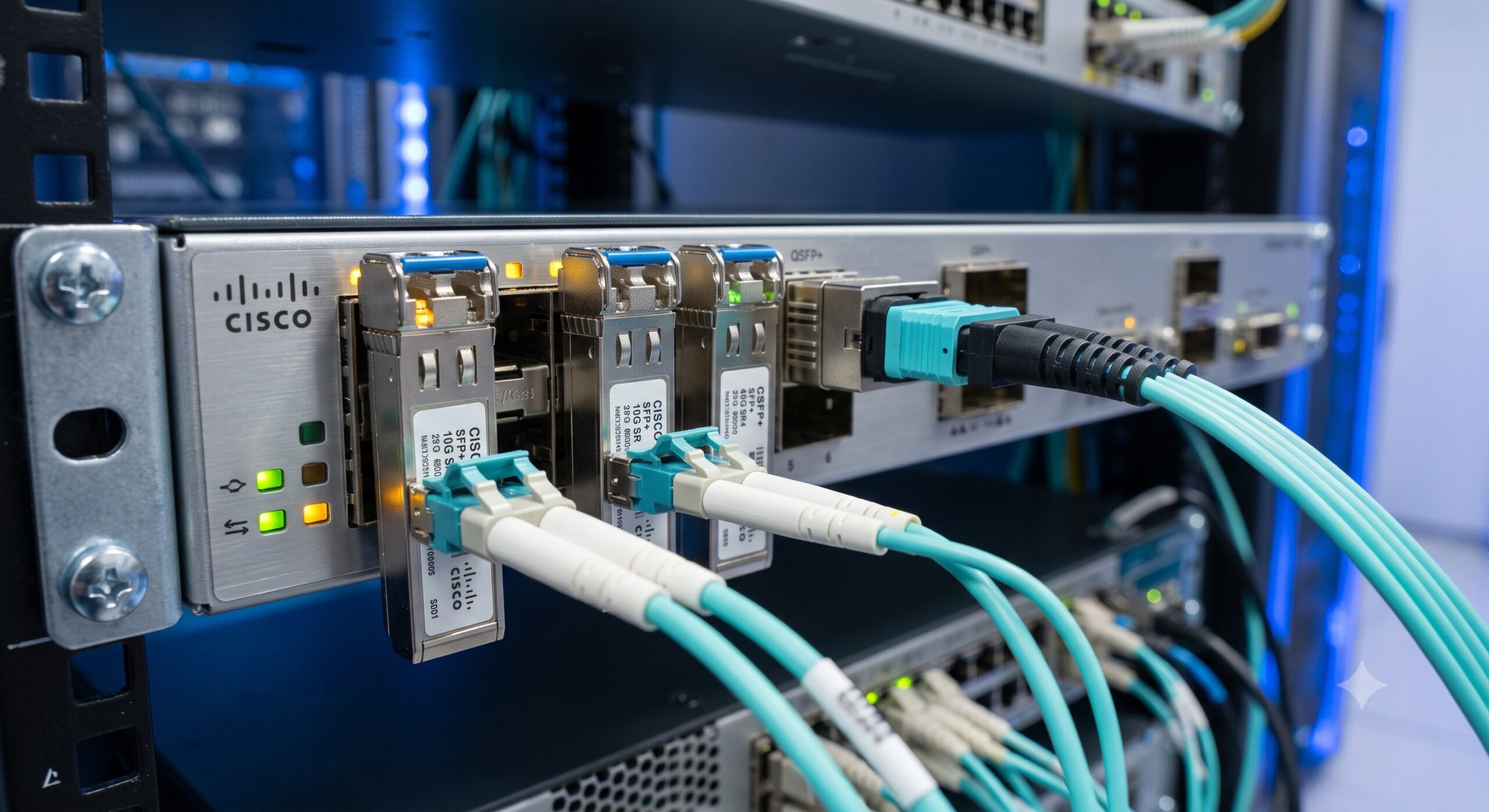
For third-party compatible modules that meet MSA specifications, various vendors offer EEPROM-encoded alternatives. When sourcing third-party optics, the customer must ensure that the module is explicitly encoded for the target Cisco platform—for example, a module coded for a Catalyst 9300 versus a Nexus 9000—as platform-specific validation logic differs. Pre-shipment verification on actual hardware is recommended to confirm link bring-up and DOM functionality .
This document serves as a comprehensive technical introduction to the Cisco Switch Optics Compatibility Matrix. For current and complete compatibility information across all Cisco platforms, network professionals are directed to the live Compatibility Matrix portal, which provides interactive search, dynamic filtering, and PDF export capabilities.
📥 Download Technical Specification
Click the button below to view or download the full official PDF datasheet.

Leave a comment