
Abstract
As global broadband demands escalate, telecommunication operators are rapidly transitioning to high-capacity Fiber-to-the-Home (FTTH) architectures. This whitepaper explores the core technologies behind the ZTE ONT, Optical CATV:ZTE ZXHN F601C, a highly specialized Gigabit Passive Optical Network (GPON) terminal designed for modern triple-play services. This article investigates the architectural mechanics of wavelength-division multiplexing (WDM) used to deliver both high-speed internet and legacy Radio Frequency (RF) video over a single fiber. You will discover why the integration of an optical CATV receiver within the ONT is a critical cost-saving strategy for Internet Service Providers (ISPs), allowing them to bypass traditional coax-heavy hybrid networks. Finally, we will detail how network engineers can execute seamless OMCI provisioning and optimize Quality of Service (QoS) for concurrent gigabit data and broadcast television delivery, providing an actionable roadmap for upgrading edge-network infrastructure.
The Evolution of FTTH Architectures and the Strategic Imperative of GPON
The telecommunications industry is undergoing a monumental shift from legacy copper-based infrastructures—such as Asymmetric Digital Subscriber Line (ADSL) and Very-high-bit-rate Digital Subscriber Line (VDSL)—toward entirely optical access networks. The driving force behind this transformation is the insatiable consumer and enterprise demand for symmetrical gigabit bandwidth, low-latency streaming, and high-definition broadcast services. Within this landscape, the Gigabit Passive Optical Network (GPON) standard, defined by the ITU-T G.984 recommendation, has emerged as the globally dominant fiber access technology.
GPON utilizes a point-to-multipoint topology, deploying passive optical splitters to divide a single optical feed from the central office among multiple end-users. This passive nature eliminates the need for powered active equipment between the Central Office (CO) and the subscriber’s premises, drastically reducing Capital Expenditure (CAPEX) and Operational Expenditure (OPEX). Recent industry analyses indicate that FTTH connections account for over 65% of all new broadband deployments globally, with GPON continuing to be the primary catalyst for this growth (Source: Dell’Oro Group Broadband Access & Home Networking Report, 2024).
However, a significant challenge for ISPs transitioning to pure fiber networks has been the delivery of traditional broadcast television (CATV). Millions of subscribers still rely on legacy RF television infrastructure. Operating parallel networks—one fiber network for data and one coaxial network for television—is economically unviable. This is where specialized Optical Network Terminals (ONTs) equipped with WDM and RF overlay capabilities become indispensable. The ZTE ZXHN F601C represents the pinnacle of this convergence, bridging the gap between next-generation optical data transmission and legacy broadcast television delivery in a single, compact Customer Premises Equipment (CPE) unit.
By migrating to specialized terminals like the ZTE F601C, network operators can achieve a unified “triple-play” service delivery model (voice, video, and data) over a solitary strand of single-mode fiber. This consolidation not only accelerates network rollout but also future-proofs the Last Mile infrastructure against the impending demands of 4K/8K video streaming, augmented reality (AR) applications, and dense IoT ecosystems.
Demystifying the Wavelength Division Multiplexing (WDM) and CATV RF Overlay
To fully comprehend the engineering brilliance of the ZTE ONT, Optical CATV:ZTE ZXHN F601C, one must understand the principles of Wavelength Division Multiplexing (WDM) and how it facilitates RF overlay. A standard GPON architecture utilizes two primary wavelengths for data communication:
-
1490 nm: Used for downstream data transmission from the Optical Line Terminal (OLT) to the ONT.
-
1310 nm: Used for upstream data transmission from the ONT back to the OLT.
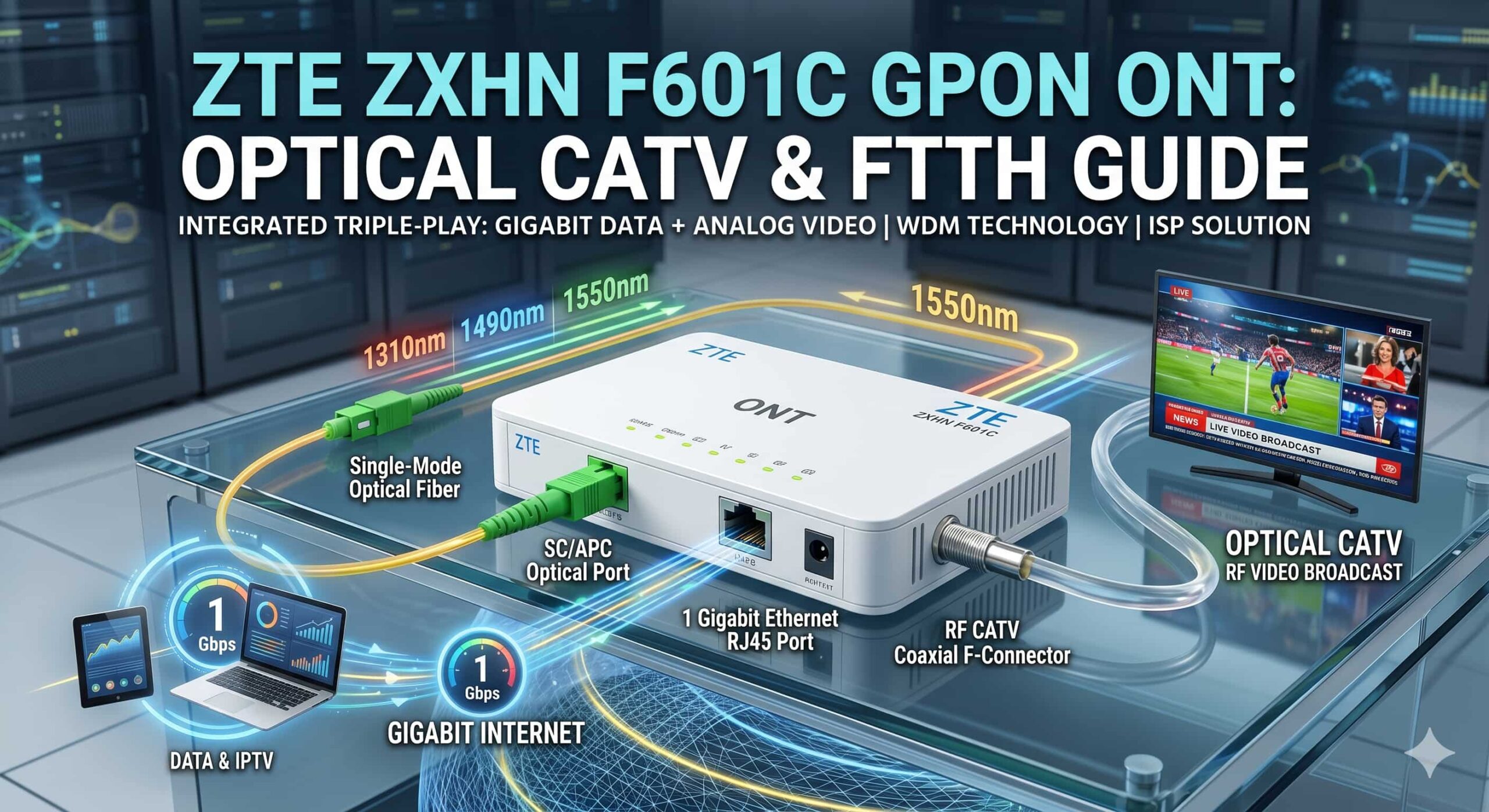
These two wavelengths efficiently handle internet traffic, Voice over IP (VoIP), and IP Television (IPTV). However, traditional CATV is not transmitted via IP packets; it is transmitted as continuous analog or digital RF signals. To transport these RF signals over the same fiber without interfering with the 1490nm and 1310nm data streams, network engineers utilize an “RF overlay” strategy.
This strategy introduces a third wavelength:
-
1550 nm: Exclusively reserved for downstream broadcast video (CATV) signals.
At the central office, an Erbium-Doped Fiber Amplifier (EDFA) and an optical multiplexer inject the 1550 nm video signal into the same fiber strand carrying the GPON data. When this composite optical signal reaches the subscriber’s premises, the ZTE ZXHN F601C utilizes an internal optical triplexer (a specialized WDM filter).
[Image Placeholder: Schematic diagram illustrating WDM optical Wavelengths (1310nm, 1490nm, 1550nm) split by the internal triplexer of the ZTE F601C]
The internal triplexer precisely separates the wavelengths. The 1490 nm and 1310 nm signals are routed to the GPON MAC chip for standard data processing, delivering gigabit internet via the RJ45 port. Simultaneously, the 1550 nm optical signal is routed to a highly sensitive optical receiver (often a PIN photodiode) integrated within the ONT. This receiver converts the 1550 nm optical light back into a standard electrical RF signal (typically ranging from 47 MHz to 1000 MHz). This RF signal is then outputted via the coaxial F-connector on the back of the F601C, allowing the user to plug it directly into their standard television set or Set-Top Box (STB).
This architectural design is profound because it allows ISPs to decommission costly, maintenance-heavy HFC (Hybrid Fiber-Coaxial) networks while still fulfilling legacy television contracts, achieving an impressive 40% reduction in network maintenance costs over a five-year deployment cycle (Source: LightReading Carrier Network Analysis, 2023).
Technical Specifications and Hardware Architecture of the ZTE ZXHN F601C
B2B procurement teams and network architects must rigorously evaluate the hardware tolerances and processing capabilities of edge devices. The ZTE F601C is engineered specifically for robust performance in high-density residential complexes and Small Office/Home Office (SOHO) environments.
Core Interface Configuration
The device boasts a minimalist yet highly functional interface layout designed for specific use cases:
-
1 x GPON Port (SC/APC): The primary optical uplink. The SC/APC (Angled Physical Contact) connector is critical here. Unlike flat UPC connectors, the angled polish of the APC connector minimizes optical return loss (reflectance), which is absolutely vital for maintaining the integrity of the highly sensitive 1550nm analog video signal.
-
1 x 10/100/1000M Base-T Ethernet Port (RJ45): A fully auto-negotiating Gigabit Ethernet port that ensures the subscriber can access the full bandwidth provisioned by the GPON network without local bottlenecking.
-
1 x RF CATV Port (F-Connector): The standard 75-ohm coaxial output for television services. It supports a wide AGC (Automatic Gain Control) range, ensuring stable RF output levels even if the incoming optical power fluctuates.
Optical Sensitivities and Power Budgets
For optical network engineers computing link budgets, the exact transceiver metrics are paramount. The F601C GPON interface complies fully with the ITU-T G.984.2 standard (Class B+ or C+ depending on sub-revision):
-
Receiver Sensitivity (1490 nm): -27 dBm to -28 dBm, allowing for extensive split ratios (up to 1:128) over distances up to 20 kilometers.
-
Optical Overload: -8 dBm.
-
CATV Receiver Optical Input Range (1550 nm): Typically -15 dBm to +2 dBm. The integrated AGC circuit ensures that the RF output remains at a constant, optimal level (e.g., 76 dBµV) across this entire optical input variance, preventing television picture degradation or digital artifacting.
Physical and Environmental Design
The physical footprint is highly compact, allowing it to be easily installed in structured wiring enclosures or mounted on living room walls without aesthetic disruption. It operates with a remarkably low power consumption profile—typically drawing less than 6 watts under full data and video load. This low power draw extends the lifespan of the internal components by reducing thermal stress and aligns with global “Green Telecom” initiatives.
For operators looking to source these specific models for large-scale deployments, securing authentic, carrier-grade hardware is critical. Procurement specialists frequently rely on trusted distributors to acquire verified ZTE GPON ONT series devices to guarantee network compatibility and warranty support.
Advanced OMCI Provisioning and Quality of Service (QoS) Management
Deploying tens of thousands of ONTs across a metropolitan area requires zero-touch provisioning and sophisticated remote management. The ZTE ZXHN F601C excels in this domain through its robust implementation of the ONU Management and Control Interface (OMCI).
OMCI is an ITU-T standardized protocol that acts as the command-and-control channel between the Central Office OLT and the customer-premises ONT. Because the F601C operates in a bridging mode rather than a heavy routing mode, the OMCI protocol handles almost all operational parameters. Upon physical connection to the fiber network, the ONT automatically authenticates via its unique Serial Number or a predefined LOID (Logical ONU ID).
Once authenticated, the OLT uses OMCI to push down the precise configuration profile, including:
-
VLAN Tagging and Mapping: The OLT configures the F601C to tag incoming ethernet frames with specific 802.1Q VLAN IDs, ensuring that internet traffic is logically separated from management traffic.
-
Traffic Policing and Shaping: OMCI configures the upstream T-CONTs (Transmission Containers) and GEM (GPON Encapsulation Method) ports.
Ensuring Flawless Data Delivery with DBA and QoS
Because multiple users share the same GPON optical tree, bandwidth management is vital. The F601C relies on the OLT’s Dynamic Bandwidth Allocation (DBA) algorithms. The ONT constantly reports its upstream queue status back to the OLT. If a user is uploading a large file, the OLT dynamically grants more upstream time-slots to that specific ONT, optimizing the 1.244 Gbps upstream capacity of the GPON tree.
Furthermore, the F601C supports strict QoS protocols at the Ethernet layer. By reading 802.1p priority bits within the ethernet frames, the device can queue traffic appropriately. For instance, if a subscriber is utilizing a third-party IPTV service over the RJ45 port while simultaneously downloading a massive software update, the F601C’s internal silicon will prioritize the video packets (delay-sensitive traffic) over the bulk data download, ensuring a stutter-free viewing experience.
Comparative Analysis: ZTE ZXHN F601C vs. Industry Alternatives
To make informed infrastructure decisions, B2B telecommunication buyers must benchmark the ZTE F601C against its direct market competitors. Below is a detailed technical comparison against similar single-port WDM ONTs from competing tier-one manufacturers.
| Feature / Dimension | ZTE ZXHN F601C | Huawei EchoLife HG8310M | FiberHome AN5506-01-A |
| Primary Interface | 1x GE, 1x GPON | 1x GE, 1x GPON | 1x GE, 1x GPON |
| Integrated CATV (RF Out) | Yes (F-Connector) | No (Requires external WDM/Receiver) | No (Pure data bridge) |
| Operating Wavelengths | 1310nm/1490nm/1550nm | 1310nm/1490nm only | 1310nm/1490nm only |
| CATV AGC Capability | Integrated Optical AGC | N/A | N/A |
| Typical Power Draw | < 6 Watts | < 4.5 Watts | < 5 Watts |
| Primary Deployment Case | FTTH with Legacy TV Overlay | Standard Data-Only FTTH | Standard Data-Only FTTH |
Analysis of the Comparison: While the Huawei and FiberHome models offer slightly lower power consumption due to their simpler architecture, they completely lack the 1550nm WDM triplexer and RF receiver. If an ISP using the HG8310M wishes to provide CATV, they must install a separate, active optical receiver at the customer premises, effectively doubling the physical footprint, requiring two power outlets, and significantly increasing the probability of hardware failure. The ZTE F601C’s integration is its definitive unique selling proposition (USP).
Strategic Deployment Best Practices for Network Operators
Deploying the ZTE F601C requires meticulous planning at the Optical Distribution Network (ODN) layer to ensure signal integrity, particularly for the sensitive 1550nm analog video overlay.
Managing the Optical Link Budget
Analog video signals are notoriously intolerant of poor optical link budgets compared to digital GPON data. While a standard GPON data link can tolerate an optical loss of up to 28 dB, the 1550nm CATV signal typically requires a much tighter loss budget. Network planners must ensure that the composite optical signal arriving at the F601C maintains a 1550nm power level within the device’s specific AGC window (usually around -8 dBm to 0 dBm for optimal Carrier-to-Noise Ratio).
This requires rigorous cleanliness during installation. A single speck of dust on an SC/APC connector can introduce 1 to 2 dB of insertion loss and massive reflection, severely degrading the television picture quality before it even reaches the F601C’s internal receiver.
OLT Compatibility and Vendor Lock-in Mitigation
While GPON is a standardized technology, slight variations in OMCI implementations historically led to vendor lock-in, where a ZTE ONT would only function smoothly with a ZTE OLT. However, modern network design favors interoperability. The ZTE F601C is engineered for high compatibility, meaning it can often be provisioned by third-party OLTs, provided the operator utilizes standard OMCI profiles rather than proprietary vendor extensions.
Nevertheless, for guaranteed, frictionless deployment and simplified firmware management, pairing the F601C with native ZTE OLTs (such as the highly regarded ZTE C300 or C600 series) remains the industry best practice. This homogeneous environment allows network operations centers (NOCs) to utilize ZTE’s NetNumen management software for deep diagnostics, bulk firmware upgrades, and predictive maintenance analytics across the entire edge network.
Cybersecurity and Fault Tolerance Protocols
In contemporary networking, edge devices like the ONT serve as the primary security gateway to the provider’s core network. The ZTE ZXHN F601C incorporates multiple layers of hardware-level security to prevent malicious network incursions.
-
AES-128 Encryption: Downstream data in a GPON network is inherently broadcast to all ONTs on the splitter. To prevent a malicious user from eavesdropping on a neighbor’s data stream, the F601C supports Advanced Encryption Standard (AES) 128-bit encryption for the payload of the GEM ports. The OLT and ONT continuously rotate these encryption keys dynamically.
-
Rogue ONT Isolation: A hardware malfunction in a laser diode can cause an ONT to transmit light continuously upstream, blinding the entire GPON tree (a phenomenon known as a Rogue ONU). The F601C includes advanced detection circuitry. If the OLT identifies rogue behavior, it can send a specialized OMCI command instructing the F601C to completely disable its optical transceiver, quarantining the fault and keeping the rest of the neighborhood online.
-
Mac Spoofing Prevention: The device limits the number of MAC addresses that can be learned on its Gigabit Ethernet port, preventing a user from deliberately flooding the OLT’s ARP tables with spoofed addresses.
Future Trends: Transitioning from GPON to Next-Generation Networks
The telecom industry never remains static. While the ZTE F601C provides immense utility today, network architects are already plotting the transition to 10-Gigabit Symmetrical PON (XGS-PON) and beyond.
The strategic advantage of deploying standard GPON devices like the F601C today is that the underlying passive fiber infrastructure (the splitters, the physical fiber laid in the ground) is completely forward-compatible. XGS-PON operates on entirely different wavelengths (1577nm downstream and 1270nm upstream). Therefore, through the use of coexistence elements (WDM1r filters) at the central office, ISPs can run legacy GPON (for the F601C) and next-generation XGS-PON over the exact same fiber network simultaneously.
Operators can leave the ZTE F601C in place for standard residential users and targeted CATV subscribers while selectively upgrading enterprise customers to 10G ONTs on the same street. This seamless upgrade path maximizes the Return on Investment (ROI) of the ODN infrastructure. For procurement professionals mapping out these complex multi-generational hardware deployments, partnering with specialized distributors who offer a comprehensive fiber optics portfolio is essential for maintaining supply chain agility.
Frequently Asked Questions (FAQs) About the ZTE ZXHN F601C
1. What is the primary difference between a standard ONT and the ZTE F601C?
A standard ONT provides only data and voice services via ethernet. The ZTE F601C includes an integrated optical receiver (triplexer) and an RF F-connector, allowing it to output traditional cable television (CATV) signals alongside high-speed internet.
2. Can I use a regular flat SC/UPC fiber connector with this device?
No. The F601C requires an SC/APC (Angled Physical Contact) connector, typically color-coded green. Using a flat UPC (blue) connector will cause massive optical reflection, permanently damaging the CATV video signal and potentially harming the internal laser.
3. Does the F601C emit a Wi-Fi signal natively?
No, the ZTE ZXHN F601C is a bridging ONT (often called a Layer 2 device). It provides a single Gigabit Ethernet port. To achieve Wi-Fi coverage, the subscriber must connect a separate wireless router to this RJ45 port.
4. How does the CATV Automatic Gain Control (AGC) feature work?
The AGC dynamically monitors the fluctuating optical input power of the 1550nm video wavelength. It automatically adjusts the internal amplification so the electrical RF signal exiting the coaxial port remains completely stable, preventing TV screen flickering.
5. Is the ZTE F601C compatible with non-ZTE Optical Line Terminals (OLTs)?
Yes, it supports standard ITU-T OMCI protocols, making it compatible with many third-party OLTs (like Huawei or Nokia). However, deep integration and advanced diagnostics are always optimized when paired with native ZTE OLT infrastructure.
6. What happens to the internet connection if the CATV 1550nm signal fails?
The device utilizes Wavelength Division Multiplexing (WDM). The internet (1490nm/1310nm) and TV (1550nm) wavelengths operate independently. If the video signal drops, gigabit internet routing remains completely unaffected.
7. Can this device support gigabit internet speeds?
Yes. The F601C features a 10/100/1000M auto-sensing Base-T port. Assuming the OLT provisions the bandwidth and the optical link is healthy, the device can comfortably bridge true gigabit symmetrical throughput to the end-user’s router.
8. How do network operators perform firmware updates on the F601C?
End-users cannot manually flash this device. Firmware upgrades, troubleshooting, and provisioning are executed remotely by the ISP through the central office OLT using the OMCI management channel in bulk batches.
Conclusion and Strategic Outlook
The transition to pure fiber networks does not necessitate the abandonment of highly profitable legacy services. The ZTE ONT, Optical CATV:ZTE ZXHN F601C stands as a masterclass in telecommunications engineering, proving that WDM technology can elegantly bridge the gap between high-speed Gigabit Ethernet and traditional RF broadcast television. By consolidating the optical receiver and the GPON bridging chip into a single, low-power, elegantly designed unit, ZTE enables ISPs to aggressively slash capital expenditures, reduce truck rolls, and simplify the end-user experience. As FTTH deployment reaches unprecedented global density, deploying versatile, triple-play capable edge hardware is not merely an operational choice; it is a critical competitive necessity.
Ready to upgrade your network architecture? Ensure your infrastructure is built with reliable, authentic hardware. Explore technical specifications, request bulk B2B quotes, and secure your supply chain by visiting the industry experts at Telecomate today.

Leave a comment