
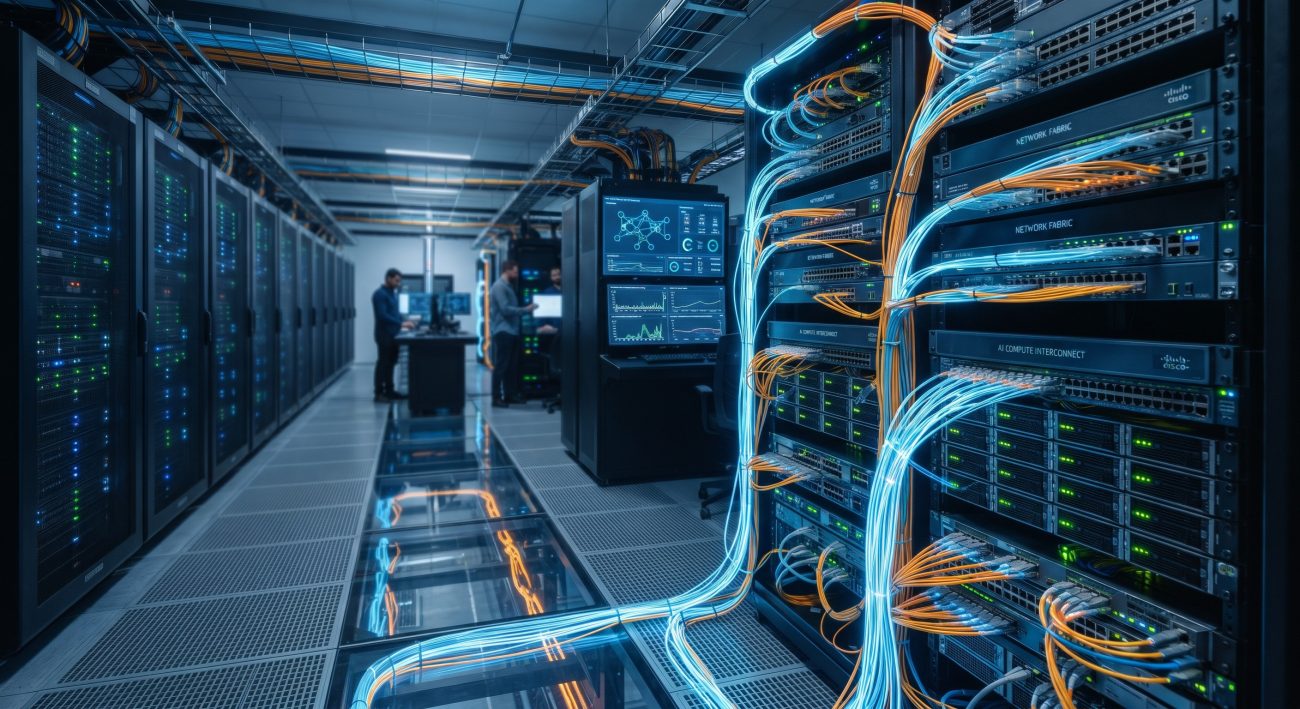
Ultra-Low Latency Demands: Why Tail Latency Defines AI Cluster Economics
In synchronized distributed training and inference workloads, the completion time of a collective operation is dictated not by the average packet, but by the slowest packet in the fabric. This straggler effect transforms tail latency from a secondary QoS metric into a first-order determinant of GPU utilization and job completion time (JCT). Industry data indicates that network congestion accounts for 35% to 42% of wasted cycles in clusters exceeding 16,000 GPUs, with a mere 0.1% packet loss capable of slashing GPU utilization by 13% . For a 70B-parameter model operating under FP8 precision on a single H100 GPU, the theoretical per-token latency floor is approximately 21 ms before any interconnect cost is introduced, underscoring how fabric-level delays compound directly into serving economics .
This analysis examines the packet pipeline mechanics that govern tail latency determinism in high-bandwidth AI compute networks, benchmarking architectural approaches against measurable metrics including P99/P99.9 latency, buffer behavior under incast, and the efficacy of modern congestion control mechanisms.
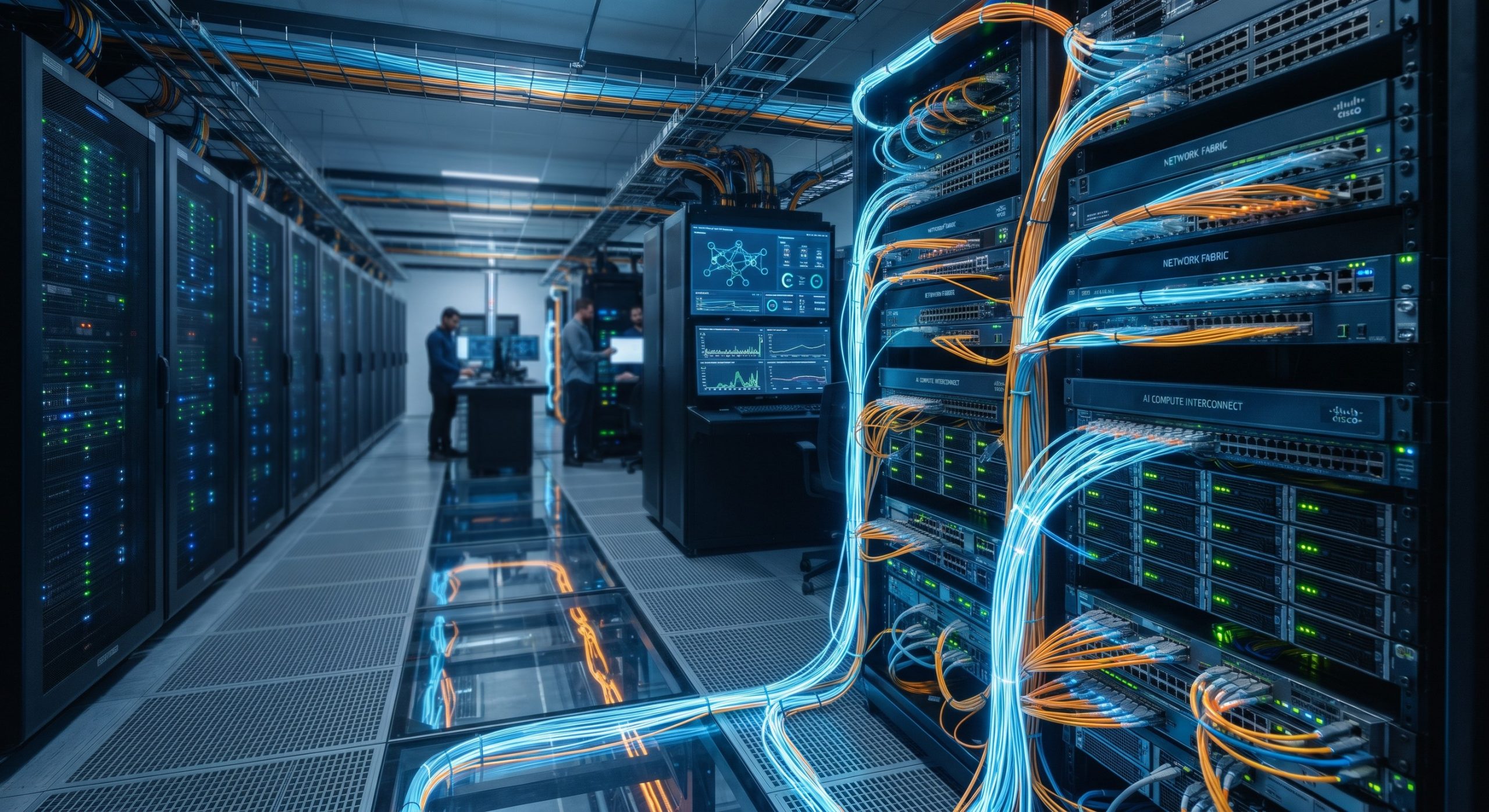
ASIC Packet Forwarding Pipeline: Where Microseconds Are Won or Lost
Switch Silicon Architecture and Buffer Dynamics
The packet forwarding pipeline in modern AI fabric ASICs comprises three latency-critical stages: ingress parsing and lookup, buffer queuing and scheduling, and egress transmission. In conventional store-and-forward switching, the entire packet must be received before forwarding begins, introducing latency proportional to packet size. Cut-through switching reduces this to the time required to read the destination address, but the critical bottleneck under AI workloads is buffer occupancy under incast.
When multiple GPUs simultaneously transmit gradients to a single receiver in an AllReduce operation, the resulting many-to-one traffic pattern can overflow switch buffers within microseconds. Traditional Priority-based Flow Control (PFC) reacts to static thresholds, triggering pause frames that propagate congestion throughout the fabric and create head-of-line blocking . Broadcom’s Tomahawk Ultra addresses this through Credit-Based Flow Control (CBFC) combined with Link Layer Retry (LLR), achieving approximately 250 ns switching latency for intra-rack scale-up fabrics . The Thor Ultra NIC complements this with enhanced RoCE (eRoCE), enabling out-of-order packet placement directly into GPU memory and eliminating the retransmission penalties inherent to in-order delivery requirements .
Congestion Control: DCQCN vs. Hardware-Native Approaches
For RoCEv2-based fabrics, DCQCN (Data Center Quantized Congestion Notification) remains the dominant congestion control algorithm, relying on ECN marking and rate reduction at endpoints. However, empirical studies at 16,384 GPU scale reveal that RoCEv2 with PFC and DCQCN experiences catastrophic incast buffer collapse under synchronized AllReduce, with model FLOPs utilization (MFU) degrading from 51.4% to 34.2% due to cascading pause frame storms . InfiniBand NDR, by contrast, leverages hardware-native credit-based flow control and SHARPv3 in-network reduction, cutting collective packet volumes by 50% and sustaining 52.8% MFU . The emerging Ultra Ethernet Consortium (UEC) specification attempts to bridge this gap through packet spraying across all available paths, selective retransmission, and packet trimming with hardware SACK—mechanisms designed to preserve Ethernet’s operational familiarity while delivering deterministic tail behavior .
| Key Parameter | Technical Specification |
|---|---|
| Switching Capacity (Tomahawk 6) | 102.4 Tbps |
| Scale-Up Latency (Tomahawk Ultra + CBFC/LLR) | ~250 ns |
| NIC Throughput (Thor Ultra) | 800 Gbps (2×400G / 1×800G) |
| Congestion Control Mechanisms | PFC, DCQCN, packet spraying, packet trimming |
| Tail Latency Target (Inference) | |
| GPU Utilization Loss at 0.1% Packet Loss | 13% reduction |
| MFU: InfiniBand NDR vs. RoCEv2 (16K GPUs) | 52.8% vs. 34.2% |
Traffic Shaping and Topology Considerations for Deterministic Tail Latency
Incast Mitigation Through Packet Spraying
Equal-Cost Multi-Path (ECMP) hashing, the default load-balancing mechanism in most leaf-spine fabrics, suffers from hash polarization under the elephant flows characteristic of AI workloads. When multiple large flows collide onto the same uplink, the resulting congestion concentrates at specific spine ports, driving tail latency spikes that propagate to all participants in the collective. Packet spraying—splitting each flow into fine-grained chunks distributed across all available paths—eliminates this polarization but requires out-of-order reassembly at the destination NIC. Broadcom’s Thor Ultra implements this in hardware, while the UEC specification formalizes the transport semantics for multi-vendor interoperability .
Google’s Virgo fabric offers a complementary approach: replacing three-tier Clos topologies with a two-layer flattened architecture that reduces hop count and limits cumulative queuing probability at intermediate stages. At scales exceeding 100,000 accelerators, Virgo employs multiple independent switching planes with deep telemetry to detect and reroute around congestion without disrupting synchronized workloads .
Buffer Sizing and Microburst Absorption
AI traffic patterns produce microbursts—short-duration traffic spikes that can exceed average link utilization by orders of magnitude. Insufficient buffer allocation at ToR switches leads to packet drops that trigger go-back-N retransmissions under RoCEv2, adding milliseconds of recovery latency to operations measured in microseconds. Deep-buffer switch ASICs such as Broadcom’s Jericho 4 incorporate HBM packet buffers with virtual output queuing (VOQ) to absorb incast bursts without dropping, making them suitable for inter-pod aggregation where traffic aggregation ratios are highest . The trade-off is increased power and cost relative to shallow-buffer Tomahawk-class silicon, reinforcing the need for tiered fabric design matched to workload phase characteristics.
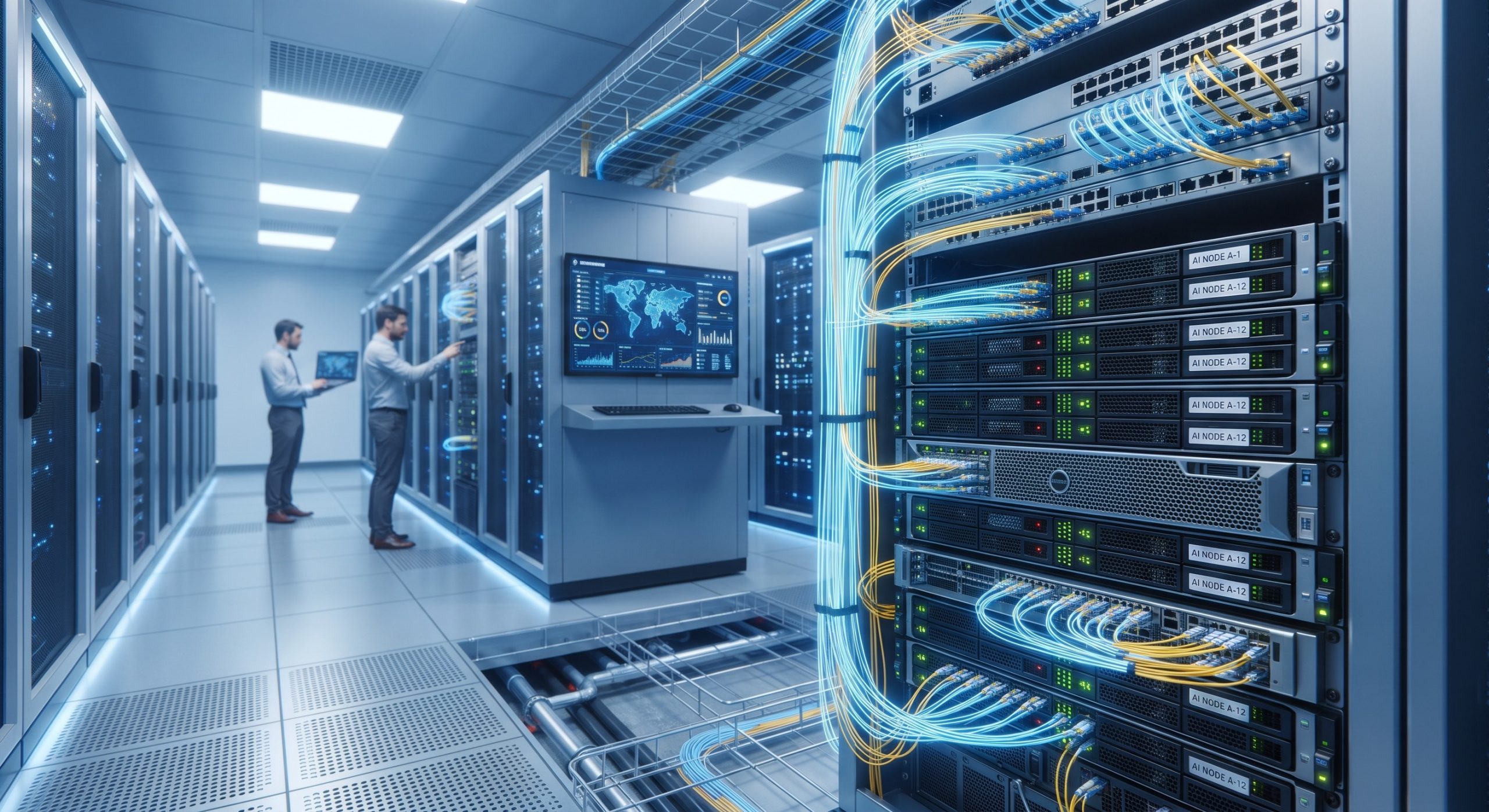
Benchmarking Methodology: Metrics That Matter for AI Fabrics
Validating tail latency claims requires test instrumentation that emulates collective communication primitives at wire rate, not just single-flow throughput. Modern test platforms measure JCT (Job Completion Time) distributions under AllReduce, AllGather, and All-to-All patterns, reporting P95, P99, and P99.9 latency alongside out-of-sequence packet counts and buffer occupancy histograms . For inference workloads, Time-to-First-Token (TTFT) and per-token latency under concurrent load provide the relevant SLO-aligned metrics .
Organizations evaluating fabric upgrades should demand benchmark data that reflects their specific parallelism strategy (tensor, pipeline, or data parallel) and model architecture, as MoE All-to-All traffic exhibits fundamentally different congestion signatures than dense model AllReduce . Without workload-matched validation, reported latency figures may mask tail pathologies that emerge only under production communication patterns.
Verdict: Architectural Alignment Determines Tail Latency Outcomes
The packet pipeline evidence supports a clear conclusion: tail latency in AI compute networks is an architectural property, not a tunable parameter. InfiniBand NDR retains measurable advantages in latency determinism for tightly coupled training at scale, with hardware credit-based flow control and in-network reduction delivering MFU improvements that amortize the protocol premium within 8.4 months of continuous operation . However, Ethernet-based fabrics with packet spraying, CBFC, and out-of-order placement are closing the gap for workloads where vendor diversity and operational integration outweigh raw latency determinism .
For network architects specifying high-bandwidth AI compute infrastructure, the decision framework should prioritize: (1) workload communication profile (AllReduce-heavy vs. All-to-All-heavy), (2) scale trajectory and topology constraints, (3) measured P99.9 latency under production-equivalent collective patterns, and (4) total cost of ownership inclusive of GPU idle time at target MFU. Tail latency benchmarks that ignore any of these dimensions produce incomplete guidance for capital allocation decisions measured in millions of dollars.
Leave a comment