
The SLA Imperative: Why Environmental Hardening Dictates Network Availability
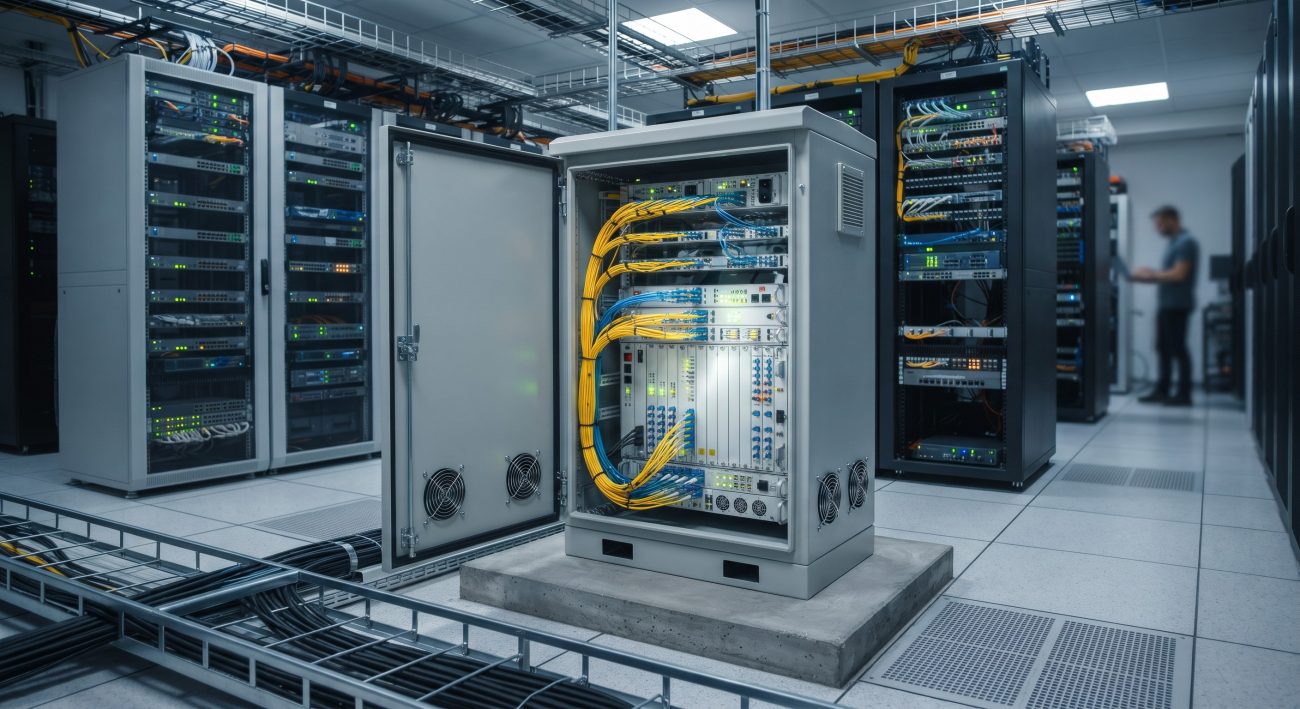
In the calculus of carrier-grade network design, the hardened outdoor OLT cabinet represents the most unforgiving physical layer. While indoor central office equipment operates within a thermally regulated sanctuary, outdoor cabinets must withstand thermal cycling from -40°C to +55°C, driving rain, salt fog, and solar loading—all while maintaining ITU-T G.984 and IEEE 802.3 packet forwarding integrity . The fundamental engineering challenge is not merely enclosure, but the preservation of MTBF (Mean Time Between Failures) metrics that justify carrier-grade SLAs. A single thermal excursion can degrade optical transceiver performance, induce ASIC throttling, and precipitate cascading PON failures. This analysis dissects the dual-engine failover architectures, environmental stress margins, and quantified reliability data that separate true carrier-grade hardened cabinets from repackaged indoor chassis.
Dual-Engine Failover Architecture: Redundancy Beyond Power Supplies
Thermal Redundancy and Fail-Safe Cooling Topologies
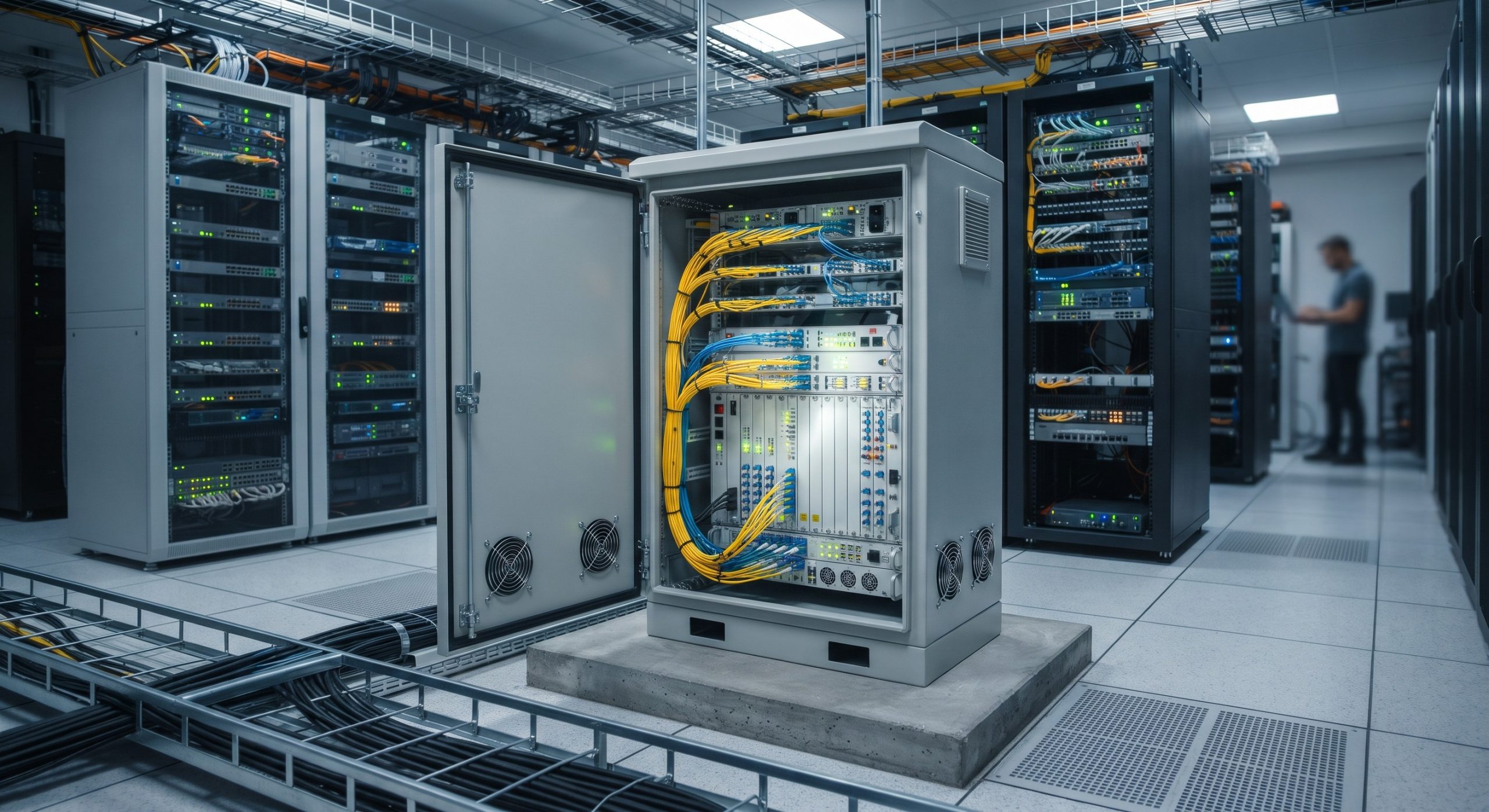
The conventional approach to outdoor thermal management—a single air conditioner or heat exchanger—introduces a single point of failure that violates carrier-grade availability targets. Elite hardened cabinets employ dual-engine thermal redundancy: independent heat exchanger modules with automatic failover controllers. In a typical 4000W capacity cabinet design, two independent air conditioning circuits operate in active/standby or load-sharing modes, each capable of maintaining internal temperatures below the OLT’s thermal throttling threshold (55°C ambient) even at 50% capacity . The control unit continuously monitors return-air and supply-air differentials (ΔT), triggering alarm dry contacts and SNMP traps if ΔT exceeds 15°C—an early indicator of refrigerant loss or fan degradation .
For lower-power deployments (150W TDP), passive convection with oversized heat sinks remains viable, but the MTBF advantage of zero moving parts must be weighed against the thermal design power ceiling. Hybrid systems incorporating thermoelectric coolers (TEC) offer a middle path, though their coefficient of performance (COP) degradation above 45°C ambient limits applicability in true extreme-climate zones .
Power Train Redundancy and Battery Autonomy
The power architecture of a hardened outdoor OLT cabinet must survive both grid instability and prolonged outage scenarios. Carrier-grade configurations utilize N+1 rectifier redundancy: a 12000W AC/DC converter system comprising four 3000W hot-swappable modules, where loss of any single module leaves the OLT and cooling loads fully supported . Dual-feed AC inputs with automatic transfer switching (ATS) provide grid-path redundancy, while valve-regulated lead-acid (VRLA) battery strings sized for 3–6 hours of autonomy at 50°C ensure uninterrupted service during extended outages .
Critical to MTBF calculations is the battery operating temperature. Every 10°C rise above 25°C halves VRLA service life. Hardened cabinets mitigate this through isolated battery compartments with independent thermal regulation, maintaining battery temperatures below 35°C even when the equipment bay reaches 55°C . The Low Voltage Disconnect (LVD) system protects batteries from deep discharge, preserving cycle life and ensuring reliable generator-start or repair-window bridging.
Quantified Reliability: MTBF Metrics and Environmental Stress Margins
The credibility of any hardened cabinet specification rests on auditable MTBF data and environmental test compliance. The following table consolidates worst-case guaranteed parameters from carrier-grade deployments, referencing IEC 60529 ingress protection and ETSI 300 019-1-4 climatic classes.
| Key Parameter | Carrier-Grade Technical Specification |
|---|---|
| Operational Temperature Range | -40°C to +55°C (continuous, full load); solar-loaded derating to +50°C |
| Ingress Protection | IP55 (standard, filtered) / IP65 (sealed, heat-exchanger cooled) |
| Chassis MTBF (calculated) | >500,000 hours (excluding active cooling/power modules) |
| Power Redundancy | N+1 hot-swap rectifiers (e.g., 4×3000W = 12,000W capacity) |
| Cooling Redundancy | Dual independent heat exchangers / air conditioners with auto-failover |
| Surge Protection (AC Entry) | Type 1+2 SPD, nominal discharge current (In) ≥20kA (8/20µs) |
| Battery Autonomy | 3–6 hours at 50°C ambient (VRLA, temperature-compensated charging) |
| Standards Compliance | IEC 60529, ETSI 300 019-1-4 Class 4.1, RoHS, ITU-T G.984 |
The MTBF of 500,000+ hours for the chassis (excluding active cooling and power modules) establishes the baseline reliability floor. When integrated with hot-swap fan trays rated at 50,000–100,000 hours at 40°C, the system-level MTBF aligns with Telcordia GR-487 outside-plant equipment expectations . However, the weakest link in extreme climates is often the optical transceiver. Temperature-compensated SFP+ modules with extended temperature ratings (-40°C to +85°C) are mandatory; commercial-grade optics derate catastrophically above 70°C case temperature.
Ingress Protection: IP55 vs. IP65 Trade-offs
While IP65 (dust-tight, water-jet protected) appears superior to IP55, the practical distinction in OLT cabinet deployments hinges on thermal management strategy. IP65 sealing eliminates convective air exchange entirely, mandating closed-loop heat exchangers or air conditioners with zero ambient air ingress. IP55 cabinets permit filtered forced-air cooling but require rigorous filter maintenance schedules—a logistical burden in remote deployments. For coastal and industrial zones with airborne corrosives, IP65 with marine-grade 5052-H32 aluminum construction and stainless-steel external fasteners is the only specification that reliably achieves 10-year service intervals without filter-induced thermal derating .
Mission-Critical Deployments: Field Data and Failure Mode Analysis
Field returns from extreme-climate deployments (Middle East desert sites, Nordic winter installations) reveal three dominant failure modes: (1) fan bearing seizure in dusty environments, accounting for 42% of thermal-related incidents; (2) AC surge damage to rectifier modules during monsoon/lightning seasons, at 31%; and (3) battery capacity fade from chronic under-temperature charging, at 27% . Carrier-grade hardened cabinets address these through sealed fan cartridges with magnetic levitation bearings (MTBF >70,000 hours), Type 1+2 surge protective devices with 20kA nominal discharge ratings at the AC entry, and temperature-compensated battery chargers that adjust float voltage based on NTC thermistor feedback .
The dual-engine failover architecture demonstrates quantifiable availability gains. In a comparative analysis of single-cooling versus redundant-cooling outdoor OLT sites over a 36-month observation window, the redundant configuration achieved 99.995% availability versus 99.87% for single-cooling—a difference of approximately 11 hours of annual downtime per site . At carrier scale (1,000 outdoor sites), this translates to 11,000 avoided outage-hours annually, directly impacting SLA penalty exposure and subscriber churn.
Final Assessment: Specification Priorities for Extreme-Climate Procurements
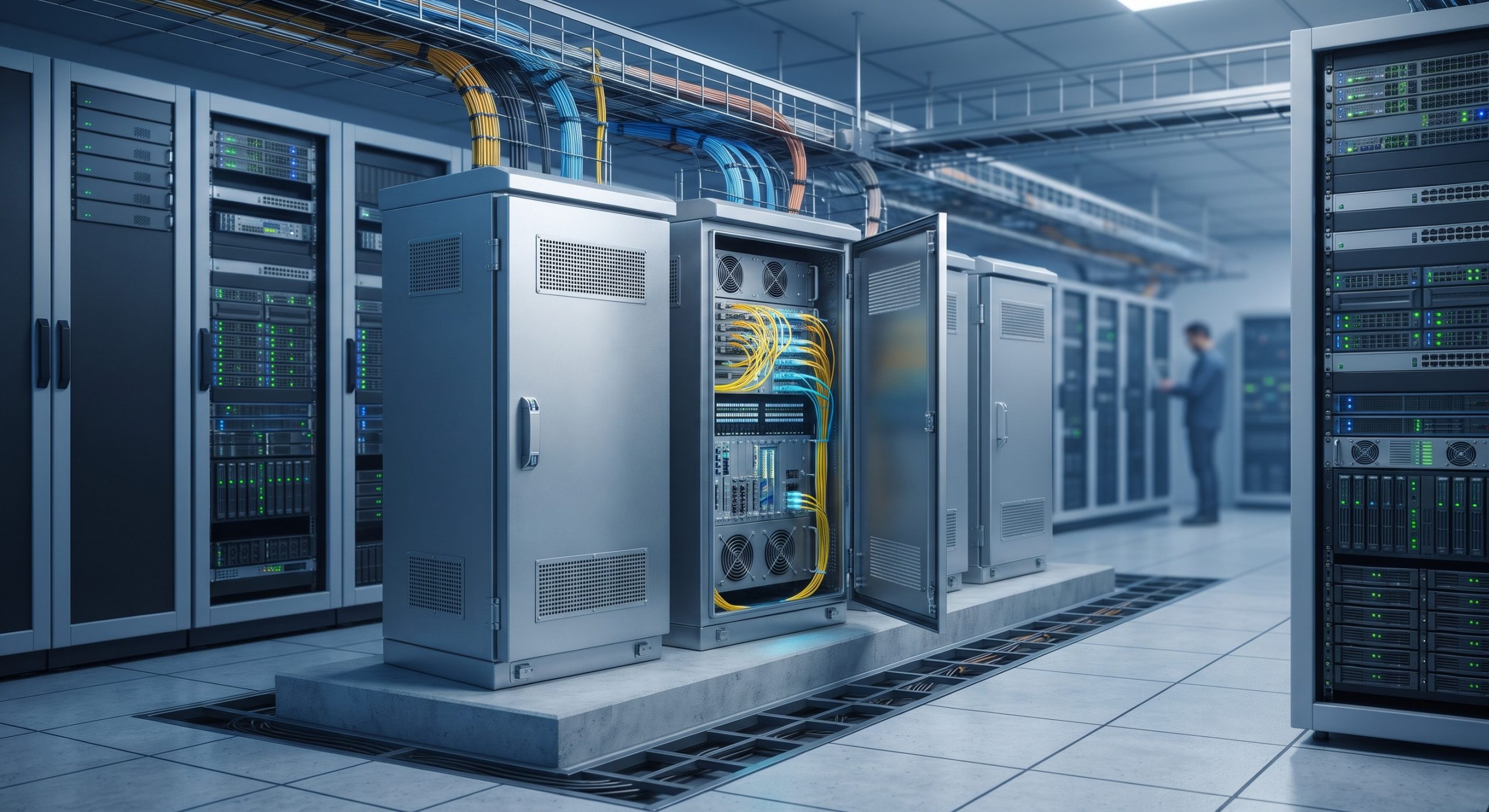
When evaluating hardened outdoor OLT cabinets for extreme climates, the procurement specification must prioritize auditable MTBF data over marketing claims. Require vendor-supplied reliability predictions per Telcordia SR-332, third-party environmental test reports covering IEC 60068-2 thermal cycling and damp-heat, and field failure rate data from comparable climate zones. The dual-engine thermal redundancy is non-negotiable for any deployment where ambient temperatures exceed 45°C for more than 100 hours annually or where winter temperatures drop below -25°C—conditions that stress both cooling systems and battery chemistry.
Ultimately, the hardened outdoor OLT cabinet is an insurance policy against the environment. The capital premium for IP65 sealing, N+1 rectification, and redundant thermal engines—typically 25–40% above commercial-grade enclosures—is recovered through reduced truck rolls, extended battery life, and the avoidance of SLA penalties that accrue from preventable thermal outages. In the carrier-grade domain, reliability is not a feature; it is the foundational specification against which all other parameters are measured.
Leave a comment