
In an era where connectivity fuels innovation, the notion of a “perfect network” is both aspirational and elusive. Yet, enterprises that master the balance of scalability, security, and simplicity unlock transformative outcomes—from seamless hybrid work to AI-driven operations. The truth is, there’s no universal blueprint. A flawless network for a smart factory differs wildly from one powering a fintech startup. However, core principles transcend industries. By dissecting real-world successes (and costly failures), we’ll uncover how to tailor network architectures to your unique demands while dodging the traps that derail even seasoned engineers.
Principle 1: Modular Design for Future-Proofing
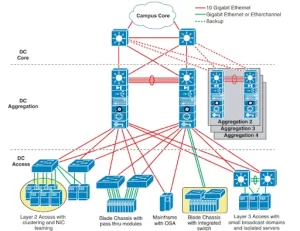
Networks that thrive share a common trait: modularity. This means segmenting functions into discrete, interoperable blocks.
Example: A Hospital’s Life-Saving Fabric
- Challenge: A Level 1 trauma center’s network collapsed under IoT device sprawl (patient monitors, smart pumps).
- Solution:
- Core Layer: Cisco Catalyst 9500 switches for 40G spine-leaf topology.
- Distribution Layer: Aruba 8400 switches isolating clinical vs. guest traffic.
- Access Layer: Juniper Mist APs with dynamic VLAN assignment for BYOD devices.
- Result: 99.999% uptime for EHR systems and 60% faster patient data retrieval.
Principle 2: Security as the Foundation, Not an Add-On
Zero Trust isn’t a buzzword—it’s a survival tactic.
Example: Retail’s PCI-DSS Nightmare
- Mistake: A national chain bolted-on firewalls after a breach, creating policy conflicts.
- Fix:
- Microsegmentation: Palo Alto PA-3400 series enforced VLAN-level isolation for POS systems.
- Encryption Everywhere: MACsec on Aruba 2930F switches for in-store traffic.
- Continuous Validation: Cisco ISE authenticated every device (even HVAC controllers).
- Outcome: Passed PCI 4.0 audit with no exceptions and reduced breach response time by 83%.
Principle 3: Performance Metrics That Matter
Forget “uptime” alone. Modern networks demand:
- Jitter: <1ms for VoIP/UC (e.g., Zoom, Teams).
- Packet Loss: <0.1% for real-time analytics.
- Convergence: Sub-second failover during outages.
Example: Trading Floor’s Latency War
- Problem: High-frequency traders lost millions due to 2ms latency spikes.
- Fix:
- Arista 7280R switches with 750ns port-to-port latency.
- PTPv2 Precision Timing: Synced clocks across NYSE and LSE data centers.
- Forensic Analytics: ThousandEyes mapped ISP bottlenecks in real time.
- ROI: $9M annual profit gain from arbitrage opportunities.
Principle 4: Scalability Without Complexity
Growth shouldn’t cripple operations.
Example: Cloud Startup’s Scaling Trap
- Blunder: Over-provisioned AWS Direct Connect links, burning $300K monthly.
- Solution:
- SD-WAN Orchestration: VMware Velocloud dynamically routed traffic via 5G/LTE during peak SaaS usage.
- Auto-Scaling Fabrics: Cisco ACI expanded spine nodes based on Kubernetes pod demand.
- Cost Analytics: AppNeta flagged underused Azure ExpressRoute circuits.
- Savings: 40% lower cloud bills while handling 500% user growth.
Principle 5: Observability That Drives Action
Telemetry is useless without actionable insights.
Toolkit for Clarity:
- Flow Analysis: Kentik detects East-West anomalies (e.g., lateral ransomware movement).
- Wi-Fi Heatmaps: Ekahau pinpoints dead zones in warehouses.
- API Integrations: ServiceNow auto-tickets switch failures via Cisco DNA Center.
Case: Manufacturing’s Predictive Win
- Breakthrough: Deployed Splunk + Cisco Tetration to predict switch failures via ML.
- Impact: Cut unplanned downtime by 92% and extended hardware lifecycles by 3 years.
The Myth of Perfection: When Good Enough Wins
Chasing the 100% uptime unicorn often backfires. A major bank learned this after a $2M failed attempt to eliminate all SPOFs (Single Points of Failure). The fix? Accept 99.99% uptime, redirect funds to AI-powered threat hunting. Sometimes, “perfect” is the enemy of resilient.







Leave a comment