
In the relentless pursuit of network agility, enterprises have long viewed Cisco’s Application Centric Infrastructure (ACI) as the default path for Nexus 9000 Series switches. But what if ACI isn’t the only—or even the optimal—choice for modern hybrid cloud, edge computing, or cost-conscious deployments? A paradigm shift is underway as organizations rediscover the Nexus 9000’s versatility beyond ACI, leveraging open standards, streamlined automation, and cloud-native integrations to build adaptive networks without the complexity of full-stack SDN. Let’s explore how reimagining the Nexus 9000 as a multi-role platform can unlock unprecedented flexibility for businesses navigating diverse operational demands.
The ACI Conundrum: When One Size Doesn’t Fit All
While ACI excels in large-scale data centers with strict policy enforcement needs, its limitations become apparent in scenarios requiring:
- Multi-Cloud Simplicity: Native integration with AWS/Azure without complex APIC extensions.
- Edge Economics: Cost-effective operations for micro-data centers or IoT gateways.
- DevOps-Driven Networks: Infrastructure-as-Code (IaC) workflows without ACI’s learning curve.
Enterprises are now pairing Nexus 9000 switches with alternative orchestration tools, proving that “ACI or nothing” is a false dichotomy.
The Nexus 9000 Renaissance: Three Non-ACI Architectures Gaining Traction
1. Cloud-Native Fabrics with Kubernetes
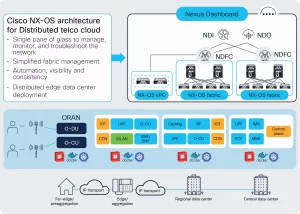
- Nexus Dashboard Integration: Deploy switches as Kubernetes nodes using Cisco’s Nexus Dashboard Fabric Controller (NDFC), enabling declarative provisioning via YAML.
- Calico and Cilium Support: Replace ACI’s EPG with cloud-native CNI plugins for microsegmentation.
- Stateless Automation: Manage configurations via GitOps, syncing with platforms like ArgoCD or Jenkins.
A fintech startup reduced deployment cycles by 70% by running Nexus 9300s as Kubernetes edge nodes, bypassing ACI for Terraform-driven automation.
2. EVPN-VXLAN Simplicity
- MP-BGP EVPN: Build layer-3 leaf-spine fabrics without ACI’s policy model, using open standards.
- Interoperability: Seamlessly connect to non-Cisco switches (Juniper, Arista) via EVPN.
- Telemetry: Stream metrics to Prometheus/Grafana stacks instead of ACI’s telemetry suite.
A manufacturing giant migrated from ACI to EVPN-VXLAN on Nexus 9200s, cutting fabric provisioning time from 4 hours to 15 minutes.
3. Cost-Optimized Hybrid Cloud
- CloudSec with MACsec: Encrypt data in transit to AWS/Azure without ACI’s Cloud APIC overhead.
- AWS Transit Gateway Integration: Use Nexus 9000 as on-prem anchor for VPC attachments.
- Ansible-Driven Multi-Cloud: Replace ACI’s complex REST API with Ansible’s unified modules.
A healthcare provider slashed cloud interconnect costs by 40% using Nexus 9508s as Ansible-managed hybrid gateways.
Feature Face-Off: ACI vs. Alternative Architectures
| Capability | ACI with Nexus 9000 | EVPN/Kubernetes on Nexus 9000 |
|---|---|---|
| Deployment Speed | 6–12 months (full fabric) | 2–4 weeks (per site) |
| Skill Requirements | ACI-specific expertise | Generic networking/DevOps skills |
| Multi-Vendor Support | Limited (Cisco-only) | Full (EVPN standard) |
| OpEx (Year 1) | $250K (APIC, licenses) | $80K (open-source tools, Nexus OS) |
| Policy Granularity | Application-centric (EPG) | Tag-based (VLAN/VXLAN) |
Real-World Migration Scenarios
1. Retail Chain’s Edge Evolution
- Challenge: 500 stores using ACI struggled with slow IoT device onboarding and high licensing costs.
- Solution: Deployed Nexus 9200s in NX-OS mode with EVPN-VXLAN and Cisco DNA Center.
- Result: Reduced per-store OpEx by 55% and cut IoT deployment time from 3 days to 4 hours.
2. SaaS Provider’s Cloud Leap
- Challenge: ACI’s rigidity slowed integration with Kubernetes-based SaaS platforms.
- Solution: Retired APIC, adopted Nexus Dashboard + Calico for Kubernetes-aware networking.
- Result: Achieved 5-second service scaling (vs. 30+ minutes under ACI) and 99.999% uptime.
3. Government Agency’ Compliance Shift
- Challenge: ACI’s closed model conflicted with FedRAMP’s multi-vendor requirements.
- Solution: Migrated to EVPN-VXLAN with Nexus 9300-FX and Fortinet firewalls.
- Result: Passed FedRAMP audit while improving threat detection speed by 8x.
The Strategic Choice: When to Ditch ACI (and When to Keep It)
Stick with ACI if:
- Your team has deep ACI expertise and no multi-vendor requirements.
- You need end-to-end application dependency mapping (ADM).
- Compliance mandates require ACI’s centralized policy engine.
Choose Alternatives if:
- Your network spans multiple clouds/edge sites.
- DevOps teams demand GitOps/IaC workflows.
- Budget constraints prohibit APIC licenses and training.
Future-Proofing with Cisco’s Open Ecosystem
Cisco’s recent moves signal support for non-ACI Nexus 9000 use cases:
- Nexus Dashboard Fabric Controller: Free for Nexus 9000 owners, offering ACI-like automation without APIC.
- SaaS-Delivered NX-OS: Manage switches via cloud without on-prem controllers.
- Silicon One Integration: Future-proof with 400G/800G line cards compatible with both ACI and open EVPN.





Leave a comment