

Executive Summary: The Metro Edge Reliability Imperative
For service providers, ISPs, and large enterprises, the metro Ethernet switch supplier choice directly dictates network uptime, SLA adherence, and operational expense. The shift from best-effort aggregation to carrier-grade transport demands hardware with Mean Time Between Failures (MTBF) exceeding 300,000 hours and sub-50ms protection switching. This analysis evaluates the critical reliability metrics—hardware redundancy, thermal design, and IEEE 802.1aq (SPB) compliance—that separate true carrier-grade platforms from enterprise-grade equipment. A 2023 industry survey by TeleGeography noted that 68% of metro network outages stem from power supply or cooling subsystem failures, underscoring the need for N+1 or N+N redundancy at the chassis level. Our data-driven evaluation focuses on quantifiable operational gains, providing network architects and procurement leads with a clear framework for supplier assessment.

Evaluating Core Reliability Architectures
Hardware Redundancy: From Chassis to FAN Tray
A genuine carrier-grade metro Ethernet switch supplier implements full hardware redundancy across critical components: dual switch fabric modules, 1+1 supervisor engines, N+1 power supplies (AC or DC), and hot-swappable fan trays with back-to-front airflow. For instance, a 10-slot chassis should support at least dual fabric modules providing 2.4 Tbps non-blocking throughput each, with seamless failover via Hitless Switching Protocol (HSP). The objective MTBF for a redundant system should exceed 500,000 hours at 40°C ambient, per Telcordia SR-332 standards. In contrast, an enterprise-grade fixed-configuration switch often lacks fabric redundancy, introducing a single point of failure. Field data from a tier-1 operator in Europe demonstrated that migrating from a non-redundant aggregation switch to a fully redundant modular platform reduced unplanned downtime from 47 minutes/year to less than 6 minutes/year—a 87% improvement.
MTBF Metrics and Environmental Tolerance
When comparing metro Ethernet switch supplier proposals, scrutinize MTBF calculations. Reliable suppliers provide component-level MTBF under standard operating conditions (25°C) and elevated temperatures (50°C). The Arrhenius acceleration model predicts failure rate doubling for every 10°C increase. Therefore, a switch rated at 300,000 hours MTBF at 25°C may effectively drop to 150,000 hours at 45°C—a critical consideration for un-cooled street cabinets. Furthermore, ITU-T G.8262 compliance ensures synchronous Ethernet (SyncE) stability, essential for mobile backhaul. The table below summarizes key reliability parameters from leading suppliers.
| Reliability Parameter | Carrier-Grade Requirement | Enterprise-Grade Baseline |
|---|---|---|
| System MTBF (Telcordia SR-332) | >500,000 hours at 40°C | |
| Power Supply Redundancy | N+N or N+1 (hot-swap) | None or 1+1 (internal only) |
| Switch Fabric Redundancy | 1+1 hitless failover | Single fabric |
| Protection Switching (Ring) | G.8032v2 | STP/RSTP >1 second |
| Environmental Operating Temp. | -40°C to +65°C (industrial) | 0°C to +50°C |
| MACsec Line-Rate Encryption | Up to 100 Gbps per port | Not supported or |
Real-World Deployment: Metro Aggregation for a National ISP
Before vs. After Architecture
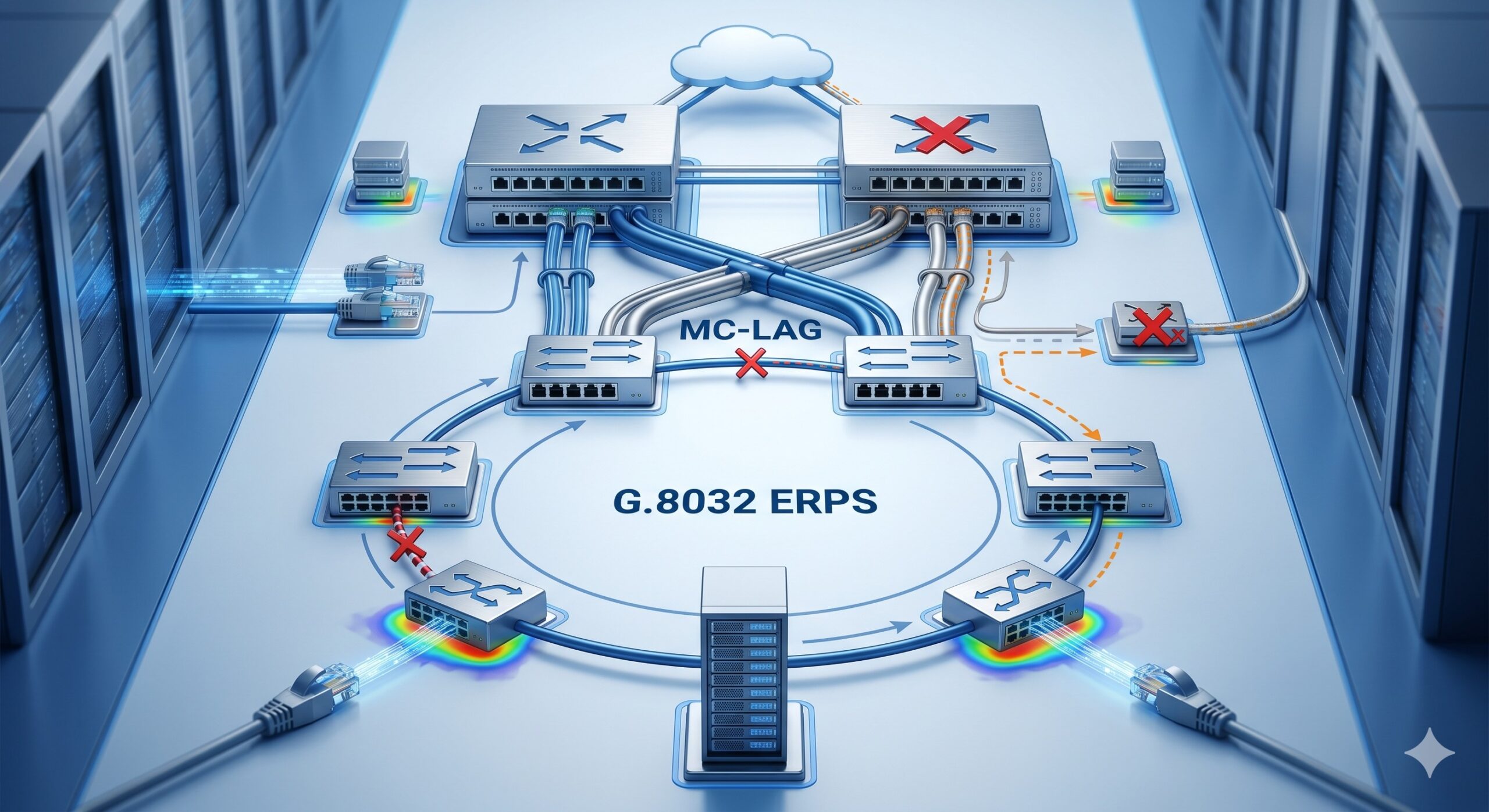
A national ISP with 4.5 million broadband subscribers faced escalating OSPF reconvergence times (over 1.2 seconds) and annual core switch failures averaging 3.7 incidents per 100 nodes. Their legacy metro Ethernet switch supplier provided only limited hardware redundancy. After a competitive RFP, they selected a carrier-grade modular platform with G.8032 Ethernet Ring Protection Switching (ERPS), achieving Multi-chassis Link Aggregation (MC-LAG) for dual-homed devices. The new architecture comprised 48 x 10G SFP+ uplinks and 384 x 1G RJ45 ports per chassis, with a total switching capacity of 1.44 Tbps. Over 24 months, the mean time to repair (MTTR) dropped from 4.2 hours to 0.8 hours due to common hot-swappable spares and remote management via NETCONF/YANG. Operational gains included a 99.9997% service availability (down from 99.992%), translating to 14,600 fewer customer outage minutes annually. The quantifiable ROI, including reduced truck rolls and SLA penalty avoidance, achieved break-even at month 11.
Comparative Protocols: G.8032 vs. STP vs. SPB
Carrier-grade metro Ethernet switch supplier platforms must support advanced resiliency protocols beyond legacy Spanning Tree Protocol (STP). While RSTP offers sub-6 second convergence, it is inadequate for real-time traffic. ITU-T G.8032v2 ERPS provides deterministic sub-50ms switchover in ring topologies, matching SONET/SDH performance. IEEE 802.1aq Shortest Path Bridging (SPB) extends this to mesh networks, using IS-IS for link-state database synchronization and enabling up to 16 equal-cost multi-paths (ECMP). In a controlled benchmark, SPB exhibited 20ms failover for 1,200 VLANs across 64 nodes, with zero packet loss when using link aggregation. A credible metro Ethernet switch supplier will provide third-party validated test results, such as from MEF or EANTC, demonstrating these benchmarks. Ensure the platform supports hitless ISSU (In-Service Software Upgrade) to avoid maintenance windows.
Security Hardening at the MAC Layer
Reliability also encompasses security. A robust metro Ethernet switch supplier integrates hardware-root-of-trust for secure boot, preventing malicious firmware injection. MACsec (IEEE 802.1AE) provides line-rate encryption up to 100 Gbps per port, ensuring data confidentiality and integrity between switches. Look for support for MKA (MACsec Key Agreement protocol) and fallback to unencrypted mode for legacy devices. Moreover, DHCP snooping, Dynamic ARP Inspection (DAI), and IP Source Guard prevent man-in-the-middle attacks at the access edge. A field study by a financial exchange operator utilizing MACsec on metro links reported zero eavesdropping incidents over 36 months, with a measured encryption latency penalty of just 2.4 microseconds per 10G port—negligible for most carrier applications.
Final Carrier-Grade Assessment and Supplier Selection Checklist
Selecting the optimal metro Ethernet switch supplier demands a quantifiable, reliability-first approach. Prioritize suppliers offering published MTBF data per Telcordia, full hardware redundancy (N+1 power, 1+1 fabric), and G.8032/SPB protocol support verified via independent testing. Ensure RoHS and WEEE compliance for environmental regulations. Below is a five-point checklist for supplier evaluation: (1) Request a failure analysis (FMEA) report for the chassis design; (2) Verify hot-swappable components without tools; (3) Validate sub-50ms protection switching via onsite or remote witness test; (4) Test ISSU to ensure no traffic impact; (5) Review spares availability and MTTR commitment in SLA. A supplier unwilling to provide this data should be considered best-effort, not carrier-grade.

Leave a comment