
Introduction: The Imperative of Carrier-Grade Reliability in Access Networks
In the demanding landscape of telecom infrastructure, the upgrade of an Optical Line Terminal (OLT) is not merely a routine maintenance task; it is a critical operation that directly impacts service availability, revenue, and subscriber satisfaction. For the Huawei SmartAX MA5600T, a platform synonymous with high-density GPON, 10GPON, and Ethernet P2P access, an upgrade must be executed with surgical precision to maintain the carrier-grade reliability it is renowned for . This guide provides a deep technical dive into the MA5600T upgrade process, focusing on the architectures and best practices that ensure high availability, data integrity, and robust security, aligning with rigorous industry standards such as IEEE 802.3, ITU-T G.984, and RoHS directives .
We will dissect the upgrade methodologies, from common upgrades with service interruption to hitless upgrades, examining their impact on Mean Time Between Failures (MTBF) and network resilience.
MA5600T Core Architecture: Redundancy and High Availability
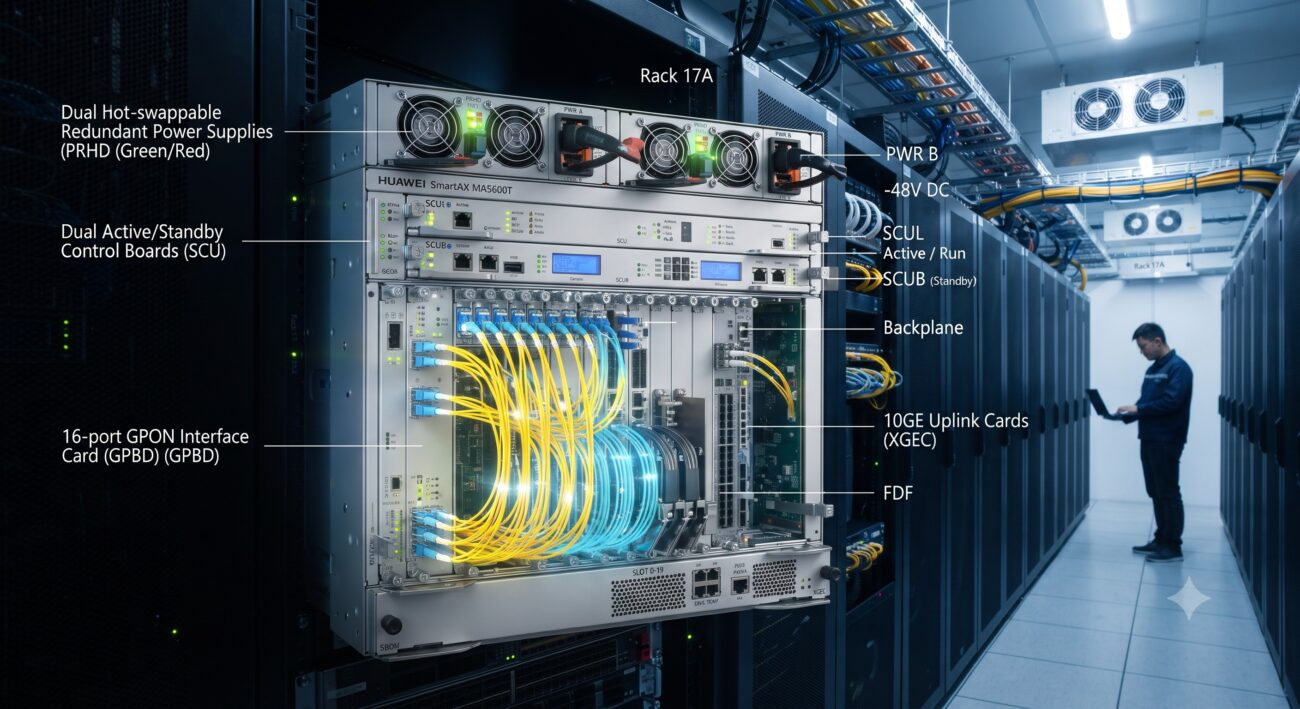
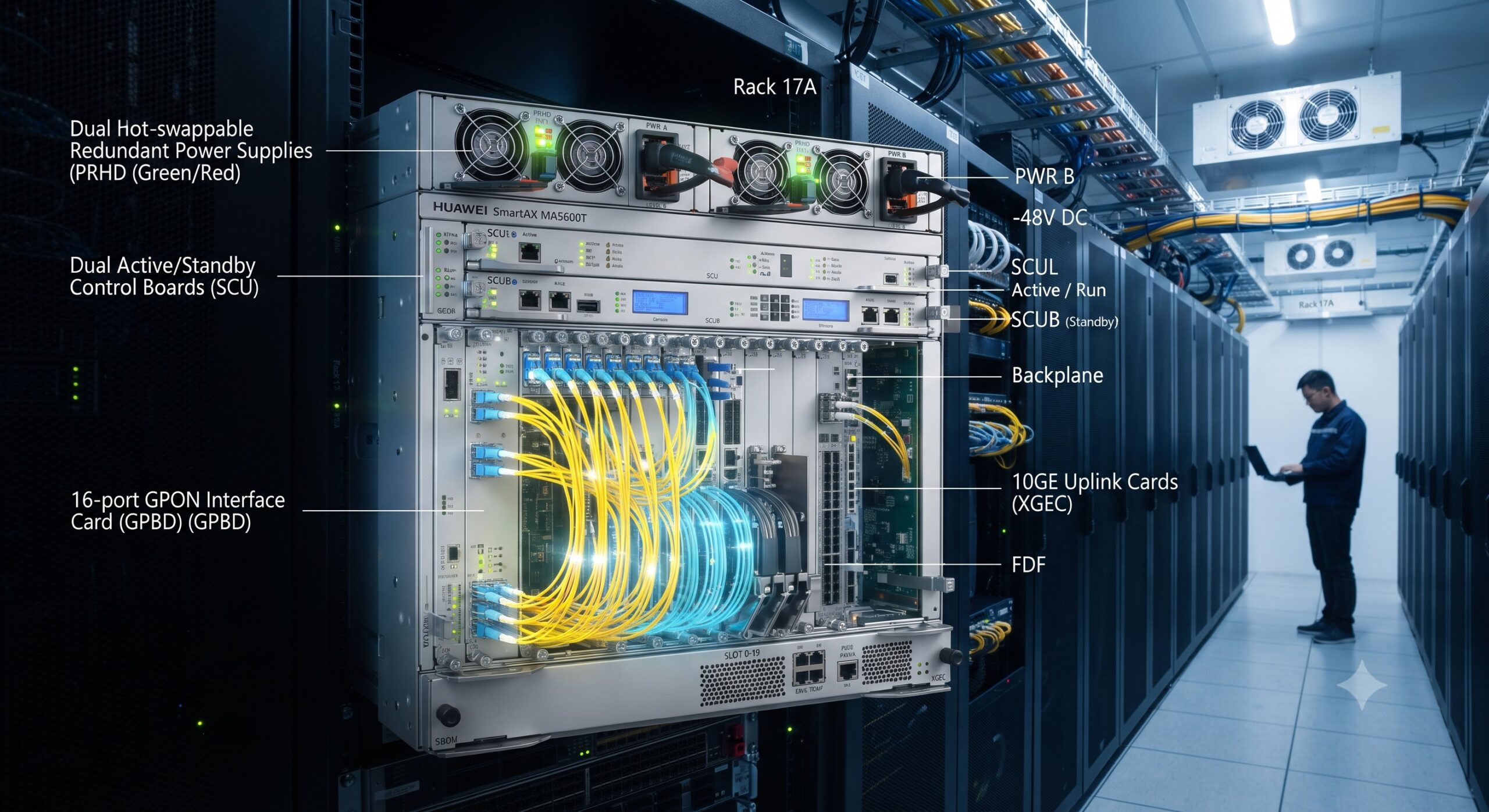
Understanding the underlying hardware architecture is foundational to executing a successful upgrade. The SmartAX MA5600T is engineered for mission-critical environments, featuring a modular design that supports active/standby control boards (e.g., H801SCUB, H801SCUL, H801SCUF) . This 1+1 redundancy is the cornerstone of the hitless upgrade capability, where the standby board is upgraded first, followed by a graceful active/standby switchover to upgrade the original active board .
Chassis and Backplane Specifications
The large-frame chassis offers 16 service slots, while the MA5603T and MA5608T provide 6 and 2 slots, respectively, with full compatibility for service boards across the series . The system boasts a massive 3.2 Tbit/s backplane bus switching capacity and a 960 Gbit/s switching capacity from the control board, ensuring non-blocking performance for high-density deployments . This robust architecture supports a maximum of 512K MAC addresses and up to 4,096 GPON ONTs per shelf, underscoring its status as a high-density OLT .
| Parameter | Technical Specification |
|---|---|
| Backplane Switching Capacity | 3.2 Tbit/s |
| System L2/L3 Switching Capacity | 960 Gbit/s |
| Control Board Switching Capacity | 400 Gbit/s |
| MAC Address Table Size | 512K |
| Maximum GPON ONTs Supported | 4096 per shelf |
| Chassis Slots (Large Frame) | 16 Service Slots |
| Ambient Operating Temperature | -5°C to +45°C |
| Power Supply | -48V DC (-38.4V to -57.6V) |
| Maximum Power Consumption (Fully Loaded) | 1420W |
| Hitless Upgrade Base Requirement | V800R011C00 or Later |
Deconstructing the Upgrade: Common vs. Hitless
Selecting the appropriate upgrade scenario is the first critical decision. The two primary methods are common upgrades (with service interruption) and hitless upgrades (without service interruption).
Common Upgrade (Service Interruption)
This mode is typically employed for single control board configurations or when upgrading from older base versions. The entire system restarts, leading to an interruption period that can range from 15 to 50 minutes . This duration is contingent on the volume of original system configurations and the time required for control boards and service boards to recover .
Hitless Upgrade (Minimal Service Impact)
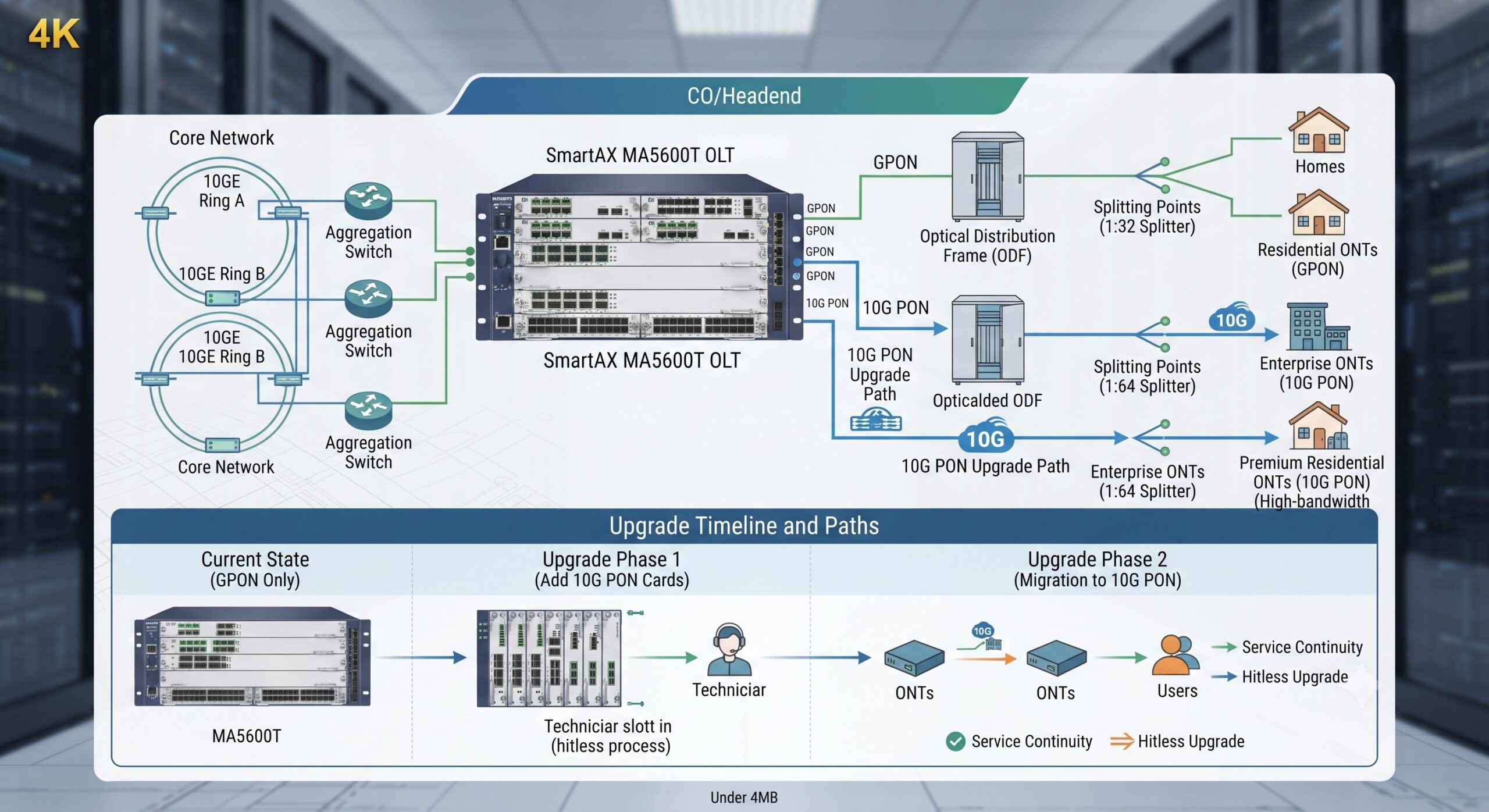
For networks with active and standby control boards running base version V800R011C00 or a later version, the hitless upgrade is the gold standard . This process upgrades the standby control board, performs an active/standby switchover, and then upgrades the original active board. Service interruption is minimized to 5-10 minutes, isolated to the service board restart, ensuring a near-seamless experience for subscribers .
Step-by-Step Upgrade Methodology: A Technical Walkthrough
The upgrade process is a structured sequence of events, from pre-upgrade validation to post-verification.
Phase 1: Prerequisites and Preparation
- Version Validation: Meticulously verify the source and target versions. For instance, an upgrade from V800R013C10 to V800R017C10SPH229 requires precise adherence to the specified version paths .
- File Integrity: Ensure the MD5 checksum of the downloaded combined package matches the released Hash Checksum file to prevent corruption .
- System Backup: Systematically back up configurations and databases (e.g.,
backup data tftp 192.168.1.3 db_old.dat) . - Disable Automatic Functions: Stop auto-save functions (
autosave interval off) to prevent write operations during the upgrade .
Phase 2: Execution
- Load Package Files: Load the combined package file via U2000 or CLI. Load times vary by control board type; for example, a 60 MB file for SCUB/SCUF boards takes approximately 20 minutes (single board) or 40 minutes (dual boards) .
- Activation: Activate the loaded files. The service impact during this stage necessitates operation during a maintenance window (e.g., early morning).
- Post-Upgrade Sync: Upon restart, the Network Management System (NMS) will need to synchronize data with the NE .
Addressing Critical Vulnerabilities: Security as a Core Upgrade Driver
Beyond feature enhancements and performance improvements, upgrades are often mandated by critical security patches. A notable instance is CVE-2020-9067, a buffer overflow vulnerability in some Huawei products, including the MA5600T .
This vulnerability allowed an attacker to perform remote code execution when the product functioned as an OLT. Mitigation strictly required upgrading to specific secure versions:
- V800R017C10SPH229 or later for versions V800R013C10, V800R015C00, V800R015C10, V800R017C00, and V800R017C10 .
- V800R018C00SPH207 or later for version V800R018C00 .
This reinforces that an upgrade is a fundamental security mechanism, protecting the network from advanced threats.
Comparative Analysis: MTBF and Operational Gains
Quantifying the benefits of a structured upgrade approach involves evaluating key performance indicators. The table below compares the characteristics of common versus hitless upgrades, directly impacting network availability metrics.
Table 2: Upgrade Scenario Impact on Network Availability
| Feature | Common Upgrade (Service Interruption) | Hitless Upgrade (Minimal Interruption) |
|---|---|---|
| Control Board Requirement | Single or Dual | Dual (Active/Standby) |
| Base Version Requirement | All Versions | V800R011C00 or Later |
| Service Interruption | 15–50 Minutes | 5–10 Minutes |
| Network Availability | Lower (Planned Downtime) | Higher (Near-Zero Downtime) |
Operational Guidelines and Best Practices
Expert Recommendations
- Downgrade Preparedness: Always retain the source version’s combined package file and patches to enable a quick rollback if necessary .
- Utilize U2000 for Scale: For batch upgrades, the U2000 NMS is highly efficient, capable of upgrading 200 devices per day, compared to 40 via CLI .
- Voice Service Considerations: Be aware of protocol changes. For example, in V800R008 and later versions, the command for configuring SNMP on ONTs (
ipconfig iphost vlan) replaced older, separate commands . - Environmental Factors: Ensure stable power supply during the upgrade. The device operates within an ambient temperature range of -5°C to +45°C and a humidity range of 5% RH to 95% RH .
Conclusion: Securing the Future of the MA5600T
Upgrading the Huawei SmartAX MA5600T is a strategic endeavor that transcends mere software updates. It is a process of fortifying network reliability, enhancing security posture, and unlocking new capabilities. By meticulously following the prescribed upgrade paths—whether common or hitless—and adhering to best practices in file integrity, backup, and configuration management, network architects can ensure the MA5600T continues to deliver carrier-grade performance. The ultimate goal is a seamless upgrade that mitigates security vulnerabilities like CVE-2020-9067, minimizes service disruption, and leverages the platform’s advanced redundancy features to maintain a high MTBF, guaranteeing an unparalleled subscriber experience in the evolving FTTx landscape .

Leave a comment