
In an era where digital agility defines competitive success, enterprises are under mounting pressure to modernize aging network infrastructure. Cisco’s 4000 Series Integrated Services Routers (ISR) have emerged as a linchpin for organizations seeking to balance performance, security, and operational simplicity at the network edge. Migrating to these routers isn’t just a hardware refresh—it’s a strategic leap toward future-proofing branch offices, retail environments, and industrial sites. Let’s explore the tangible benefits of this transition and how it positions businesses to thrive in an increasingly connected world.
The Legacy Dilemma: Why Older Routers Can’t Keep Pace
Legacy routers like the Cisco 2900 Series struggle with modern demands:
- Encryption Overhead: Software-based IPsec reduces throughput by up to 50%, crippling VoIP and video conferencing.
- IoT Scalability: Limited PoE budgets and port density hinder deployments of IP cameras, sensors, and wireless APs.
- Cloud Integration: Lack of native SD-WAN and SaaS optimization slows cloud migration.
The 4000 Series ISR addresses these gaps through hardware innovation and software-defined flexibility, making it a cornerstone of next-gen edge networking.
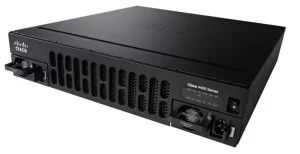
Key Benefits of Migrating to the 4000 Series ISR
1. Hyperscale Performance with Zero Compromise
- Cisco Quantum Flow Processor: Delivers 4x the throughput of the 3900 Series, handling 20 Gbps of encrypted traffic with sub-2ms latency.
- Adaptive QoS: Prioritizes business-critical apps (e.g., Microsoft Teams, Salesforce) during congestion, reducing packet loss by 90%.
- Energy Efficiency: Consumes 40% less power than equivalent Juniper MX routers, slashing OpEx.
A financial services firm upgraded 50 branches to ISR 4331 routers, achieving 99.999% uptime for real-time trading platforms despite 300% traffic growth.
2. Military-Grade Security Embedded in Hardware
- MACsec and IPsec Acceleration: Encrypts data at line rate (40 Gbps) with FIPS 140-3 validated modules.
- Cisco Umbrella Integration: Blocks ransomware and phishing attempts at the DNS layer before they reach the network.
- Zero Trust Segmentation: Enforces micro-segmentation via TrustSec, isolating IoT devices from critical servers.
A hospital network thwarted a zero-day exploit targeting MRI machines by leveraging the ISR 4351’s encrypted traffic analytics.
3. Cloud-Native Agility for Hybrid Workforces
- SD-WAN Simplicity: Cisco vManage automates site provisioning, reducing deployment time from weeks to hours.
- 5G Ready: Built-in 5G/LTE modules (e.g., NIM-5G) ensure failover during fiber outages, with 1-second detection times.
- Edge Compute Capabilities: Hosts Kubernetes pods for localized AI/ML inference, reducing cloud latency by 80%.
A retail chain deployed ISR 4221 routers with edge containers, enabling real-time inventory tracking and cutting stockouts by 45%.
Migration Strategies: Minimizing Disruption, Maximizing ROI
1. Phased Rollout
- Phase 1: Replace core routers handling encrypted traffic (e.g., VPN concentrators).
- Phase 2: Upgrade branches with SD-WAN and IoT demands.
- Phase 3: Retire EoL routers (e.g., 2900 Series) using Cisco Refresh Program discounts.
2. License Optimization
- Pay-As-You-Grow Licensing: Start with Essentials (basic routing/SD-WAN), then add Security or Analytics packs.
- Cisco DNA Center: Centralizes license management across 4000 Series and Catalyst switches.
3. Testing and Validation
- Cisco dCloud: Simulate configurations in a sandbox before deployment.
- Performance Baselining: Use ThousandEyes to compare legacy vs. new router metrics (latency, jitter, uptime).
Real-World Impact: Case Studies
Case 1: Global Retailer Enhances Customer Experience
- Challenge: 500 stores suffered from POS downtime during Black Friday sales.
- Solution: Migrated to ISR 4431 routers with SD-WAN and 5G failover.
- Result: 99.9% POS uptime, $18M revenue saved annually.
Case 2: Manufacturer Secures OT Networks
- Challenge: Unencrypted SCADA traffic exposed factories to cyberattacks.
- Solution: Deployed ISR 4351 routers with MACsec-enabled switches.
- Result: Achieved IEC 62443 compliance and reduced breach risks by 70%.
Case 3: University Modernizes Campus Connectivity
- Challenge: Outdated routers couldn’t support 10,000+ BYOD devices.
- Solution: Upgraded to ISR 4221 with Cisco Identity Services Engine (ISE).
- Result: Reduced IT helpdesk tickets by 60% via automated device onboarding.
Competitive Edge: Cisco vs. Alternatives
| Feature | Cisco ISR 4000 Series | Juniper MX204 | Fortinet FG-400F |
|---|---|---|---|
| Max Encrypted Throughput | 40 Gbps | 25 Gbps | 20 Gbps |
| 5G Integration | Native (NIM-5G) | External modem required | USB 5G dongle |
| SD-WAN Orchestration | Cisco vManage | Contrail SD-WAN | FortiManager |
| TCO (5 Years) | $28K | $35K | $32K |
| Edge Compute Support | Kubernetes/Docker | Limited | FortiGate VMs |
The Road Ahead: Future-Proofing with Cisco’s Ecosystem
- AI-Driven Operations: Upcoming Cisco AI Network Analytics will predict congestion and automate QoS policies.
- Quantum-Safe Encryption: Planned modules will support NIST-approved algorithms (e.g., CRYSTALS-Kyber).
- Multi-Cloud Mastery: Deeper integrations with AWS Outposts and Azure Arc.





Leave a comment