

EXECUTIVE SUMMARY
The Cisco ISR 4000 Series Integrated Services Routers deliver a modular, high-performance voice and data architecture for enterprise branch and managed services deployments. At the core of the platform’s voice capability lies the fourth-generation Packet Voice Digital Signal Processor Module (PVDM4) and the Network Interface Module (NIM) voice portfolio. This datasheet provides systems engineers, solution architects, and procurement teams with a definitive technical reference for selecting, integrating, and scaling voice DSP resources across the ISR 4000 Series chassis. The architecture supports densities from 32 to 256 channels per PVDM4 module on the motherboard or T1/E1 NIM, with dedicated onboard DSP resources for analog and BRI voice modules eliminating the need for separate packet voice DSP provisioning. All voice processing functions—including transcoding, conferencing, echo cancellation, and secure media termination—are hardware-accelerated to ensure deterministic performance under full call load.

ARCHITECTURE & CHASSIS DESIGN
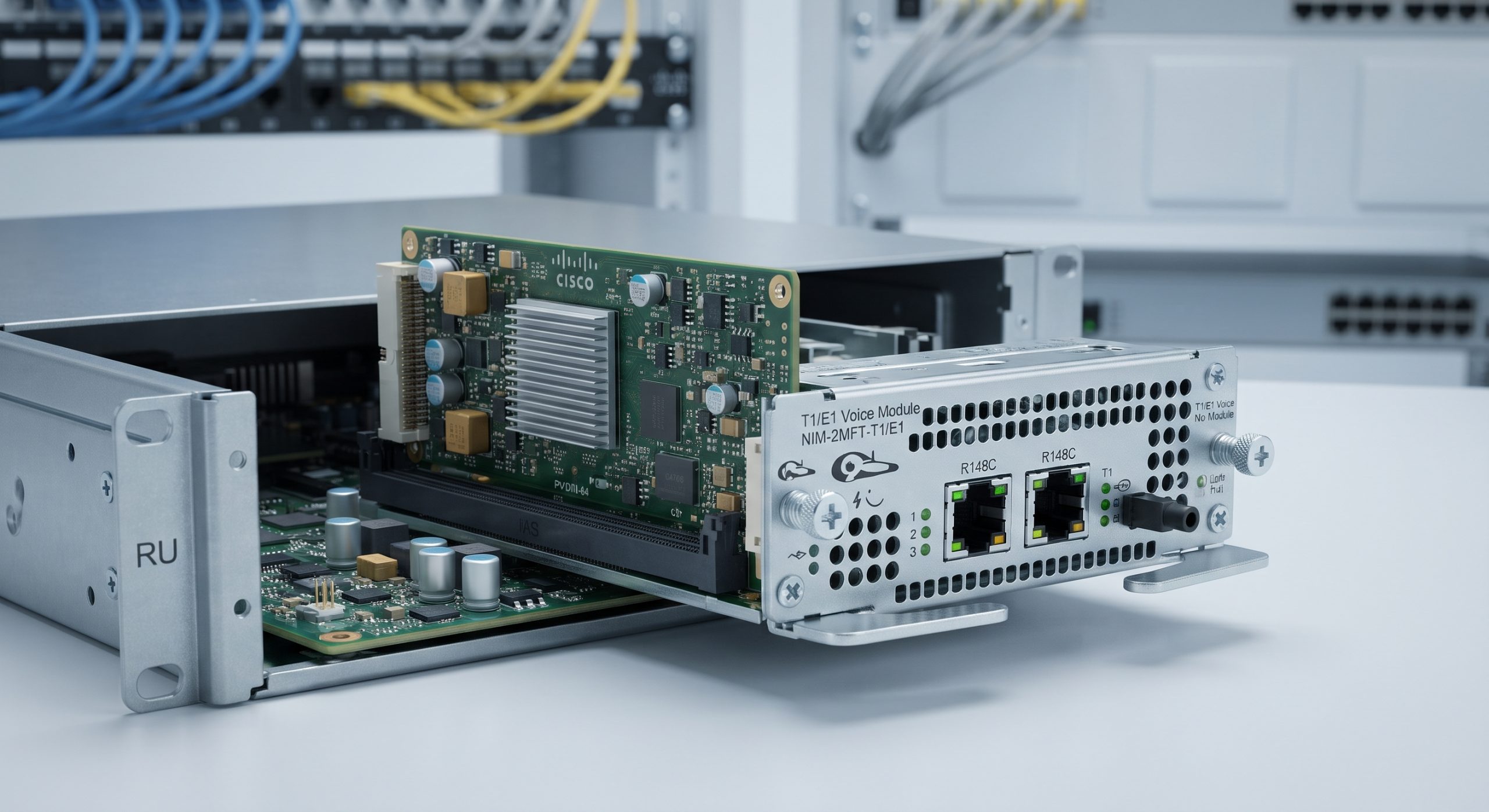
The ISR 4000 Series voice architecture is built upon a distributed DSP resource model. The PVDM4 module is available in four density variants: 32, 64, 128, and 256 channels, measured against low-complexity codec profiles such as G.711. These modules install directly into a dedicated slot on the router motherboard or into a T1/E1 Multiflex Trunk NIM. The physical placement determines the functional scope: a PVDM4 seated on the motherboard services IP-based media functions including transcoding, conferencing, and transrating, while a PVDM4 installed on a T1/E1 NIM additionally provides TDM-to-IP voice packetization for digital trunk interfaces. This design allows architects to right-size DSP capacity independently for TDM gateway functions and IP media services. The analog voice NIMs (FXS, FXO, E/M) and BRI NIMs incorporate fixed, non-configurable onboard DSPs, consuming zero PVDM4 resources for basic voice packetization and echo cancellation up to 128 ms tail length.
HARDWARE FEATURES
Voice processing on the PVDM4 leverages a multicore DSP architecture optimized for rich-media workloads. Supported codecs include G.711, G.729, G.729a/b, G.722, iLBC, AMR-NB, and Opus, enabling universal transcoding between any supported codec pair without external media resources. Conferencing services support both ad hoc and meet-me modes in conjunction with Cisco Unified Communications Manager and Unified Communications Manager Express. Echo cancellation complies with ITU-T G.168 with a 128-millisecond tail length, ensuring voice quality across mixed TDM and IP networks. The PVDM4 incorporates multiple power-saving modes, including a standby state that reduces module power draw by up to 5 watts when voice resources are idle. For high-density deployments, the SM-X-PVDM enhanced services module scales IP-based voice processing to 2048 low-complexity channels, 1024 medium-complexity channels, or 512 high-complexity channels, requiring an available SM-X slot on supported chassis.
COMPLIANCE & STANDARDS
All voice modules for the ISR 4000 Series are designed to meet applicable industry and regulatory standards for telecommunications equipment. Echo cancellation conforms to ITU-T G.168. Voice codec implementations adhere to their respective ITU-T and IETF specifications. The NIM form factor supports online insertion and removal (OIR), allowing module replacement or addition without powering down the router, which maintains service continuity in production environments. Regulatory compliance for the host ISR 4000 Series platforms encompasses safety, EMC, and telecom network protection requirements as documented in the respective platform datasheets.
TECHNICAL SPECIFICATIONS
The following table summarizes the core technical parameters for the PVDM4 voice DSP module family and associated voice NIM interfaces. Channel density figures represent maximum supported channels under low-complexity codec operation.
| Parameter | Specification |
|---|---|
| Module Form Factor | PVDM4: pluggable module for motherboard slot or T1/E1 NIM slot; SM-X-PVDM: SM-X slot |
| DSP Densities (PVDM4) | 32, 64, 128, or 256 channels (low-complexity codec) |
| Channel Capacity by Codec Complexity (PVDM4-256) | 256 low-complexity / 192 medium-complexity / 128 high-complexity |
| Supported Codecs | G.711, G.729, G.729a/b, G.722, iLBC, AMR-NB, Opus |
| Echo Cancellation | ITU-T G.168 compliant, 128 ms tail length |
| Voice Services | TDM-to-IP packetization (NIM-mounted PVDM4 only), transcoding, conferencing, transrating, SRTP media termination |
| Power Savings (PVDM4) | Up to 5 W reduction in power-saver mode |
| Voice NIM T1/E1 Interfaces | 1, 2, 4, or 8 port Multiflex Trunk; channelized or clear-channel |
| Analog Voice NIMs | 2/4-port FXS, 2/4-port FXO, 2FXS/4FXO combo, 4-port E/M; onboard fixed DSP |
| BRI Voice NIMs | 2 or 4 port BRI-NT/TE; onboard fixed DSP |
| SM-X High-Density DSP | SM-X-PVDM-2000: up to 2048 low-complexity channels, IP media services only |
| Online Insertion and Removal | Supported on NIM slots |
| Platform Compatibility | ISR 4321, 4331, 4351, 4431, 4451, 4461 (ISR 4221 excludes UC voice support) |
ORDERING OPTIONS
PVDM4 modules are ordered as standalone field-replaceable units and are available in four densities: PVDM4-32, PVDM4-64, PVDM4-128, and PVDM4-256. T1/E1 voice NIMs are available in 1-port, 2-port, 4-port, and 8-port Multiflex Trunk configurations, with channelized and clear-channel variants: NIM-1MFT-T1/E1, NIM-2MFT-T1/E1, NIM-4MFT-T1/E1, NIM-8MFT-T1/E1, NIM-1CE1T1-PRI, NIM-2CE1T1-PRI, and NIM-8CE1T1-PRI. Analog voice NIMs include NIM-2FXS, NIM-4FXS, NIM-2FXO, NIM-4FXO, NIM-2FXS/4FXO, and NIM-4E/M. BRI voice NIMs are available as NIM-2BRI-NT/TE and NIM-4BRI-NT/TE. For high-density IP media services requiring SM-X slot capacity, the SM-X-PVDM-2000 provides up to 2048 low-complexity channels. Note that PVDM4 modules are not compatible with ISR G2 platforms, and PVDM2/PVDM3 modules are not supported on ISR 4000 Series routers. The ISR 4221 does not support unified communications voice features and therefore cannot host PVDM4 or voice NIM modules.
📥 Download Technical Specification
Click the button below to view or download the full official PDF datasheet.
Leave a comment