

Introduction: The Architectural Heartbeat of the Modern Data Center
In the sprawling digital ecosystems of modern cloud providers and enterprise colocation facilities, network architecture is the critical infrastructure upon which all services depend. As data volumes surge with the proliferation of AI, machine learning, and high-performance computing, the edge of the network—specifically the Top of Rack (ToR)—has become a focal point for architectural innovation. A ToR switch serves as the direct gateway for servers within a single rack to the broader data center fabric . This design moves away from centralized models (like End-of-Row switching), where every server cable must traverse long distances to a common aggregation point, creating congestion and management nightmares . The localized approach of ToR minimizes cable runs, reduces latency, and provides a modular, scalable foundation for modern leaf-spine topologies . However, the true sophistication of these systems lies not in their physical placement, but in the advanced silicon and forwarding logic engineered within their 1RU chassis.

Core Architecture: Beyond the 1RU Chassis
Merchant Silicon and the ASIC Revolution
At the heart of nearly every state-of-the-art ToR switch lies a highly integrated Application-Specific Integrated Circuit (ASIC) . This is not merely a network processor but a purpose-built forwarding engine that executes packet switching at line rate. The industry often refers to this as “merchant silicon,” with major players like Broadcom (Trident, Tomahawk, and newer 800G-ready families) and innovative new entrants like Xsight Labs dominating the space . The choice of ASIC defines the switch’s entire operational profile—its port speeds, buffer sizes, and feature set. A key tradeoff in ToR switch design is balancing cost and space efficiency with the limitations of these chips. Most forwarding logic resides on a single chip, meaning memory buffers and forwarding tables are inherently limited compared to chassis-based modular switches . For example, the limited Ternary Content-Addressable Memory (TCAM) space restricts the number of IPv4/IPv6 prefixes and MAC addresses the hardware can store, a crucial consideration for large-scale network design where route summarization is paramount to prevent control-plane overload .
Interface Technology and Port Configurations
Modern ToR switches are a testament to the evolution of interface speeds. The traditional 1GbE and 10GbE have been supplanted by 25GbE as the standard for server access, with 100GbE, 200GbE, and even 400GbE uplink ports becoming the norm for connecting to spine switches . A prime example is the Huaqin S8130, a high-performance open network ToR switch that supports 24x 200GbE downstream ports (using QSFP56 for 56G PAM4 modulation) and 8x 400GbE uplinks (via QSFP-DD), delivering a massive 8.0 Tbps switching capacity . Similarly, the Juniper QFX5120-48Y offers 48 ports of 25GbE with 8x 100GbE uplinks, supporting advanced EVPN-VXLAN fabrics . The emergence of “Universal” ToR switches, like the Xsight Labs X2 platform, represents a paradigm shift, allowing any of the 32 ports to be independently configured at 100G, 200G, or 400G speeds, offering unprecedented flexibility to match heterogeneous server and storage NIC requirements . This is enabled by 112G SerDes (Serializer/Deserializer) technology, supporting both legacy 28G and cutting-edge 112G signaling on a single chip .
Latency and Packet Forwarding: The Silicon Pipeline
For latency-sensitive applications like High-Frequency Trading (HFT) and AI training workloads, the internal pipeline of the ASIC is critical. This pipeline comprises the ingress parsing, lookup, forwarding decision, and egress queuing stages. Modern ASICs, such as the Xsight Labs X2, advertise ultra-low latency figures as low as 550 nanoseconds (with 25G SerDes) . Achieving such low latency requires deep engineering in the physical layer (PHY) and the memory architecture. However, latency is not the only consideration. A significant challenge in ToR design is buffer size. Small buffer sizes on commodity merchant silicon can lead to performance degradation during “Incast” scenarios—where multiple servers simultaneously send traffic to a single egress port, overwhelming the shallow buffers and causing packet drops . High-performance designs thus incorporate sophisticated buffer management and congestion control algorithms directly into the ASIC hardware to mitigate these effects.
| Key Parameter | Technical Specification (Example: High-End ToR) |
|---|---|
| Switching Capacity | 8.0 Tbps (e.g., Broadcom BCM56780 based) |
| Server Port Density | 48 x 25GbE or 24 x 200GbE |
| Uplink Ports | 8 x 400GbE (QSFP-DD) or 4x100GbE |
| Latency (ASIC) | As low as 550ns |
| Power Consumption | 180W (at 12.8T) to 272W |
| Forwarding Tables | Limited by TCAM; requires route summarization |
Deployment Architectures: ToR in the Leaf-Spine Fabric
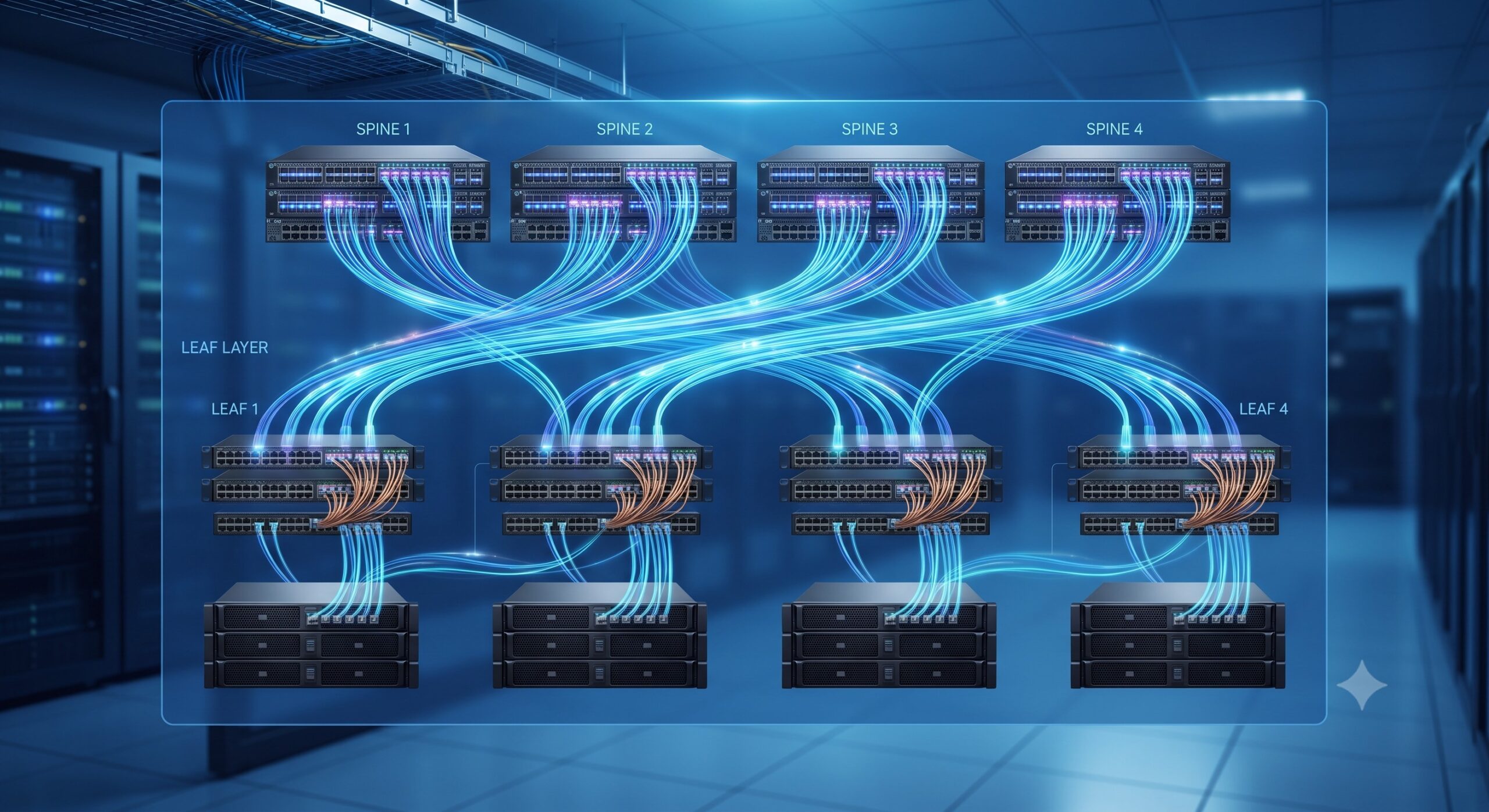
In a modern spine-and-leaf architecture, the ToR switch functions exclusively as the leaf device. Each server rack houses one or more ToR switches, which aggregate traffic from all servers within that rack. These leaf switches then connect to multiple spine switches via high-speed uplinks (e.g., 40GbE, 100GbE, or 400GbE) in a full-mesh topology . This design ensures that traffic is distributed evenly across the spine, preventing the congestion and single points of failure seen in traditional three-tier (core-aggregation-access) models. This architecture improves agility and simplifies cabling, as long copper or fiber runs are minimized, and the “cable plant” is contained within each rack. For instance, a typical deployment might see a Dell PowerSwitch S5248F-ON connecting 48 servers at 25GbE and uplinking to spine switches via 2x 200GbE and 4x 100GbE ports .
Management and Programmability: The SONiC and SDN Factor
The software ecosystem of a ToR switch has become as critical as the hardware. To avoid vendor lock-in and enable rapid innovation, the industry has embraced open-source Network Operating Systems (NOS), most notably the Software for Open Networking in the Cloud (SONiC). SONiC decouples the network software from the underlying hardware, allowing operators to provision, manage, and upgrade switches using cloud-native principles . The Xsight Labs Universal ToR platform integrates fully with SONiC, leveraging the Switch Abstraction Interface (SAI) to ensure interoperability and programmability for advanced AI-driven networking features . This programmability extends to the data plane, where intelligent packet processing can be customized for specific application needs, such as load balancing, firewalling, or network packet brokering, moving beyond simple L2/L3 forwarding .
Conclusion: The Evolving Future of ToR Silicon
The Top of Rack switch has evolved from a simple connectivity box to a high-performance, programmable compute node in its own right. As data center speeds escalate towards 800GbE and beyond, the spotlight remains firmly on the internal ASIC. The future of ToR switching lies in increased integration (CMOS shrinking, like TSMC 5nm technology), lower power footprints (some platforms achieving under 80W at 3.2T processing), and unified hardware platforms capable of supporting all legacy and emerging port speeds . For the network architect, the choice of a ToR switch is no longer merely about port density; it is a complex evaluation of forwarding table sizes, ASIC latency, buffer depth, and the ability to support a disaggregated, software-defined future. The ultimate goal is to build a flexible, resilient, and sustainable network fabric that can scale efficiently to meet the relentless demand of future data-driven applications.

Leave a comment