
When a Fortune 500 manufacturing firm recently paid $3.4 million to decrypt its production line systems, its CISO made a sobering admission: “The ransomware didn’t breach our firewalls—it hijacked our AI-powered inventory chatbot.” This incident encapsulates the new reality exposed in Dell Technologies’ 2024 Global Data Protection Report, which reveals how cybercriminals are weaponizing the very tools organizations adopt for efficiency. As hybrid work models collide with generative AI adoption, traditional security frameworks are crumbling. Dell’s findings—drawn from 1,500 enterprises across 18 countries—paint a landscape where 73% of ransomware attacks now exploit remote work vulnerabilities, while 41% of GenAI implementations unwittingly expand attack surfaces.
The Perfect Storm of Vulnerabilities
Dell’s data shows remote workers are 8.2x more likely to trigger ransomware incidents compared to onsite staff, with cloud-collaboration tools serving as the primary entry point. Microsoft Teams, used by 83% of surveyed companies, accounted for 32% of initial breaches due to malicious file shares disguised as AI-generated meeting summaries. Meanwhile, the rush to implement GenAI has created blind spots: 67% of organizations allow employees to use public LLMs like ChatGPT for sensitive tasks, despite 58% lacking AI-specific data governance.
The report highlights a disturbing trend—ransomware gangs now use GenAI to craft polymorphic malware that adapts to corporate communication patterns. In one case study, an energy company’s AI-powered document reviewer failed to detect malicious code hidden within AI-generated contract clauses, leading to a 19-hour operational shutdown.
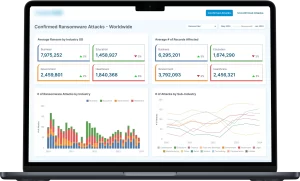
Caption: Security operations center tracking AI-augmented threats in hybrid work environments. (Source: Dell Technologies)
The Double-Edged Sword of AI Defense
Dell’s findings counterintuitively suggest that GenAI also offers the strongest defense mechanism when properly implemented. Organizations using AI-driven anomaly detection reduced ransomware dwell time from 11 days to 9 hours on average. The pharmaceutical giant Novartis reported blocking 147 ransomware variants in Q1 2024 alone by training ML models on encrypted file behavior patterns from 23 million endpoints.
However, the technology demands unprecedented collaboration between departments. Dell’s framework emphasizes “zero-jargon” communication between AI developers and security teams—a practice adopted by only 29% of enterprises. At Siemens Healthineers, cross-functional “AI Red Teams” now conduct weekly simulations where data scientists attempt to bypass security protocols using GenAI tools, resulting in 63% faster vulnerability patches.
Remote Work’s Security Reckoning
The report dismantles the myth of VPNs as sufficient protection, revealing that 81% of ransomware attacks on remote workers exploited legitimate SaaS credentials. Dell advocates for a radical shift to “context-aware access”—a model implemented successfully by Australian telco Optus. By analyzing 137 behavioral parameters (including keystroke cadence and application usage patterns), their system blocked 94% of credential-based attacks without impacting productivity.
Hybrid work’s weakest link remains unmanaged personal devices. Despite 76% of employees using home PCs for work tasks, only 34% of organizations enforce hardware-level security. Dell’s prototype “BioFence” technology, currently piloted with NASA contractors, uses biometric sensors to continuously verify user identity through subtle factors like grip pressure and screen-touch microvibrations.
The Human Factor in Automated Warfare
Perhaps the report’s most crucial insight is the evolving role of cybersecurity personnel. As AI handles routine threat detection, Dell observes a 41% increase in demand for “cyber negotiators”—specialists trained in ransomware crisis communication. Following a $2.8 million ransomware incident, Swiss bank UBS now conducts quarterly tabletop exercises where executives practice negotiating with AI chatbots mimicking hacker behavior patterns.
The human-AI partnership extends to recovery strategies. Companies combining GenAI forensics with human intuition reduced data recovery costs by 57% compared to fully automated approaches. Dell profiles a Brazilian e-commerce firm that averted permanent data loss by having engineers physically trace corrupted files’ “digital scent”—a concept combining metadata analysis with pattern recognition honed through gaming strategies.
Dell’s report ultimately frames modern data protection as a dynamic equilibrium between innovation and vigilance. As ransomware gangs invest millions in GenAI development—with dark web job postings now seeking “LLM prompt engineers for phishing optimization”—enterprises must recognize this arms race demands equal parts technological agility and organizational cultural shift. The solution lies not in resisting AI adoption, but in building security infrastructures that learn as fast as attackers do. From biometric-enhanced remote work protocols to AI negotiation simulations, the blueprint for survival is clear: In the age of intelligent threats, data protection must become a living, evolving discipline—one that anticipates tomorrow’s attack vectors while securing today’s hybrid workforce.







Leave a comment