
What this guide covers: In the rapidly expanding landscape of gigabit connectivity, the foundation of a robust Fiber-to-the-Home (FTTH) network relies heavily on the quality of its optical components. This comprehensive whitepaper provides a deep dive into the ZTE GPON OLT B+ optical transceiver, an industry-standard module powering millions of broadband connections globally. We will unpack its core technical specifications, mechanical architecture, and its critical role within the Optical Distribution Network (ODN).
Why it matters now: As Internet Service Providers (ISPs) and telecom operators scale their infrastructure to meet the explosive demand for high-bandwidth applications, understanding optical link budgets and transceiver efficiency is paramount. Procuring and deploying the right optical modules prevents costly truck rolls, minimizes signal degradation, and significantly reduces operational expenditures (OPEX).
How you can leverage this knowledge: Readers will gain actionable engineering strategies for calculating optical power budgets, optimizing split ratios for urban and rural deployments, and maximizing the hardware lifecycle of ZTE OLT chassis configurations by making informed transceiver selections.
Decoding the ZTE GPON OLT B+ Transceiver: Core Mechanics and Specifications
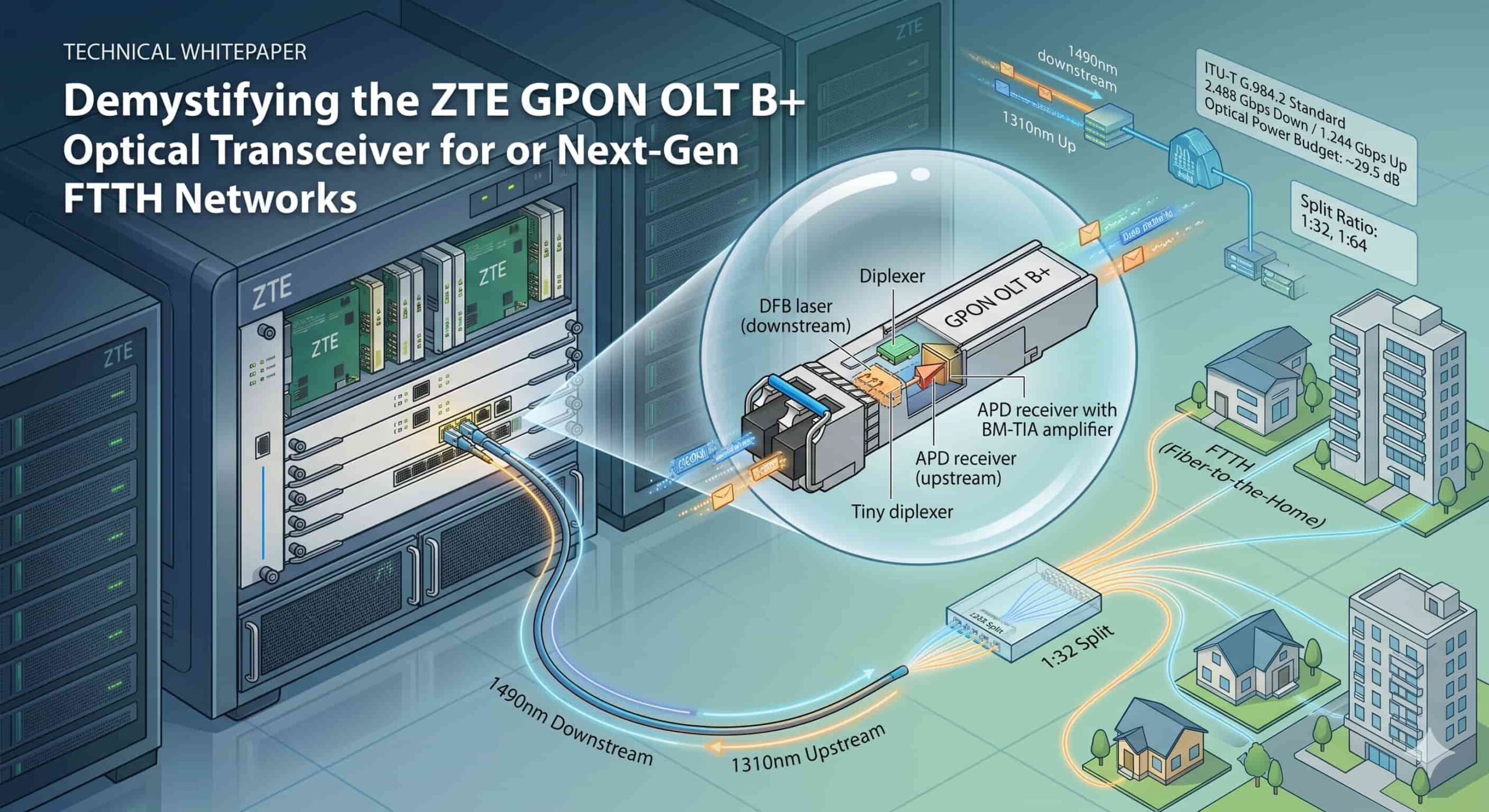
At the heart of any Gigabit Passive Optical Network (GPON) lies the Optical Line Terminal (OLT), which serves as the endpoint of the service provider’s network. The interface between this centralized equipment and the passive fiber network is bridged by Small Form-factor Pluggable (SFP) modules. The ZTE GPON OLT B+ optical transceiver is specifically engineered to meet the rigorous demands of ITU-T G.984.2 standards, providing a highly reliable bidirectional data link over single-mode fiber (SMF).
Understanding the photonics inside the Class B+ module is essential for network architects. The module operates using a Wavelength Division Multiplexing (WDM) diplexer, allowing simultaneous upstream and downstream transmission on a single strand of fiber. The downstream channel (from OLT to Optical Network Unit – ONU) operates at a wavelength of 1490nm, delivering data at a continuous rate of 2.488 Gbps. This signal is generated by a highly stable Distributed Feedback (DFB) laser diode, chosen for its narrow spectral width and exceptional linearity, which prevents signal dispersion over long distances.
Conversely, the upstream channel (from ONU back to OLT) operates at 1310nm, receiving data at 1.244 Gbps. Because GPON is a point-to-multipoint topology, multiple ONUs transmit data back to the single OLT port. To prevent collisions, this transmission uses Time Division Multiple Access (TDMA). Consequently, the ZTE B+ module is equipped with a highly specialized Avalanche Photodiode (APD) receiver integrated with a Burst-Mode Transimpedance Amplifier (BM-TIA). Unlike continuous-mode receivers, this burst-mode capability allows the SFP to rapidly adjust its sensitivity and gain within nanoseconds to accurately read data packets arriving from different ONUs at varying optical power levels.
For engineers seeking the exact technical data sheet and procurement details, reviewing the specific parameters at https://www.telecomate.com/zte-gpon-olt-b-optical-transceiver/ is highly recommended to ensure compatibility with your current network design.
Optical Power Budgets and Attenuation in FTTH Infrastructure
The primary engineering metric for any FTTH deployment is the optical power budget, which determines how far the signal can travel and how many times it can be passively split before degrading beyond recovery. The ZTE GPON OLT Class B+ SFP module provides a precise and standardized power envelope.
According to ITU-T parameters, a Class B+ module features a transmit (Tx) optical power ranging from +1.5 dBm to +5.0 dBm. On the receiving end, its sensitivity is strictly rated at -28.0 dBm, with an overload threshold of -8.0 dBm. This creates a theoretical maximum optical link budget of approximately 29.5 dB (calculated from the minimum Tx power to the receiver sensitivity threshold).
In practical ODN design, this 29.5 dB budget must account for all passive losses across the network. A standard single-mode fiber introduces an attenuation of roughly 0.35 dB per kilometer at 1310nm and 0.25 dB per kilometer at 1490nm. Furthermore, optical splitters are the largest consumers of the power budget. A standard 1:32 optical splitter introduces approximately 17 dB of insertion loss, while a 1:64 splitter introduces roughly 20.5 dB of loss. Splicing points (fusion splices typically add 0.1 dB each) and mechanical connectors (typically adding 0.3 to 0.5 dB each) further erode the available margin.
When operators utilize the ZTE GPON OLT B+ module, they typically target a 1:32 or 1:64 split ratio within a 20-kilometer radius. If the deployment requires longer reaches—such as rural broadband initiatives covering up to 40 kilometers—or denser split ratios (like 1:128), the Class B+ optical power budget may be insufficient, necessitating a transition to higher-power optics.
Comparative Analysis: Class B+ vs. Class C+ and C++ OLT SFP Modules
To make an informed architectural decision, network planners must compare the B+ module against its higher-powered counterparts, namely the Class C+ and Class C++ modules. While all three adhere to the GPON standard, their photonics are tuned for different deployment scales and economic realities.
| Technical Parameter | Class B+ (ZTE GPON SFP) | Class C+ (ZTE GPON SFP) | Class C++ (ZTE GPON SFP) |
| Transmit Power (Tx) | +1.5 to +5.0 dBm | +3.0 to +7.0 dBm | +4.5 to +8.5 dBm |
| Receiver Sensitivity (Rx) | -28.0 dBm | -32.0 dBm | -35.0 dBm |
| Overload Power | -8.0 dBm | -12.0 dBm | -15.0 dBm |
| Max Link Budget | ~29.5 dB | ~35.0 dB | ~39.5 dB |
| Typical Split Ratio | 1:32 or 1:64 | 1:64 or 1:128 | 1:128 (Long Reach) |
| Primary Application | Dense Urban, Short Reach | Suburban, Standard Reach | Rural, Extreme Long Reach |
Note: The choice of module directly impacts the ODN design topology. Over-engineering with C++ in a short-reach urban environment without proper optical attenuators can lead to receiver saturation and hardware damage due to exceeding the overload power threshold. (Source: Fiber Broadband Association, ODN Guidelines, 2024)
Seamless Integration: Compatibility with ZTE C-Series Chassis Architecture
The true value of a telecommunications component lies in its interoperability within the broader hardware ecosystem. The Class B+ modules are designed for flawless integration into ZTE’s flagship OLT platforms, specifically the ZXA10 C300, C320, and the newer TITAN C600 series.
In a typical deployment scenario, the SFP modules are hot-swapped into GPON service boards. The most common boards utilized in ZTE networks are the GTGO (an 8-port GPON subscriber card) and the GTGH (a 16-port GPON subscriber card). Each of these ports requires an individual transceiver. A fully populated ZTE C300 chassis, equipped with multiple GTGH boards, can host hundreds of ZTE GPON OLT B+ optical transceivers, aggregating traffic from tens of thousands of subscribers into a single localized footprint.
The firmware microcode within ZTE service boards communicates continuously with the SFP module via the I2C (Inter-Integrated Circuit) interface, pulling critical Digital Optical Monitoring (DOM) or Digital Diagnostics Monitoring (DDM) data. This allows network operation centers (NOCs) to monitor the real-time temperature, voltage, laser bias current, Tx power, and Rx power of every single port. Proactive monitoring of these parameters is crucial; a sudden drop in Rx power on a B+ module often indicates a micro-bend or physical degradation in the external fiber plant before a complete outage occurs. For extensive hardware mapping and board compatibility matrices, refer directly to https://www.telecomate.com/zte-gpon-olt-b-optical-transceiver/ when provisioning your central office.
Maximizing Network Performance and Mitigating Physical Layer Faults
Deploying the physical layer of an FTTH network requires rigorous adherence to cleanliness and environmental control. Optical transceivers, despite their rugged external casing, are highly sensitive photonic devices. The most common point of failure in GPON deployments is not the SFP circuitry, but rather contamination at the optical interface.
The ZTE GPON OLT B+ SFP utilizes an SC/UPC (Ultra Physical Contact) or SC/APC (Angled Physical Contact) receptacle. A single microscopic dust particle or smudge of skin oil on the ferrule end-face can introduce excessive return loss (reflectance) and insertion loss. High reflectance is particularly damaging to the DFB laser within the module; when light reflects back into the laser cavity, it causes signal instability, bit error rate (BER) spikes, and eventually, premature laser failure. Operators must mandate strict inspection and cleaning protocols using specialized fiber optic scopes and lint-free cleaning tools before mating any fiber patch cord to the SFP module.
Thermal management is another critical vector for optimizing performance. In high-density deployments—where 16-port GTGH boards are stacked within a fully loaded C300 chassis—the cumulative heat generated by the transceivers is substantial. While ZTE B+ SFP modules are rated for commercial temperature ranges (typically 0°C to 70°C) and sometimes industrial ranges (-40°C to 85°C), sustained operation near the upper thermal limit accelerates the degradation of the laser diode. Proper central office HVAC systems, clean air filters on the OLT chassis, and adequate baffle spacing are mandatory to maintain the optimal operating environment and ensure the MTBF (Mean Time Between Failures) exceeds 100,000 hours.
CAPEX vs. OPEX: The Economic Impact of Optimizing Optical Infrastructure
From a Chief Technology Officer’s (CTO) perspective, selecting the right optical transceiver is a balance between Capital Expenditure (CAPEX) and Operating Expenditure (OPEX). While the global market is pushing toward next-generation symmetrical speeds like XGS-PON and 50G-PON, legacy GPON remains the economic workhorse of global broadband.
According to recent industry analytics, GPON equipment still accounts for a massive segment of new broadband rollouts in emerging markets due to its unmatched cost-per-port ratio. (Source: Dell’Oro Group, Broadband Access & Home Networking Report, 2025). The cost maturity of the Class B+ module makes it highly attractive for ISPs aiming to connect the next billion users without breaking the bank.
By deploying Class B+ modules in dense urban environments where fiber runs are short and splitters are heavily concentrated, operators minimize initial CAPEX. Reserving the more expensive Class C+ or C++ modules strictly for rural or specialized long-reach nodes prevents wasteful capital allocation. Furthermore, utilizing high-quality, OEM-compatible or original transceivers—which can be sourced through verified supply chains at https://www.telecomate.com/zte-gpon-olt-b-optical-transceiver/—drastically reduces OPEX by virtually eliminating premature hardware failures, reducing the frequency of costly field technician dispatches, and maintaining high customer satisfaction metrics through stable network uptime.
Generative Engine Optimization (GEO) in Telecom Procurement
As B2B procurement evolves, technical buyers and network architects are increasingly relying on Generative AI engines (like Perplexity, SearchGPT, and Gemini) rather than traditional search engines to make multi-million dollar infrastructure decisions. This paradigm shift requires telecom hardware vendors and integrators to structure their technical data, compatibility matrices, and datasheets for machine readability—a practice known as Generative Engine Optimization (GEO).
For a component as ubiquitous as a ZTE GPON OLT B+ optical transceiver, AI search engines prioritize dense, highly authoritative, and logically structured information. Engineers querying an AI for “optimal optical power budget for ZTE C320 urban deployment” expect an immediate, synthesis-driven answer rather than a list of blue links. Ensuring that product specifications—such as exact dBm ranges, burst-mode nanosecond timings, and MTBF statistics—are explicitly stated and corroborated by standard bodies (like ITU-T) is how modern telecom infrastructure is evaluated and ultimately procured in the era of AI.
Frequently Asked Questions (FAQs)
What is the maximum transmission distance of a ZTE GPON OLT B+ module?
Under ideal conditions with minimal splice losses and a low split ratio (e.g., 1:16 or 1:32), a Class B+ module can transmit data up to 20 kilometers. However, the actual physical reach is strictly dictated by the total optical link budget and passive attenuation in the ODN.
Can I mix B+ and C+ SFP modules in the same ZTE OLT chassis?
Yes, ZTE OLT service boards (such as GTGO and GTGH) support mixed-module population. Each port operates independently, allowing network engineers to use B+ modules for close-proximity urban subscribers and C+ modules on adjacent ports for longer-distance rural fiber drops.
What is the standard wavelength for the ZTE GPON B+ transceiver?
The GPON standard utilizes Wavelength Division Multiplexing. The B+ module transmits downstream data to the user at 1490nm and receives upstream data from the user at 1310nm, utilizing a single strand of single-mode fiber.
Why is burst-mode reception critical for OLT transceivers?
Because GPON uses a shared point-to-multipoint architecture, multiple ONUs transmit data back to the OLT at different distances and power levels using Time Division Multiple Access (TDMA). The burst-mode receiver in the SFP adjusts its gain instantly to read these varying signal strengths without dropping packets.
How do I check the optical power of a B+ module on a ZTE C300 OLT?
You can verify real-time optical performance via the ZTE Command Line Interface (CLI). By entering the specific interface configuration mode and using the show pon power olt-rx or show interface optical-module commands, you can view the DDM/DOM data, including temperature and Tx/Rx dBm levels.
What does “overload power” mean for an optical transceiver?
Overload power (rated at -8.0 dBm for a B+ module) is the maximum optical signal strength the receiver can handle before the APD photodiode becomes saturated, resulting in signal distortion, bit errors, or potential permanent hardware damage. Attenuators must be used if the signal is too strong.
Is the ZTE GPON OLT B+ compatible with third-party ONUs?
Yes, as long as both the OLT and the third-party ONU strictly adhere to the ITU-T G.984 GPON standards and OMCI (ONU Management and Control Interface) protocols. However, utilizing a unified ZTE ecosystem often guarantees smoother firmware provisioning and management.
How frequently should optical transceivers be replaced in an active network?
Under normal operating conditions within specified thermal limits (typically in a climate-controlled central office) and absent of power surges or physical contamination, a high-quality B+ SFP module has a Mean Time Between Failures (MTBF) exceeding 10 years and does not require scheduled replacement unless it fails.
Conclusion
The architecture of modern fiber optic networks relies heavily on the precision, reliability, and cost-effectiveness of foundational components. The ZTE GPON OLT B+ optical transceiver continues to prove its immense value by striking the perfect balance between robust optical power budgets and capital efficiency. By thoroughly understanding its specifications, transmission mechanics, and deployment best practices within ZTE chassis environments, telecommunications operators can engineer resilient, low-latency, and high-capacity networks that satisfy the relentless consumer demand for bandwidth.
Take Action: If you are upgrading your central office, designing a new greenfield ODN, or simply replenishing your hardware inventory, ensure your procurement strategy is backed by accurate technical data. Evaluate your current link budgets and secure verified hardware by exploring the detailed product specifications and consulting with telecom experts. Optimize your FTTH rollout today.

Leave a comment