
In an era where global data creation surpasses 120 zettabytes annually and 85% of enterprises operate hybrid infrastructures, understanding the technological triad powering digital transformation becomes crucial. This exploration demystifies how cloud computing frameworks, virtualization layers, and container ecosystems collectively enable the fluid, scalable operations defining modern IT.
The Virtualization Foundation
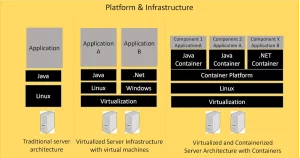
Virtualization technology, the bedrock of modern infrastructure, abstracts physical hardware through hypervisor technology. Type 1 hypervisors like VMware ESXi and KVM directly interface with hardware, achieving:
- 95-98% Hardware Utilization: Up from 15% in pre-virtualized environments
- Millisecond-Level VM Spawn Times: Critical for auto-scaling web farms
- Secure Micro-Segmentation: Isolated virtual networks with NSX-T
A 2023 study revealed that financial institutions reduced server costs by 63% through virtualization, running 400+ VMs per physical host.
Cloud Computing’s Elastic Fabric
Building on virtualization, cloud platforms introduce three service models revolutionizing IT economics:
- IaaS: Raw compute/storage (AWS EC2, Azure VMs)
- PaaS: Managed runtimes (Google App Engine, Heroku)
- SaaS: Turnkey applications (Salesforce, Office 365)
The cloud’s true power emerges in its operational paradigms:
- Horizontal Scaling: Auto-scaling groups managing 1M+ instances
- Geo-Distribution: Content delivery within 13ms via 300+ edge nodes
- Consumption Pricing: $0.023 per vCPU-hour (AWS Spot Instances)
Netflix’s Open Connect network streams 250PB daily by leveraging AWS’s auto-scaling and Azure’s media encoding synergistically.
Containerization’s Atomic Units
Containers represent the next abstraction layer, packaging apps with dependencies into portable units:
- Lightweight: 50MB container vs 4GB VM image
- Fast Startup: 200ms vs 45s VM boot time
- Declarative Orchestration: Kubernetes managing 5,000-node clusters
Docker’s union filesystem and namespaces enable:
def deploy_microservice():
    build_image(dependencies)
    push_to_registry()
    kubernetes_rollout(strategy=canary)
A major e-commerce platform handles 2.4 million container starts/hour during peak sales using Kubernetes’ horizontal pod autoscaler.
Convergence in Modern Stacks
The synergy between these technologies powers contemporary architectures:
- Virtualized Cloud Hosting: OpenStack managing 1M+ VMs across regions
- Container-as-a-Service: AWS Fargate removing VM management overhead
- Serverless Computing: AWS Lambda executing 100M functions/day
Performance metrics reveal evolutionary gains:
| Metric | Physical | VM | Container |
|---|---|---|---|
| Provision Time | 45min | 90s | 2s |
| Overhead | 0% | 5-15% | 1-3% |
| Density per Host | 1 | 20 | 500 |
| Patch Cycle | Weeks | Days | Hours |
Security Implications
Each layer introduces unique protection challenges:
- Virtualization: Hypervisor escapes (CVE-2022-0189)
- Cloud: Misconfigured S3 buckets exposing 100M+ records
- Containers: Privilege escalations via /sys mounts
Defense strategies evolve through:
- VM Introspection: Real-time memory analysis
- Cloud Security Posture Management (CSPM): Automated policy enforcement
- Container Image Scanning: 400+ vulnerability checks pre-deployment
Gartner reports 68% fewer breaches in environments using layered cloud security controls.
Cost Optimization Strategies
Financial engineering across infrastructure layers:
- Reserved VM Instances: 72% savings over on-demand
- Spot Containers: 90% discount for interruptible workloads
- Serverless Cost Monitoring: Avoiding “cold start” tax
A streaming service saved $12M annually by dynamically mixing VM reservations with container spot clusters.
Emerging Frontiers
The infrastructure evolution continues with:
- MicroVMs: Firecracker’s 125ms boot for secure serverless
- WebAssembly Containers: 10x faster than Docker in browser
- Quantum Cloud Services: 72-qubit simulators via Azure Quantum
Early adopters achieve 400μs response times using WASM-edge containers in 5G networks.







Leave a comment