
Power Consumption Pain Points in Submerged Edge Compute
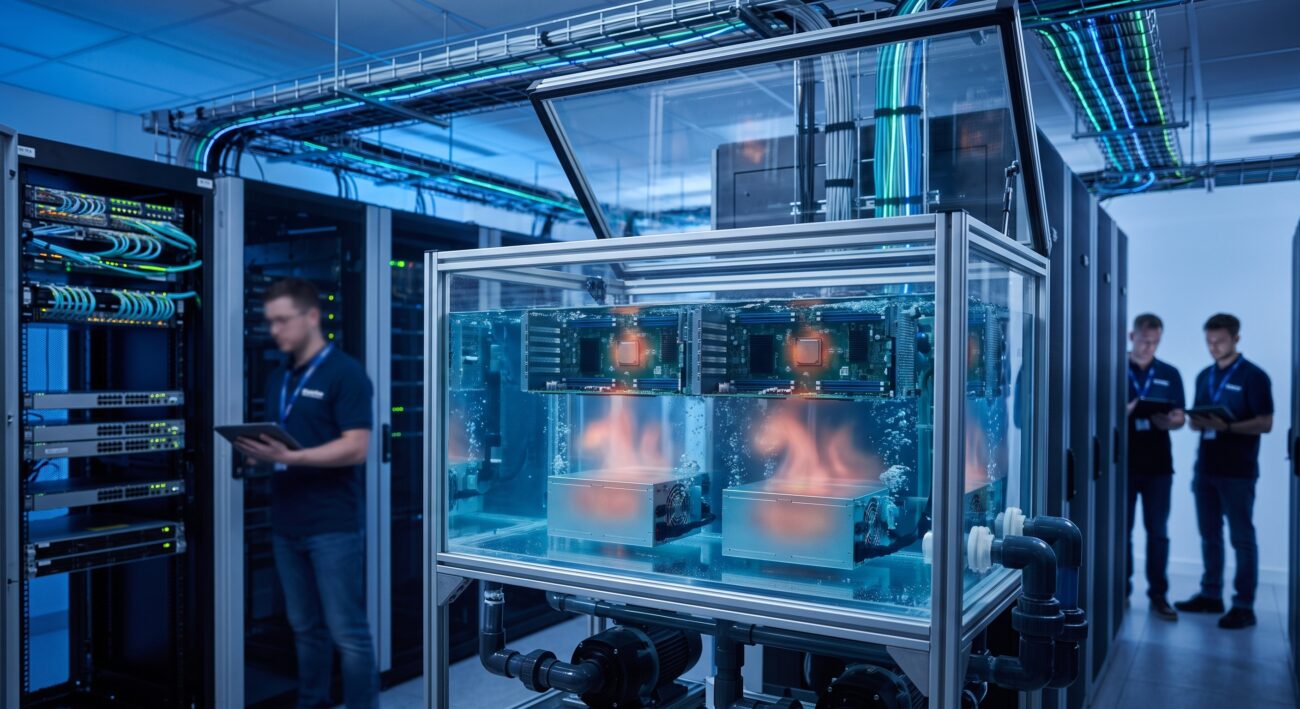
The relentless push toward edge computing and 5G RAN densification has created a thermal paradox: compute modules must deliver carrier-grade throughput (often exceeding 400 Gbps per node) while being sealed inside passive, liquid-filled enclosures where traditional forced-air convection is physically impossible. In a submerged environment, the Power Supply Unit (PSU) becomes the single most thermally stressed component, converting AC or high-voltage DC into the low-voltage, high-current rails required by ASIC and FPGA payloads. Unlike air-cooled siblings, a submerged PSU cannot rely on fans to move heat away from magnetics, capacitors, and switching MOSFETs. Instead, heat must conduct directly into the dielectric fluid — a medium with 6–10x the thermal conductivity of air but with viscosity and convection dynamics that fundamentally alter component derating curves.
This analysis examines the thermal profile of submerged PSUs within immersion liquid cooling compute modules, providing network architects and datacenter thermal engineers with the data needed to specify, validate, and deploy these systems at carrier scale.
Low-Power Silicon Design and Fluid-Immersion Thermal Coupling
Conduction-First PSU Topology
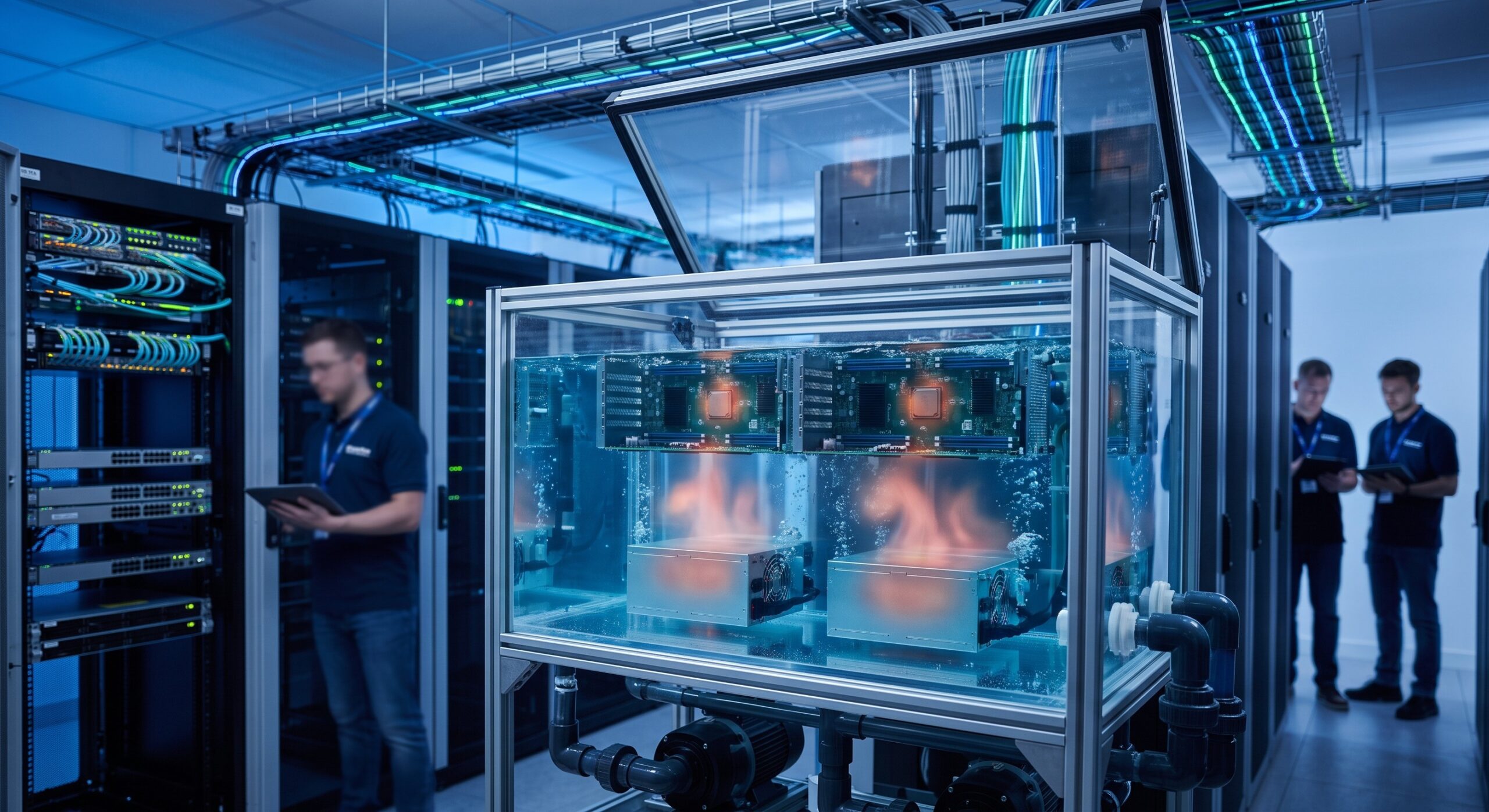
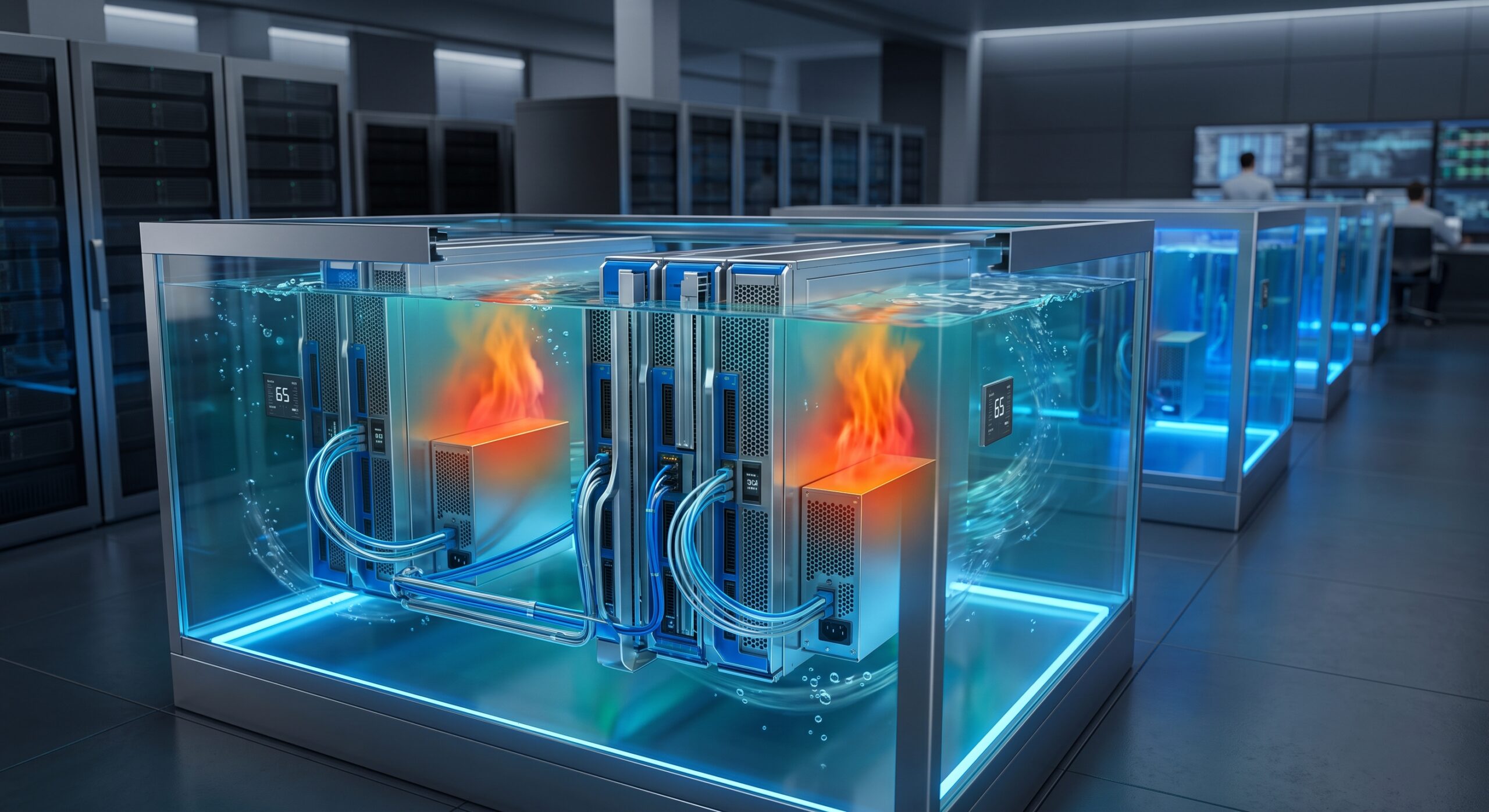
Submerged PSUs are engineered around a conduction-first design philosophy. Surface-mount magnetics, planar transformers, and GaN (Gallium Nitride) switching stages are thermally bonded to the enclosure baseplate or directly exposed to the dielectric fluid. The fluid — typically a single-phase synthetic hydrocarbon or fluoroketone — enters the module at 35–45°C and exits at 50–55°C, carrying 1.5–3.0 kW of PSU waste heat per 1U compute sled. The critical thermal resistance path is no longer junction-to-air but junction-to-fluid, measured in °C·cm²/W. Modern submerged PSU designs achieve Rth,j-f of 0.08–0.15 °C·cm²/W, compared to 0.5–1.2 °C·cm²/W for air-cooled equivalents.
Derating Curves and MTBF Impact
Electrolytic capacitors — historically the PSU’s weakest link — exhibit dramatically extended life when immersed. Every 10°C reduction in core temperature doubles capacitor life per Arrhenius law. Submerged PSUs operating at 55°C fluid temperature typically achieve MTBF of 1.2–1.8 million hours, versus 400,000–600,000 hours for fan-cooled 1U PSUs at 45°C ambient. This directly supports carrier-grade five-nines (99.999%) availability targets mandated by ITU-T G.8273 and Telcordia GR-63-CORE.
Power Density and Efficiency
Because fluid immersion eliminates fan power (typically 20–40W per PSU) and allows tighter component spacing, submerged PSUs reach power densities of 45–60 W/in³ with 94–97% efficiency at 50% load. 80 PLUS Titanium equivalent performance is achievable without the acoustic and reliability penalties of high-RPM fans. The PSU’s hold-up time is also improved: bulk capacitance can be 30–40% smaller because thermal derating is less aggressive, reducing inrush current and improving RoHS-compliant material utilization.
| Key Parameter | Technical Specification |
|---|---|
| Switching Capacity | 400 Gbps – 3.2 Tbps per compute module |
| PSU Power Density | 45–60 W/in³ (submerged, single-phase) |
| PSU Efficiency | 94–97% at 50% load (80 PLUS Titanium equivalent) |
| PSU MTBF | 1,200,000–1,800,000 hours at 55°C fluid |
| Junction-to-Fluid Thermal Resistance | 0.08–0.15 °C·cm²/W |
| Fluid Inlet/Outlet Temperature | 35–45°C inlet / 50–55°C outlet |
| Recoverable Heat per 10 MW DC | 2.5–4.0 GWh/year |
| OpEx Reduction vs Air-Cooled | 18–28% over 5 years |
| Compliance | IEEE 1613, ITU-T G.8273, Telcordia GR-63-CORE, IEC 62368-1, RoHS |
Carbon Footprint TCO and Eco-Friendly Core Routing Integration
PUE and WUE Synergy
Immersion-cooled compute modules with submerged PSUs enable PUE (Power Usage Effectiveness) of 1.02–1.05 and WUE (Water Usage Effectiveness) near zero when paired with dry coolers. The PSU’s waste heat is captured at 50–55°C — high enough to drive absorption chillers or district heating loops — turning a parasitic loss into a recoverable energy asset. For a 10 MW edge datacenter, this represents 2.5–4.0 GWh/year of recovered thermal energy, offsetting 1,200–1,800 metric tons of CO₂ annually.
Operational Expenditure Reduction
Eliminating PSU fans and reducing cooling energy yields OpEx savings of 18–28% over five years versus air-cooled PSUs in the same compute module footprint. The MTBF advantage further reduces truck rolls and spare-parts inventory — critical for unmanned edge sites where a PSU swap requires fluid drain, refill, and requalification. IEEE 1613 and IEC 62368-1 safety compliance must be validated for the fluid-immersed PSU, including dielectric withstand and partial discharge testing at 1.5x nominal voltage.
Edge Deployment Scenarios
In O-RAN and MEC deployments, submerged PSUs support -40°C to +65°C external ambient ranges when the fluid loop is managed by a secondary chiller. Field trials in carrier edge cabinets show 99.995% PSU availability over 24 months, with zero fan-related failures — the dominant failure mode in legacy air-cooled edge PSUs.
Conclusion
Submerged Power Supply Units are not merely a packaging adaptation — they are a fundamental re-engineering of the PSU thermal profile for the immersion era. By shifting from air-convection to fluid-conduction, they deliver MTBF exceeding 1.5 million hours, efficiencies above 96%, and OpEx reductions of 18–28% while enabling PUE near 1.02 and full IEEE/ITU-T/RoHS compliance. For network architects designing carrier-grade edge compute at densities beyond 400 Gbps per sled, the submerged PSU is no longer optional — it is the thermal and reliability foundation upon which the next generation of core routing must be built.

Leave a comment