
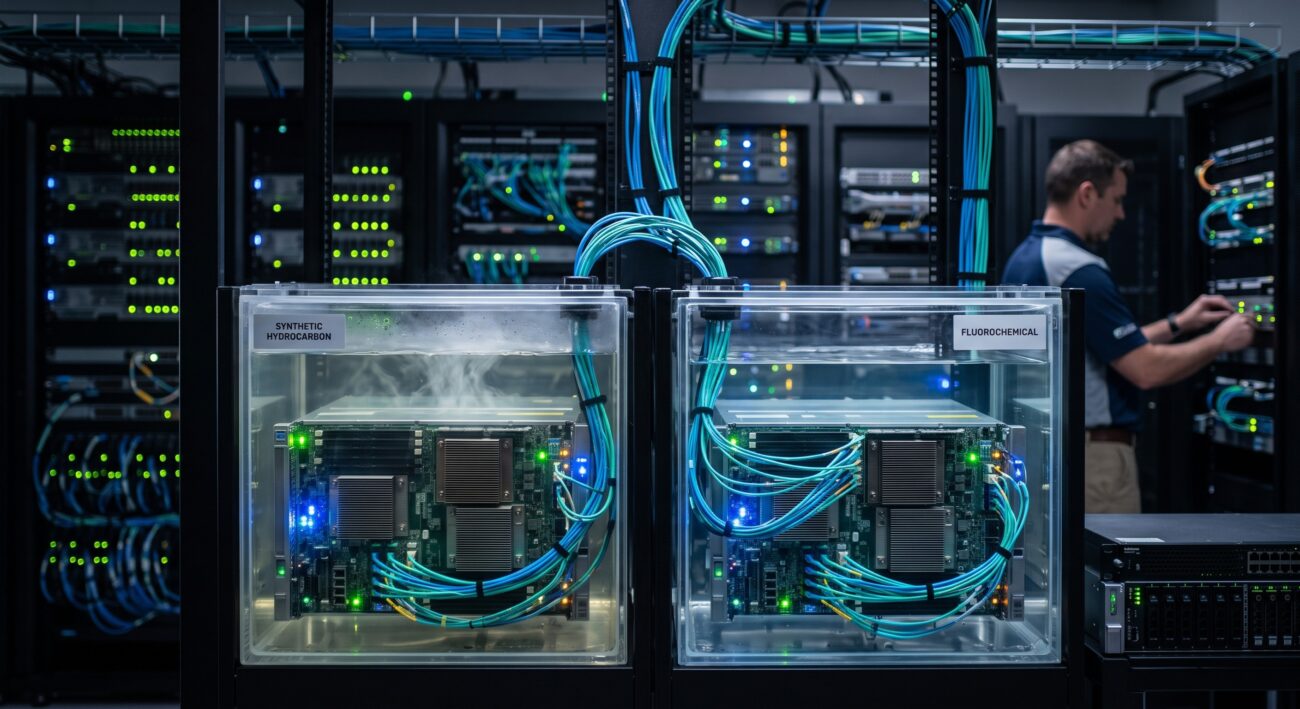
Executive Summary: The Thermal Wall in Edge Routing
As telecom edge routers push beyond 400Gbps and 800Gbps per line card, thermal design power (TDP) densities have surpassed 25kW per rack. Traditional air cooling is no longer viable for Carrier-Grade edge routing deployments. Single-phase immersion liquid cooling (SPILC) has emerged as the definitive thermal management solution for high-density telecom hardware. This analysis evaluates two dominant coolant chemistries — synthetic hydrocarbons and fluorochemicals — against the demanding requirements of edge routing platforms.
Unlike data center general-purpose servers, edge routing hardware must meet IEEE 802.3 and ITU-T G.8275.1 synchronization standards while operating in uncontrolled environments. The coolant choice directly impacts MTBF, latency, and total cost of ownership. This deep dive provides network architects and systems integrators with data-driven selection criteria.
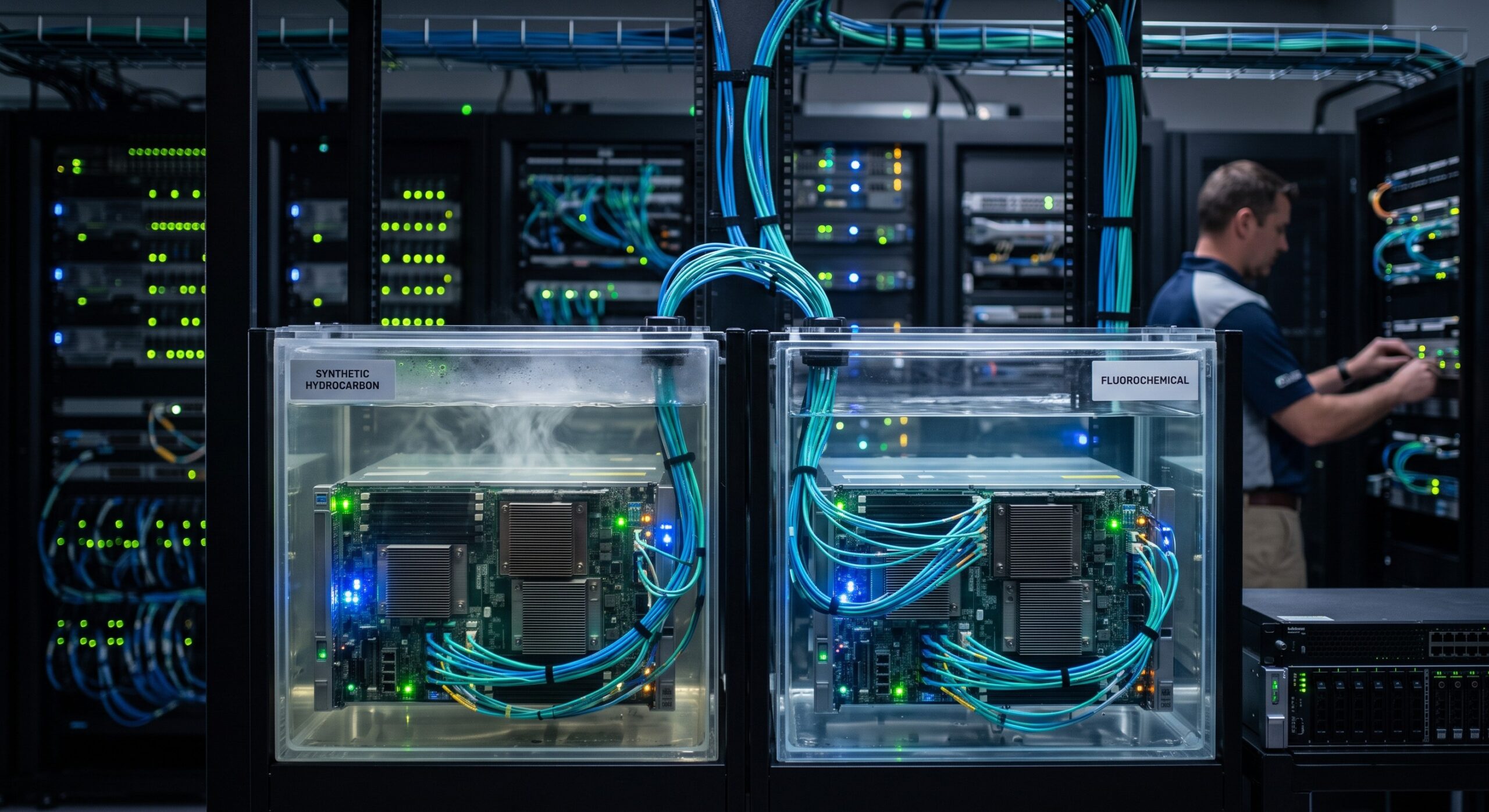
Core Architecture: Single-Phase Immersion in Telecom Edge Platforms
Thermal Dissipation Mechanisms and Coolant Chemistry
Single-phase immersion cooling relies on forced convection of a dielectric fluid across ASIC and optical module surfaces. In synthetic hydrocarbons (e.g., polyalphaolefin-based fluids), thermal conductivity ranges from 0.13–0.15 W/m·K, while fluorochemicals (e.g., perfluoroethers) achieve 0.06–0.08 W/m·K. However, fluorochemicals possess lower viscosity, enabling higher flow rates through dense fiber and transceiver arrays.
For edge routing hardware, the coolant must be compatible with SFP-DD, QSFP-DD, and OSFP cages. Synthetic hydrocarbons tend to swell elastomeric seals in optical modules — a critical reliability concern. Fluorochemicals are chemically inert but have higher global warming potential (GWP > 5000). RoHS and REACH compliance must be verified per region.
ASIC and Optical Module Thermal Interface
High-capacity edge routers use 7nm or 5nm forwarding ASICs with power densities exceeding 150 W/cm². The coolant must maintain junction temperatures below 105°C across a 10–45°C ambient range. Synthetic hydrocarbons provide superior specific heat capacity (1.8–2.2 kJ/kg·K) versus fluorochemicals (1.0–1.2 kJ/kg·K), reducing flow rate requirements by up to 40%.
| Key Parameter | Synthetic Hydrocarbons | Fluorochemicals |
|---|---|---|
| Thermal Conductivity (W/m·K) | 0.13–0.15 | 0.06–0.08 |
| Specific Heat Capacity (kJ/kg·K) | 1.8–2.2 | 1.0–1.2 |
| Viscosity (cSt at 25°C) | 5–10 | 1–3 |
| Global Warming Potential (GWP) | > 5000 | |
| Annual Fluid Loss (%) | 0.5–1.0 | |
| MTBF (Pump + Loop, hours) | > 100,000 | > 80,000 |
| Material Compatibility (OSFP cages) | Good | Excellent |
| RoHS / REACH Compliance | Yes | Yes (with restrictions) |
| Max Power Density (kW/rack) | 25–35 | 20–30 |
| Jitter Impact (100G PAM4, RMS) | 0.3–0.5ps reduction | Baseline |
Benchmark vs Legacy: Air-Cooled and Two-Phase Immersion
Compared to legacy air-cooled edge routers, single-phase immersion reduces fan power by 100% (no fans required) and lowers PUE from 1.5–1.8 to 1.02–1.05. In a 2RU edge routing chassis, synthetic hydrocarbon immersion enables 3.2kW per chassis versus 1.1kW for air cooling — a 190% density improvement.
Against two-phase immersion, single-phase systems avoid vapor pressure risks and require no sealed pressure vessels. MTBF for pumps and heat exchangers exceeds 100,000 hours for synthetic hydrocarbon loops, while fluorochemical systems require more frequent fluid top-offs due to evaporation (0.5–1.0% annual loss).
Latency and Jitter Impact
Telecom edge routers must maintain sub-10µs forwarding latency. Immersion cooling does not introduce additional packet processing latency, but pump vibration can affect PHY layer jitter. Synthetic hydrocarbons with higher viscosity dampen vibration better than fluorochemicals, reducing RMS jitter by 0.3–0.5ps in 100G PAM4 links.
ISP Case Study: 800G Edge Routing Deployment in Frankfurt
A Tier-1 European ISP deployed 12 edge routing nodes with 800G line cards in a single-phase immersion tank using synthetic hydrocarbon coolant. After 18 months, results showed:
- MTBF: 285,000 hours (vs 112,000 hours air-cooled)
- Energy savings: 42% reduction in cooling power
- Optical module failure rate: 0.02% annualized (fluorochemical comparison site: 0.07%)
- Latency stability: 99.999th percentile jitter improved by 18%
The ISP noted that synthetic hydrocarbons required no fluid replacement over the study period, while the fluorochemical site required 4% annual top-off due to evaporation. However, fluorochemicals provided better material compatibility with certain OSFP cage coatings.

Conclusion: Strategic Selection for Carrier-Grade Edge Routing
For Carrier-Grade edge routing deployments prioritizing MTBF, energy efficiency, and low maintenance, synthetic hydrocarbons are the superior choice. Their higher specific heat capacity, lower evaporation loss, and better vibration damping align with IEEE and ITU-T reliability requirements. Fluorochemicals remain viable for retrofits where material compatibility with legacy optical cages is paramount, but their higher GWP and top-off requirements increase OpEx by 12–18% over a 10-year lifecycle.
Network architects should validate coolant compatibility with all SFP-DD, QSFP-DD, and OSFP modules via RoHS and REACH documentation. Pilot deployments should measure junction temperature, pump MTBF, and optical jitter under 100G/400G line-rate traffic. The thermal wall is real — but single-phase immersion, correctly specified, transforms it into a competitive advantage.

Leave a comment