
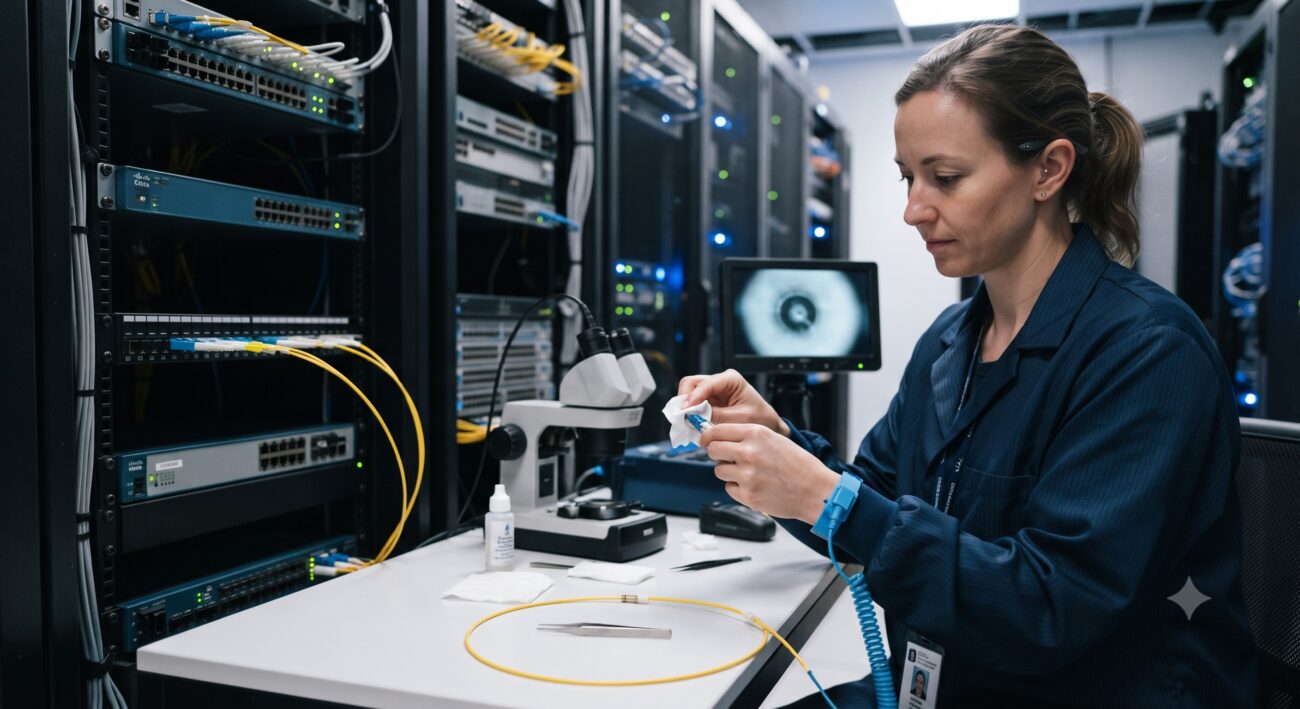
Overview & Thematic Scope
Contamination on fiber optic connector end faces is the number one cause of link failure and signal degradation in modern high-speed networks . Even microscopic particles of dust or oil can cause significant insertion loss, back reflection, and permanent damage to the connector interface . This FAQ provides definitive, expert-backed answers to the most common technical and deployment questions surrounding fiber optic patch cord cleaning, ensuring optimal performance and longevity of your optical infrastructure.
Frequently Asked Questions
- What is the best method to clean a fiber optic patch cord end face?
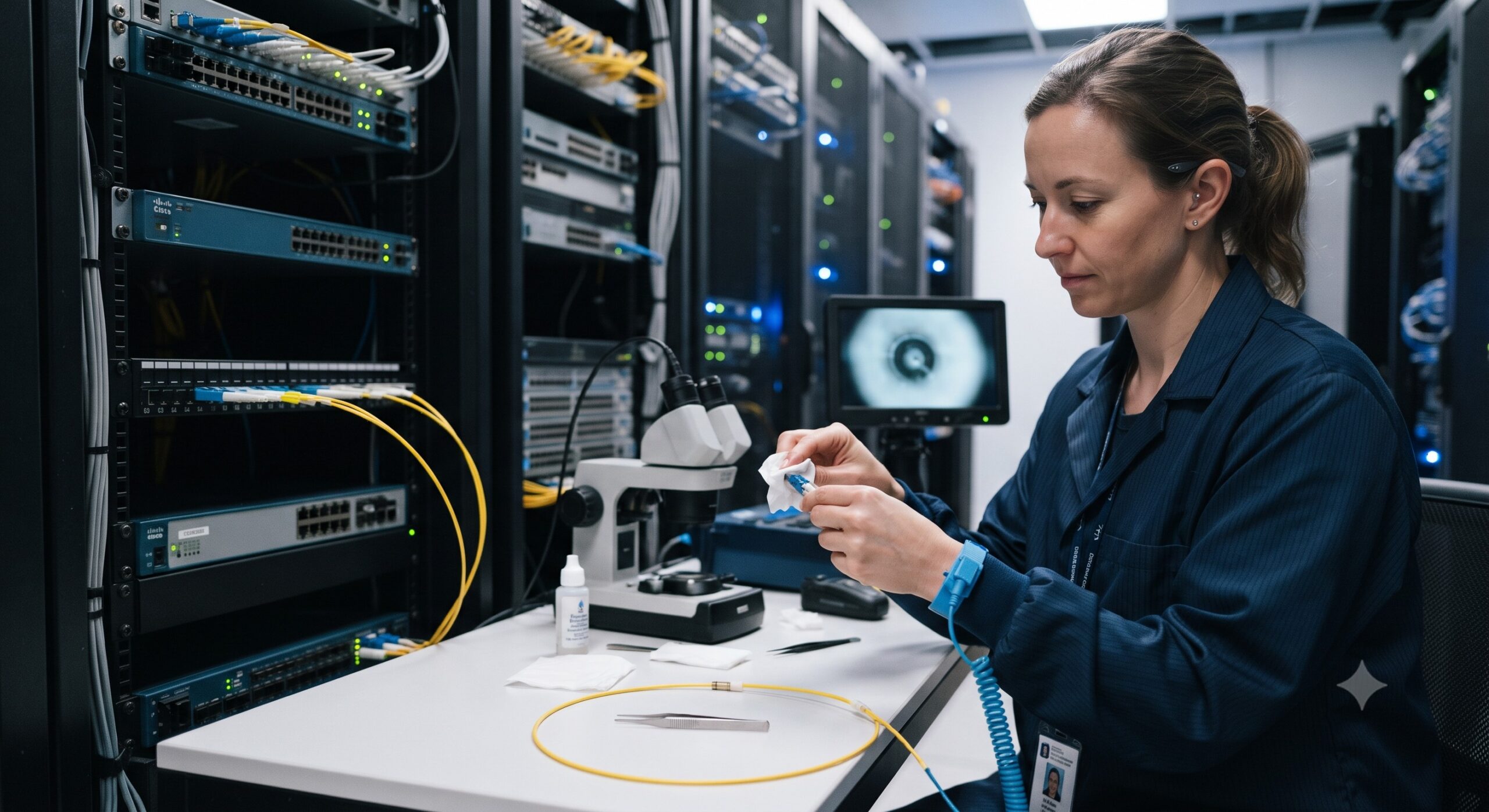
- The most reliable and effective method for cleaning a fiber optic patch cord end face is the ‘wet-to-dry’ cleaning process using a lint-free wipe and a static-dissipative solvent . This involves first moistening a section of a lint-free wipe with a specialized fiber optic cleaning fluid, drawing the connector end-face from the damp area into a dry section of the wipe. This method is superior to dry cleaning alone as the solvent helps dissolve stubborn contaminants like oils and eliminates static charge, which can attract dust particles . The process should always be followed by a final dry wipe and a thorough visual inspection with a fiber optic microscope.
- How do you clean fiber optic patch cord connectors inside a port or adapter?
- To clean connectors inside a port or bulkhead adapter, you must use a purpose-built swab or a mechanical port cleaning device designed for that specific connector type (e.g., 1.25mm for LC, 2.5mm for SC/ST/FC) . For swab cleaning, lightly dampen the cleaning end with a static-dissipative solvent, insert it into the adapter, and rotate the swab 6-12 times while applying gentle pressure to the end-face . For quick and consistent results, use a dry ‘click-to-clean’ tool, which deploys a fresh cleaning tape to wipe the connector end-face inside the port with a single push .
- What cleaning tools are essential for cleaning fiber optic end faces?
- An essential fiber optic cleaning kit should include lint-free wipes (made of non-debris producing material), a specialized static-dissipative cleaning solvent, and connector-specific tools like reel-to-reel cassette cleaners or click-to-clean tools (e.g., for 1.25mm LC, 2.5mm SC, and MPO connectors) . A fiber optic inspection microscope with appropriate probe tips is also mandatory for verifying cleanliness before mating . For cleaning hard-to-reach ports, precision swabs of the correct size are necessary .
- Why is it critical to clean both fiber optic patch cords before mating?
- It is absolutely critical to clean both ends of a mated pair because contamination from one connector will cross-contaminate the other, potentially causing permanent damage to both interfaces and severely degrading signal integrity . Even if one connector appears clean, assuming the other is clean is a major risk. Dirt, dust, or oil on either end-face can lead to immediate signal attenuation or, worse, be fused onto the glass surface by laser energy, permanently ruining the connector . Therefore, you must always inspect and clean each connector before mating them.
- Can I use isopropyl alcohol (IPA) to clean fiber optic connectors?
- While 99% isopropyl alcohol (IPA) has been historically used, it is no longer recommended as the primary cleaning solvent for modern fiber optic networks due to its significant drawbacks . IPA is hygroscopic, meaning it absorbs moisture and contaminants from the air, which can leave a hazy residue on the end-face and is ineffective against many common oils and gels . Furthermore, IPA is flammable and considered a hazardous material for shipping. It is far more effective to use a specialized, static-dissipative, residue-free, and non-flammable fiber optic cleaning fluid designed for this purpose .
- What is the proper technique for using cleaning swabs on fiber optic connectors?
- The proper swab cleaning technique involves using a clean swab for each connector to avoid cross-contamination, applying slight pressure to activate the connector’s spring, and rotating the swab with a consistent 6-12 turn motion to ensure the entire end-face is cleaned . The swab should be slightly dampened with a static-dissipative solvent (never dripping wet). For angled physical contact (APC) connectors, use a 1/4 turn back-and-forth motion to help the swab conform to the 8-degree angle . Always dispose of the swab after a single use .
- What are the steps to clean a fiber optic connector end face?
- The definitive step-by-step process is: 1) Inspect the end face with a fiber microscope to assess contamination . 2) For exposed connectors, begin with a dry cleaning method using a lint-free wipe or a reel cleaner to remove loose particles . 3) For stubborn contamination, proceed with a wet-to-dry clean: apply a specialized solvent to a lint-free wipe and draw the connector from the wet area to a dry area of the wipe . 4) Follow up immediately with a clean, dry lint-free wipe to remove any residual solvent and prevent streaking . 5) Finally, reinspect the end face with the microscope to verify it is spotless before mating .
- How does connector contamination cause fiber optic network failure?
- Contamination causes network failure by scattering and absorbing the light signal at the connection point, leading to increased insertion loss (signal attenuation) and return loss (back reflection) . This degradation in signal quality can cause bit errors, slow data rates, and intermittent connection faults. Furthermore, the presence of debris can scratch the delicate glass end-face during the mating process. In high-power laser networks, contaminants can absorb energy and fuse to the glass, causing catastrophic and permanent physical damage to the connector .

Leave a comment