
Identifying the Hidden Bottlenecks in RoCEv2 Fabric Deployment
The promise of Remote Direct Memory Access (RDMA) over Converged Ethernet is seductive: kernel bypass, sub-microsecond latency, and dramatic CPU offload for storage and AI workloads. However, the operational reality for many enterprise network architects is a sharp performance cliff. When a RoCEv2 Network Interface Module is deployed without rigorous parameter alignment, the fabric silently defaults to standard TCP/IP, collapsing throughput to a fraction of line rate and inflating tail latency . The bottleneck is rarely the silicon itself; it is the Priority Flow Control (PFC) and Explicit Congestion Notification (ECN) configuration mismatch between the RNIC and the switch fabric.

Unlike lossless InfiniBand, RoCEv2 operates over a statistically multiplexed Ethernet substrate. To achieve the deterministic behavior required for RDMA, the network must be engineered as a lossless fabric. This requires a precise orchestration of Data Center Bridging (DCB) standards, specifically IEEE 802.1Qbb for PFC and 802.1Qaz for ETS. Without this alignment, bursty storage traffic triggers microbursts that exceed switch buffer depths, leading to packet drops. In RDMA semantics, a single dropped packet triggers a Go-Back-N retransmission, devastating effective throughput.
Architectural Logic: ASIC Offload and the Lossless Pipeline
RNIC Packet Processing and Queue Pair Mechanics
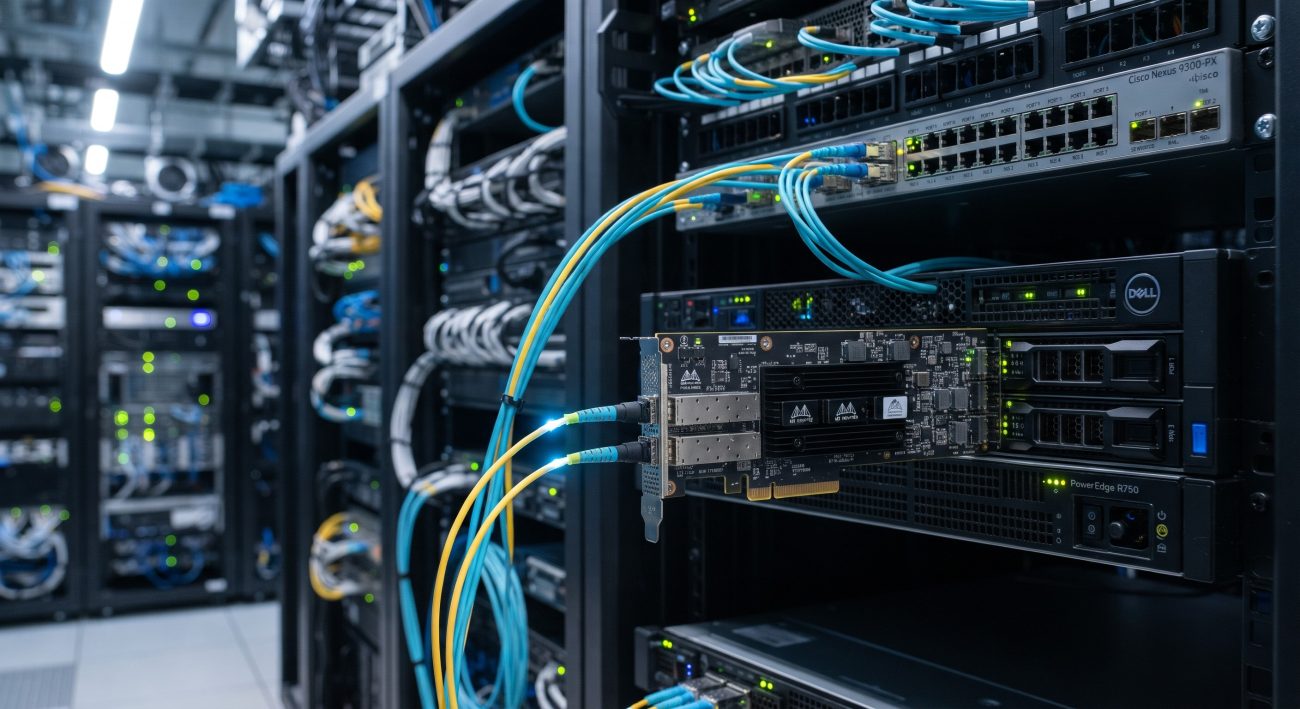
The RoCEv2 Network Interface Module is not a commodity NIC. It integrates a dedicated RDMA ASIC (often merchant silicon from Broadcom or Mellanox/NVIDIA) that manages Queue Pairs (QPs), Completion Queues (CQs), and Memory Regions (MRs) independently of the host CPU. The hardware logic encapsulates the InfiniBand Transport Header (BTH) directly into UDP/IP packets, utilizing destination port 4791 . This encapsulation allows Layer 3 routability, a critical distinction from RoCEv1, enabling scale across spine-leaf topologies.
However, the ASIC’s efficiency is contingent on strict ingress buffer management. When a switch port faces congestion, it must issue a PFC PAUSE frame for the specific CoS (Class of Service) associated with RDMA traffic—typically Priority 3 . If the RNIC and switch are not configured with identical DSCP-to-PCP mappings, the PAUSE frame either never arrives or halts the wrong traffic class, causing head-of-line blocking that stalls latency-sensitive control plane traffic.
Operational Parameter Limits and Configuration Matrix
The following table delineates the critical configuration parameters that must be synchronized across the server BIOS, RNIC firmware, and switch fabric. Deviation from these baselines is the primary cause of RDMA performance regression in enterprise deployments.
| Key Parameter | Technical Specification |
|---|---|
| RDMA Protocol Version | RoCEv2 (UDP/IP encapsulation, routable) |
| Default RoCE Traffic Priority | Priority 3 (CoS 3) with DSCP 26 |
| CNP Traffic Priority | Priority 7 with DSCP 48 |
| Flow Control Mechanism | PFC (802.1Qbb) + ECN marking (primary) |
| Typical MTU | 1500 bytes (default) / 9000 bytes (jumbo) |
| MTBF (Carrier-Grade Module) | ≥ 2,000,000 hours @ 40°C |
| Typical Power Envelope | 15.5W – 35.5W (varies by port speed) |
| Compliance Standards | IEEE 802.1Qbb, 802.1Qaz, RoHS, IBTA Vol.1 R2.0 |
For architects specifying hardware, Mean Time Between Failures (MTBF) is a non-negotiable metric. Carrier-grade RoCEv2 modules typically specify MTBF ratings exceeding 2,000,000 hours at 40°C, ensuring the reliability required for always-on financial trading or telco edge compute . Furthermore, thermal design must account for the continuous high-power state of the RDMA ASIC; modules with typical power envelopes of 15.5W to 29W require adequate chassis airflow to prevent thermal throttling that would negate latency advantages .
Configuration Best Practices: From PFC to ECN Tuning
Validating the Lossless Fabric End-to-End
Configuration must begin at the server OS level. In Linux environments, administrators must verify that the rdma_rxe or vendor-specific driver (e.g., bnxt_re, mlx5_ib) is loaded and that the link layer is active. The command ibv_devinfo should report state PORT_ACTIVE and a physical state of LINK_UP. More critically, cma_roce_mode must confirm that RoCE v2 is explicitly enabled; v1 mode will fail in routed topologies.
On the switch side, strict adherence to DCBX (Data Center Bridging Exchange) via LLDP is recommended to propagate PFC and ETS settings. However, in multi-vendor fabrics, manual static configuration often proves more reliable than auto-negotiation. The ECN marking threshold must be set conservatively—typically between 100KB and 500KB depending on buffer size—to trigger Congestion Notification Packets (CNPs) before PFC PAUSE frames are required. This hierarchy of congestion control (ECN first, PFC as last resort) prevents PFC storms and deadlocks that can cascade through a spine layer.
Field Deployment Topologies: Validation and Burn-In
Before commissioning, a rigorous burn-in procedure isolates configuration drift. A perftest suite (ib_write_bw, ib_read_lat) should demonstrate unidirectional throughput exceeding 90% of line rate for 100GbE modules and one-way latency under 2 microseconds for small messages. If throughput plateaus at approximately 10% of line rate, the fabric is almost certainly falling back to TCP; packet captures will reveal standard TCP handshakes instead of RoCEv2 BTH headers .

For high-density deployments, consider the physical layer implications. RoHS-compliant transceivers and DACs must be rated for the specific thermal profile of the top-of-rack switch. IEEE 802.3by (25GbE) and 802.3bj (100GbE) forward error correction (FEC) settings must match between the RNIC and switch port; a mismatch between RS-FEC and FC-FEC will result in link flapping or degraded BER, manifesting as intermittent RDMA completion errors.
Summary
The RoCEv2 Network Interface Module is a precision instrument that demands deterministic network behavior. Successful deployment hinges not on the theoretical peak throughput of the ASIC, but on the meticulous alignment of PFC, ECN, and QoS parameters across the entire data path. By enforcing strict configuration governance and validating with empirical burn-in metrics, network architects can eliminate the silent fallback to TCP and unlock the true ROI of RDMA convergence.

Leave a comment