
Executive Summary: The VPN Gateway as the Cornerstone of the Distributed Enterprise
In the contemporary B2B telecom landscape, the corporate network VPN gateway has transitioned from a simple access point to a mission-critical, high-performance edge platform. The permanent shift to a remote workforce demands a gateway architecture that can handle significant throughput, ensure ironclad security, and maintain carrier-grade reliability. This guide provides a deep technical analysis of the hardware, protocols, and deployment strategies that define a modern VPN gateway, ensuring network architects and systems integrators can build resilient, high-performance connectivity for their organizations.
Core Architecture and Hardware Topology
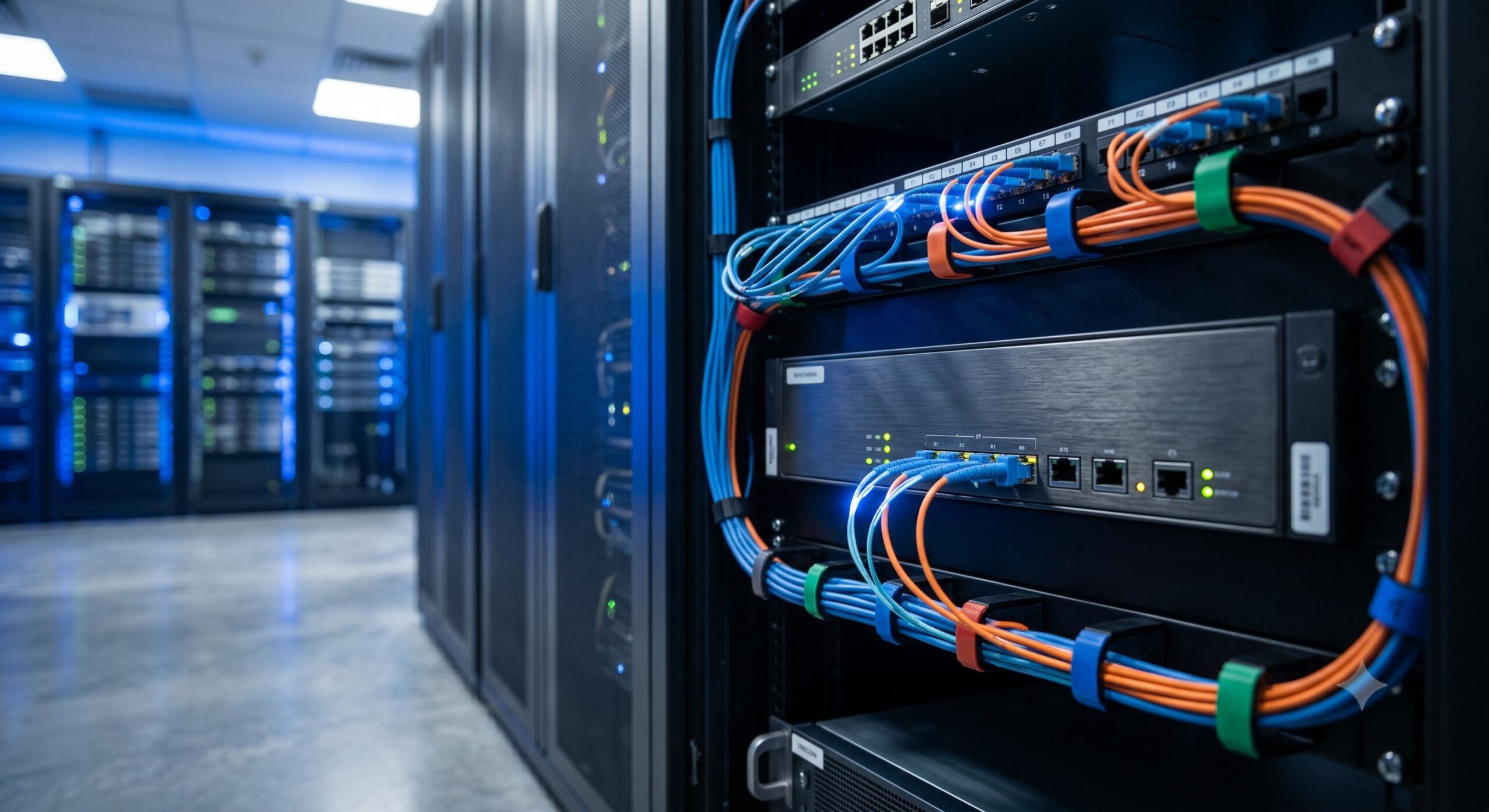
The foundation of a high-performance corporate VPN gateway lies in its hardware architecture. Unlike software-based solutions, enterprise-grade hardware leverages purpose-built ASICs for packet processing, encryption, and forwarding.
Purpose-Built ASIC vs. x86 General-Purpose Processing
Modern, high-density gateways utilize custom ASIC (Application-Specific Integrated Circuit) designs to offload computationally expensive VPN operations. For instance, IPsec encryption, which is notoriously CPU-intensive, is processed at line rate via these dedicated chips. A typical general-purpose x86 server may struggle to achieve more than 2-3 Gbps of IPsec throughput, whereas an ASIC-based platform can consistently deliver 25 Gbps to 100 Gbps per slot. This hardware acceleration provides a deterministic forwarding latency of less than 10 microseconds, a critical metric for latency-sensitive applications like VoIP and video conferencing used by a remote workforce.
Redundancy and High Availability (HA) Design
Carrier-grade reliability is defined by metrics such as MTBF (Mean Time Between Failures) and failover times. Enterprise gateways implement dual-engine failover architectures with sub-second stateful synchronization. The hardware often supports hot-swappable power supplies and fan trays, designed to comply with NEBS (Network Equipment Building System) standards, ensuring an MTBF exceeding 200,000 hours at 40°C ambient temperature.
| Key Parameter | Technical Specification |
|---|---|
| IPsec Throughput (AES-256-GCM) | 25 Gbps (Line Rate per ASIC) |
| Concurrent VPN Sessions | Up to 64,000 |
| Latency (Hardware Forwarding) | ≤ 10 Microseconds |
| MTBF | > 200,000 Hours |
| Encryption Support | AES-GCM-256, ChaCha20-Poly1305, MACsec |
Protocol Compliance and Interoperability
A corporate VPN gateway must navigate a complex landscape of protocols to ensure compatibility across diverse client devices and service provider networks.
IPsec and IKEv2 Support
While SSL/TLS is common for web-based access, the gold standard for site-to-site and secure client connectivity remains IPsec combined with IKEv2 for key exchange. Gateways must support a wide range of encryption algorithms, including AES-GCM-256 and ChaCha20-Poly1305, to offer a balance between security and performance. Hardware-level MACsec (IEEE 802.1AE) is becoming increasingly critical, providing line-rate encryption for data in transit between the gateway and the internal network core, effectively securing traffic against internal eavesdropping.
ITU-T Standards and Carrier Interconnection
For remote workforces connecting via MPLS or carrier Ethernet circuits, adherence to ITU-T Y.1731 and IEEE 802.1ag is paramount. These standards enable robust OAM (Operations, Administration, and Maintenance) capabilities, allowing the gateway to perform proactive connectivity fault management (CFM) and performance monitoring (PM) on the WAN links.
Multi-Vendor Edge Scenarios
The gateway must interoperate seamlessly with a variety of CPEs and cloud providers. This requires rigorous testing against IETF RFCs 6071 and 7296. Many modern gateways now incorporate SD-WAN (Software-Defined WAN) capabilities, using application-aware routing to steer traffic across multiple WAN transports, optimizing the remote user experience.
TCO, ROI, and Operational Gains
A data-driven evaluation of a corporate VPN gateway requires a thorough Total Cost of Ownership (TCO) analysis, considering both CapEx and OpEx.
CapEx vs. OpEx Analysis
The initial capital expenditure (CapEx) of a hardware gateway is often higher than a virtual appliance. However, the operational expenditure (OpEx) is significantly lower. The hardware’s energy efficiency, driven by low-power silicon design, reduces electricity and cooling costs. For example, a high-density chassis might consume 800W, compared to a server farm running a virtual solution that could consume 3,000W or more for equivalent throughput.
Quantified Operational Gains
From an ROI perspective, the primary gain is the reduction in network downtime. The cost of a network outage for a remote workforce can be catastrophic. With an MTBF of 200,000 hours and a failover time under 50ms, enterprise gateways ensure an uptime of 99.999% (five nines). This reliability directly translates to a quantifiable increase in productivity and a reduction in helpdesk tickets related to connectivity.
Conclusion and Deployment Takeaways
The selection and deployment of a corporate network VPN gateway for a remote workforce is a strategic decision that impacts the entire organization. The most successful implementations are those that prioritize hardware acceleration for encryption and forwarding, ensuring low-latency and high-throughput. Compliance with IEEE and ITU-T standards is non-negotiable for interoperability and carrier-grade performance. Ultimately, the data-driven choice points towards hardware solutions that optimize the TCO by reducing power consumption and maximizing reliability. By adhering to the principles outlined in this guide, network architects can create a robust, secure, and highly available infrastructure that empowers their remote workforce.

Leave a comment