
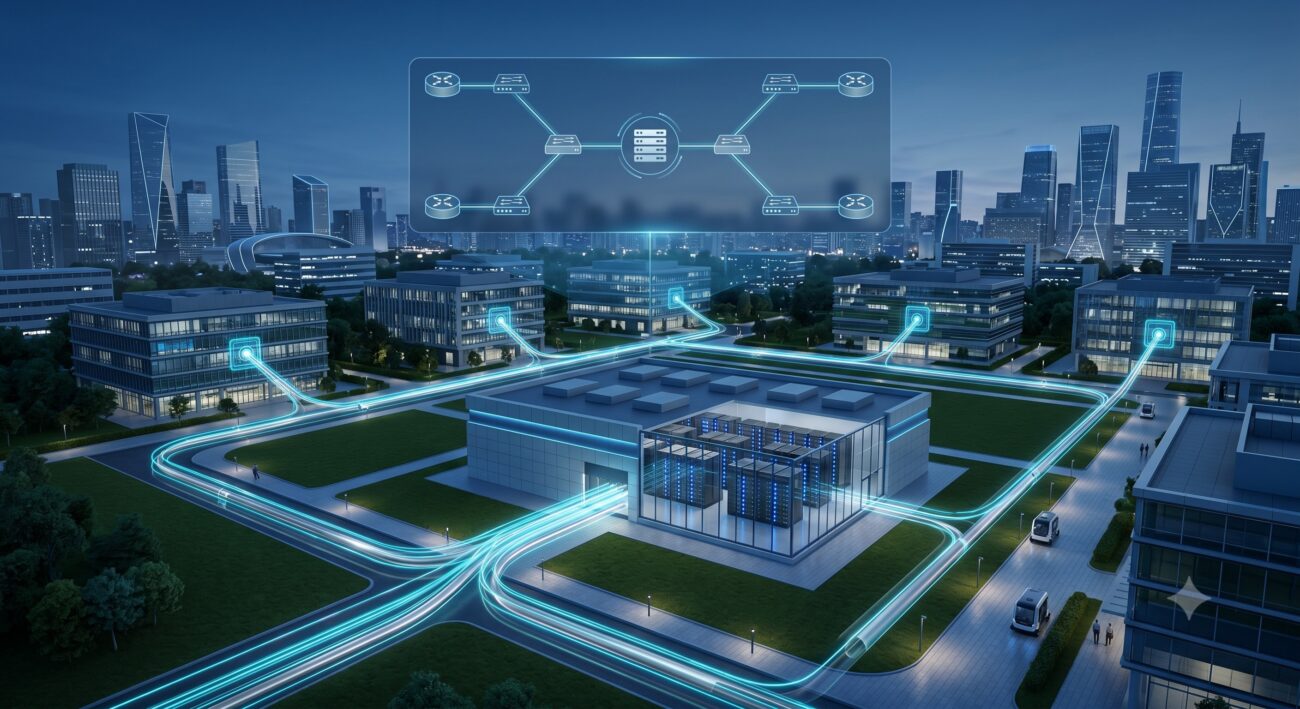
Introduction: The Digital Backbone of Innovation
In the contemporary digital economy, the high-tech park is the crucible of innovation. These ecosystems, housing everything from AI startups to semiconductor fabs and financial trading floors, demand an underlying network infrastructure that is not merely fast, but deterministic, secure, and infinitely scalable. The legacy copper-based Local Area Network (LAN), with its inherent limitations in distance and bandwidth, is proving to be a significant bottleneck. This is the domain of the high-tech park optical fiber access network, a next-generation solution based on Passive Optical Network (PON) technology that is fundamentally reshaping enterprise connectivity .
As organizations transition from on-premise servers to a cloud-first model, traffic patterns have shifted. Modern network flows are predominantly north-south, moving between the campus and the cloud or data centers . The traditional multi-layer switch architecture (core, aggregation, access) is ill-suited for this. The optical fiber access network re-architects the campus LAN by leveraging a point-to-multipoint topology, eliminating active aggregation layers and replacing them with passive optical splitters. This architectural shift, aligning with F5G (Fifth Generation Fixed Network) standards, provides a future-proof foundation that supports immediate requirements and beyond .
This guide serves as a comprehensive resource for network architects, systems integrators, and CTOs tasked with designing or upgrading high-tech park infrastructure. We will dissect the architecture, scrutinize the hardware specifications, and present real-world performance data to illustrate why all-optical networks are becoming the de facto standard for next-generation smart campuses.
Core Architecture & Hardware Topology
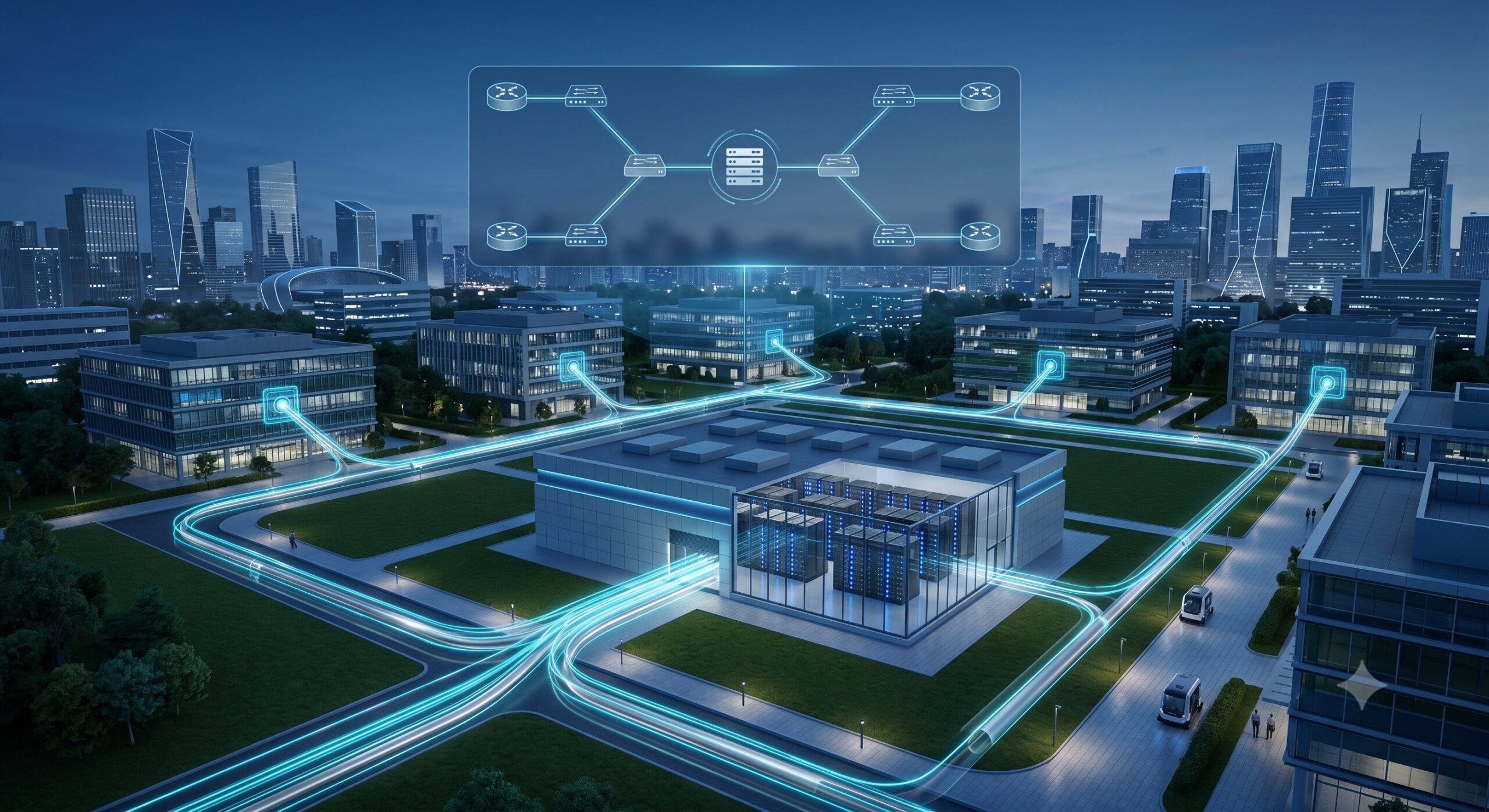
The architecture of a modern high-tech park optical fiber access network is characterized by its simplicity and efficiency. The foundational principle is the replacement of active switches in distribution closets with passive optical splitters, creating a flattened Layer 2 network. This is often referred to as a POL (Passive Optical LAN) or FTTx (Fiber to the x) solution .
The Three-Tier (Simplified) Architecture
While traditional networks have three active layers, the optical network simplifies this into a two or three-level logical hierarchy:
- Core Layer (Central Office/Data Center): This is the heart of the network, housing the high-density chassis OLT (Optical Line Terminal). The OLT serves as the central aggregation point, interfacing with the core routing and switching infrastructure. For example, platforms like the Huawei EA5800 series provide carrier-grade reliability with dual control modules, power supply redundancy, and support for GPON, XGS-PON, and the latest 50G-PON on combo cards .
- Distribution Layer (Passive Optical Splitter): This layer consists of purely passive optical splitters (e.g., 1:32 or 1:64 ratios), typically housed in Fiber Distribution Terminals (FDTs) located in building basements or floors. Because these require no power, they eliminate the need for active equipment rooms, reducing space requirements and operational costs .
- Access Layer (Terminals): The network terminates at the user premises via Optical Network Units (ONUs) or Optical Network Terminals (ONTs). These devices convert optical signals back into electrical interfaces (Gigabit Ethernet, PoE) for end-user devices (PCs, IP Phones, Wi-Fi APs) or provide direct fiber connectivity. Modern ONUs, such as the panel-type P802P, offer sleek designs for desktop deployment, while high-performance Wi-Fi 7 gateways cater to dense wireless environments .
This architecture is particularly advantageous for high-tech parks due to its inherent scalability. As bandwidth demands grow from 1G to 10G and then 50G, upgrades are handled at the OLT and ONU levels without requiring a complete re-cabling of the infrastructure .
Advantages over Legacy Ethernet
The benefits of this architecture are quantifiable. By eliminating active switches in distribution closets:
- Space Savings: Reduces equipment room space requirements by up to 80%, freeing up valuable real estate for core business functions .
- Energy Efficiency: The removal of active aggregation switches and associated cooling significantly lowers power consumption. Data suggests a reduction in energy consumption by up to 70% .
- Operational Simplicity: A flattened network architecture simplifies management. With centralized management platforms, a single administrator can oversee the entire park’s network, reducing operational labor by up to 50% .
Logic Layer Deep Dive: Protocols and Data Plane
Underpinning the physical topology is a robust logic layer that ensures deterministic performance and security. The optical fiber access network utilizes a time-division multiplexing (TDM) scheme on the physical layer, which is efficiently managed by the DBA (Dynamic Bandwidth Allocation) algorithm within the OLT.
Forwarding and Latency
For high-tech park applications, latency is critical. While traditional PON might be perceived as having higher latency than point-to-point Ethernet due to the arbitration process, modern XGS-PON and 50G-PON technologies have virtually eliminated this gap.
- Deterministic Scheduling: The system can guarantee deterministic hard isolation and predictable latency. For instance, modern solutions can support deterministic bandwidth scheduling ranging from 2M to 10G, with latency controlled to under 100 microseconds and jitter precision at the nanosecond level .
- Latency Reduction: In real-world deployments, such as the recent pilot in Chengdu, the network achieved a latency reduction of over 30% compared to previous generations, enabling elastic, on-demand bandwidth adjustments .
Security and Hard Isolation
Data security is paramount in shared campus environments. The optical network addresses this via physical isolation of different services (e.g., voice, data, IoT) through hard slicing. This ensures that security breaches in one service do not impact another, providing guaranteed bandwidth and security for mission-critical applications .
| Parameter | Optical Fiber Access Network (PON) | Legacy Copper LAN (Ethernet) |
|---|---|---|
| Max Data Rate | Up to 50 Gbps (symmetric) | 10 Gbps (copper limitations, asymmetric often) |
| Typical Latency | Variable, dependent on switch load and congestion (1-10ms+) | |
| Network Reach | Up to 20 km (no repeaters) | 100 meters per segment (requires active repeaters) |
| Energy Consumption | 70% less (passive splitters, no cooling in floors) | Baseline (active switches, cooling required for each floor) |
| Cable Lifespan | 30+ years (no replacement needed) | 5-10 years (dependent on environment and standards) |
| Space Required | 80% less (no equipment rooms) | High (space for switches, UPS, cooling per floor) |
| Security Isolation | Hard slicing/physical isolation (Layer 2) | Software VLANs (Layer 2/3, potential for misconfiguration) |
Comparative Benchmark vs. Legacy Systems
To truly grasp the value proposition, a data-driven evaluation of the optical access network versus traditional copper-based Ethernet is essential. The benchmarks below represent a typical comparison for medium and large enterprises, showcasing the superiority of optical media and PON architecture.
Performance and Metrics Comparison
Throughput: The optical fiber access network offers unparalleled scalability, currently supporting up to 50Gbps symmetric bandwidth (50G-PON) to the premises, while copper is limited to 10Gbps and constrained by distance . This directly enables use cases like AI pathology analysis, which can see report generation times reduced from 1 hour to 5 minutes – a 12x efficiency gain .
Latency: A key metric. While gigabit Ethernet switching can introduce significant serialization delays (especially with jumbo frames), modern optical networks are highly deterministic. With advanced DBA, modern PON can achieve sub-millisecond latency with
Reliability: The use of passive splitters drastically reduces the number of active components that can fail. The Mean Time Between Failures (MTBF) is significantly higher. The entire network has a designed lifespan of over 30 years without requiring media replacement.
Case Study: Implementation and Operational Gains
Real-world deployments validate the theoretical benefits of high-tech park optical fiber access networks. A recent success story involves a collaboration between ZTE and China Telecom Shanghai Branch, which launched a high-end PON computing-network gateway in a high-tech park . This solution integrated an all-optical foundation with multi-dimensional security and edge AI computing.
The results were remarkable:
- Network Reliability: The all-optical base provided a high-speed and stable network environment, ensuring “0” disconnections for various services .
- Operational Efficiency: By integrating video and AI analytics, the solution improved alert response times by over 50% .
- Cost Reduction: The intelligent energy management system, driven by integrated computing power, helped enterprises in the park reduce operating costs by an average of approximately 40% .
Furthermore, the deployment of F5G industrial optical networks at Dongfeng Intelligent Equipment Industrial Park demonstrated significant operational improvements. The implementation simplified network architecture, reduced troubleshooting time from hours to minutes, and laid a solid foundation for smart manufacturing applications .
Migration Strategy and Conclusion
Transitioning to a high-tech park optical fiber access network is a strategic investment that requires a phased approach. While the physical fiber plant is designed to last 30 years, the active equipment is lifecycle-managed.
- Assessment: Evaluate the current network’s capabilities against future bandwidth and latency requirements. Identify key use cases (e.g., AI, industrial automation) that require immediate upgrade.
- Phased Deployment: Many existing parks already have fiber to the building; the upgrade often involves transitioning from a traditional Ethernet switch in the basement to a PON ONU. This is a simple, non-disruptive change.
- Scalability: The beauty of the architecture is that upgrading from 10G-PON to 50G-PON does not require changing the ODN (Optical Distribution Network). It simply involves changing line cards at the OLT and the ONUs at the edge.
The high-tech park optical fiber access network is more than a network upgrade; it is a paradigm shift. It moves the network from a passive utility to an active enabler of business value. The ultra-low latency, deterministic performance, and operational simplicity of these all-optical solutions are essential for supporting the AI-driven workloads and cloud-native applications that define the modern high-tech park.

Investing in this infrastructure today ensures that the campus has the digital backbone to support the innovations of tomorrow, providing a significant competitive advantage in the digital era.

Leave a comment