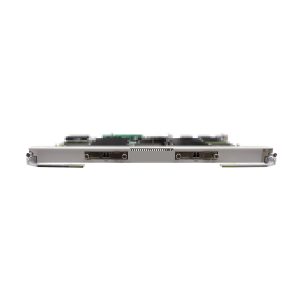


TNG2OH20

0 Reviews Write a review
SKU2037021
AvailabilityIn Stock
WarrantyUp to 36 months i
×
Warranty Policy
We provide a comprehensive warranty policy.
Refer to the table for more details.

Huawei OptiX OSN 9800 TNG2OH20 20-Port optical hybrid service processing board (Super C-band,190.675THz~196.675THz)

Description

TNG2OH20 Overview

TNG2OH20 20-Port optical hybrid service processing board (Super C-band,190.675THz~196.675THz).

To meet ultra-large cross-connect capacity and bandwidth requirements, Huawei presents the OptiX OSN 9800 product series. The OptiX OSN 9800 product series include the OptiX OSN 9800 U64, U32, P18 and universal platform subracks. Applied at the electrical layer, the OptiX OSN 9800 U64 and U32 subracks share boards by using unified software and hardware platforms, and can work with the OptiX OSN 9800 universal platform subrack and P18 subrack, OptiX OSN 8800 platform subrack and T16 subrack, and OptiX OSN 6800 optical subracks in WDM and OTN systems.

The TNG2OH20 board has only one variant: TNG2OH20L01, TNG2OH20S01.


Valid slots for the TNG2OH20 board in M05/M12/M24 subrack

Device Number of Occupied Slots Physical Slot Logical Slot
OptiX OSN 9800 M05 2 (IU1, IU2) IU1
(IU2, IU3) IU2
(IU3, IU4) IU3
(IU4, IU5) IU4
OptiX OSN 9800 M12 2 (IU1, IU2) IU1
(IU2, IU3) IU2
(IU3, IU4) IU3
(IU4, IU5) IU4
(IU5, IU6) IU5
(IU6, IU7) IU6
(IU7, IU8) IU7
(IU8, IU9) IU8
(IU9, IU10) IU9
(IU10, IU11) IU10
(IU11, IU12) IU11
(IU12, IU13) IU12
OptiX OSN 9800 M24 2 (IU1, IU2) IU1
(IU2, IU3) IU2
(IU3, IU4) IU3
(IU4, IU5) IU4
(IU5, IU6) IU5
(IU8, IU9) IU8
(IU9, IU10) IU9
(IU10, IU11) IU10
(IU11, IU12) IU11
(IU13, IU14) IU13
(IU14, IU15) IU14
(IU15, IU16) IU15
(IU16, IU17) IU16
(IU17, IU18) IU17
(IU20, IU21) IU20
(IU21, IU22) IU21
(IU22, IU23) IU22
(IU23, IU24) IU23
Item TNG2OH20

Functions and Features of the TNG2OH20 Board (OA)

Basic function
  • Amplifies the power of the received optical signals in the super C band.
  • The OSC has no limitation on the distance between two optical line amplifiers. The failure of an optical line amplifier does not affect the performance of the OSC.
Working mode Supports the gain locking, power locking and APC modes.
  • In the gain locking mode, the gain of the board is tunable and the user can query the actual gain of the board. The gain locking mode is enabled by default.
  • The power locking mode is used to lock the output power of the board in scenarios in which only dummy lights are present.
  • Automatic Power Control (APC) is one type of power locking modes. Compared with traditional power locking, APC gradually increases optical power and has no light output if no light input is present.
Gain adjustment
  • TNG2OH20L01: Adjusts the gain based on the input optical power. The transmit OA can implement the continuous adjustment of the gain ranging from 18 dB to 25 dB, and the receive OA can implement the continuous adjustment of the gain ranging from 23 dB to 32 dB.
  • TNG2OH20S01: Adjusts the gain based on the input optical power. The transmit OA can implement the continuous adjustment of the gain ranging from 19 dB to 25 dB, and the receive OA can implement the continuous adjustment of the gain ranging from 18 dB to 25 dB.
Transient control The EDFA inside the board has the transient state control function. When channels are added or dropped, the board can suppress the power fluctuation inside the signal channels to support smooth upgrades and expansions.
Online optical performance monitoring Provides an online monitoring optical port (MON). Through this optical port, a small number of optical signals can be output to an optical spectrum analyzer or an optical spectrum analyzer board. In this manner, the spectrum and optical performance of the multiplexed optical signals can be monitored without interrupting services.
Optical Doctor Supported
Digital optical label The board can work with the OTU board that supports the digital optical label function to detect digital optical label overheads and optical power:
  • Ports TAOUT and RAOUT support LS overheads and provide the automatic fiber discovery function in wavelength adding/dropping scenarios. After the Optical Doctor management system license and the OD function are configured, these ports provide route visualization and trail verification functions.
  • Ports TAOUT and RAOUT support detecting LS optical power and provide the single-wavelength optical power detection function. After the Optical Doctor management system license and the OD function are configured, these ports support OSNR detection.
Alarm and performance event monitoring
  • Detects and reports optical power levels.
  • Monitors the temperature of the pump laser.
  • Detects the drive current, pump cooling current, and temperature of the pump laser and the ambient temperature of the board.

Functions and Features of the TNG2OH20 Board (ROADM)

Basic function Implements optical-layer service grooming for multiple wavelengths.
  • Wavelength adding: adds any wavelengths from any directions through ports AM2 to AM20.
  • Wavelength dropping: drops wavelengths to any directions, and outputs them through ports DM2 to DM20.
WDM specification Supports the DWDM specifications.
Spectrum application
  • Supports Super C-band wavelengths.
  • Supports flexible grid wavelength signals. The channel spacing is n x slice. (The minimum slice is 6.25 GHz. The value of n ranges from 6 to 64. That is, a single channel is adjustable within the range of 37.5 GHz to 400 GHz.)
Optical-layer ASON Supported
Optical power adjustment Adjusts the optical power of any add wavelengths at the local station.
Loopback Supported
Alarm and performance event monitoring Detects the optical power and reports the alarms and performance events for the board.

Functions and Features of the TNG2OH20 Board (FIU)

Basic function Multiplexes and demultiplexes signals transmitted along the main path and optical supervisory channel.

Functions and Features of the TNG2OH20 Board (OSC)

Basic function
  • Receives, processes, and transmits two optical supervisory signals.
  • The OSC has no limitation on the distance between two optical line amplifiers. The failure of an optical line amplifier does not adversely affect the OSC performance.
Operating wavelength of the OSC The board has a built-in optical supervisory signal optical module with wavelengths 1491 nm and 1511 nm.
NOTE:
It indicates the wavelength of an optical module, which is usually the wavelength of the transmit port.
OSC signal regeneration function The board transmits signals from section to section. It also has the 3R function. In each regenerating station that has optical amplifiers, information can be correctly received and new supervisory signals are added.
Line fiber quality monitoring
  • The line fiber quality monitoring function can be used on the NMS, and the NMS will display monitoring figures and data. The online and offline applications of line fiber quality monitoring are supported.
  • The Fiber Doctor Management System Software Fee License needs to be purchased for this function.
Physical clock Supported
IEEE 1588v2 Supported
ITU-T G.8275.1 Supported
ITU-T G.8273.2 Supported
High-precision clock synchronization Not supported
Latency measurement Supports OTS latency measurement.
Loopback Supports outloops.

Additional information

Reviews

There are no reviews yet.

Be the first to review “TNG2OH20”

Your email address will not be published. Required fields are marked *

  ×  7  =  28

Back to Top

Search For Products

Product has been added to your cart