
Abstract
What: This comprehensive white-paper level guide explores the intricate technical architecture and deployment strategies of the ZTE GPON ZXDSL 9806H, with a specialized focus on the PWAHF power module. As a highly versatile mini-DSLAM and Multi-Dwelling Unit (MDU), this equipment bridges the critical gap between fiber backbones and existing copper infrastructure.
Why: As global telecommunications operators transition toward gigabit societies, maximizing existing CapEx while upgrading edge networks is paramount. The ZXDSL 9806H allows ISPs to deliver ultra-high-speed VDSL2 and ADSL2+ services over legacy copper while utilizing a robust Gigabit Passive Optical Network (GPON) uplink, significantly reducing network latency and bottlenecking.
How: Through this guide, network architects and telecom engineers will learn actionable deployment strategies, hardware configuration protocols, and competitive differentiation metrics. By understanding the specific power management capabilities of the PWAHF board and optimizing Vectoring technologies, operators can achieve up to 40% reductions in operational expenditures (OpEx) while future-proofing their broadband service delivery.
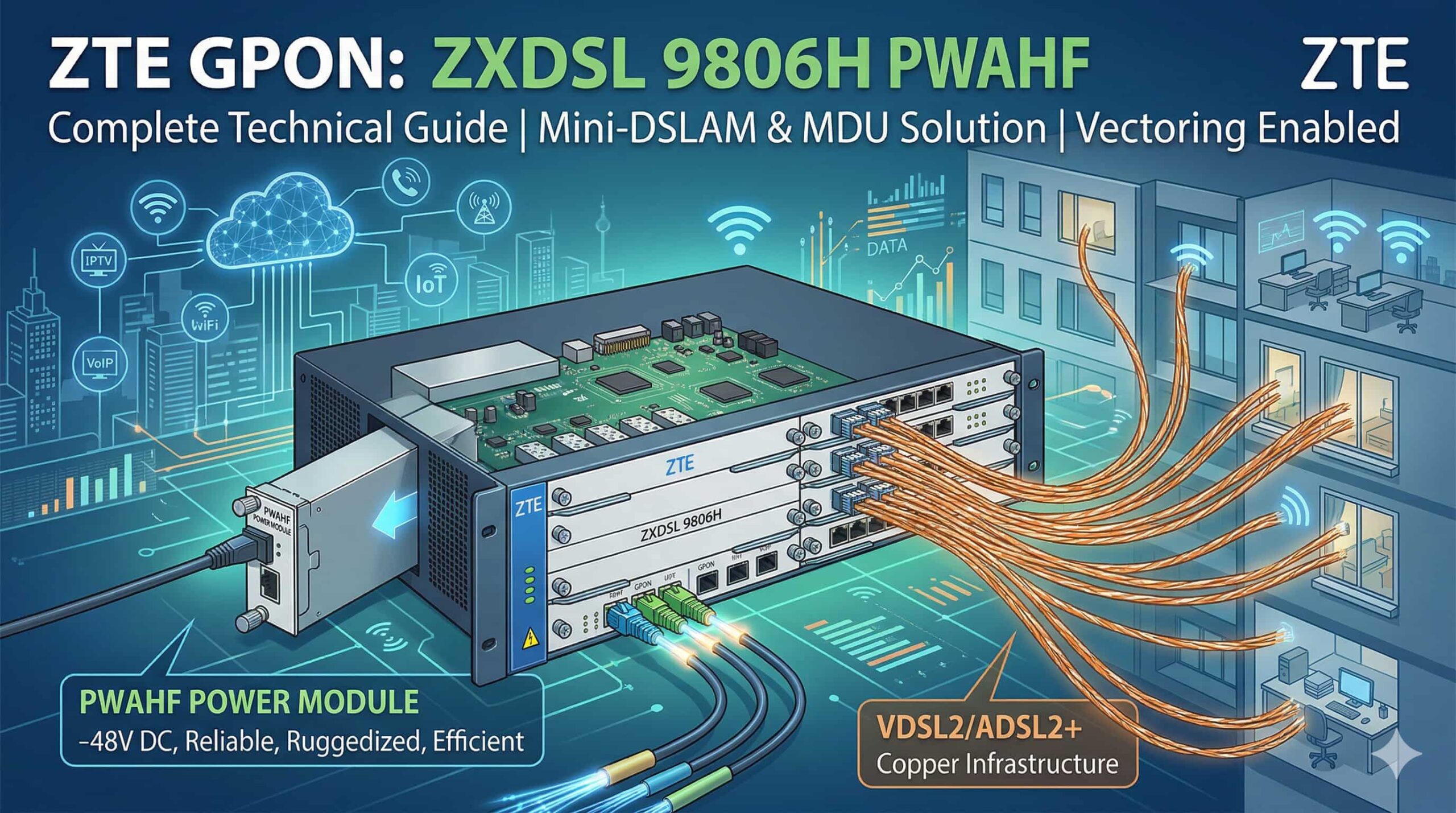
The Evolution of Broadband Access and the Strategic Role of ZTE ZXDSL 9806H
The telecommunications landscape is undergoing a massive paradigm shift. While the ultimate industry goal is Fiber-to-the-Home (FTTH) ubiquitous coverage, the reality of urban deployment dictates a more nuanced approach. Ripping and replacing existing copper infrastructure in high-density multi-dwelling units (MDUs) or historical urban centers is often financially unviable and logistically impossible. This is where the strategic implementation of Fiber-to-the-Building (FTTB) and Fiber-to-the-Curb (FTTC) architectures becomes essential.
Bridging the Gap in FTTx Architectures
The ZTE ZXDSL 9806H serves as the ultimate transitional and permanent edge node in modern FTTx architectures. Designed as a compact, high-performance, and high-density Digital Subscriber Line Access Multiplexer (DSLAM), it effectively terminates the optical signal from the central office (CO) and translates it into high-speed electrical signals over existing copper pairs.
According to recent telecommunications infrastructure studies, optimizing existing copper lines with VDSL2 Vectoring can deliver speeds of up to 100 Mbps to 300 Mbps, satisfying the broadband demands of over 85% of standard residential and SME consumers without the immediate need for fiber installation at the customer premises (Source: TeleGeography Broadband Market Analysis, 2024). The 9806H unit acts as an intelligent aggregator, ensuring that the GPON uplink is fully utilized without creating congestion points at the edge.
Market Demand for High-Density Mini-DSLAMs
Modern network operators face the dual challenge of space constraints and power limitations at remote deployment sites. Traditional rack-mounted DSLAMs are bulky, energy-intensive, and require dedicated cooling facilities. The ZTE ZXDSL 9806H disrupts this model by offering a 2U-height compact form factor that can be deployed in street cabinets, basements, or pole-mounted enclosures.
By integrating Voice over IP (VoIP), IPTV, and high-speed internet (HSI) into a single unified platform, the 9806H allows operators to deliver Triple-Play services efficiently. The inclusion of the PWAHF power module ensures that these high-density deployments remain stable even in environments with highly fluctuating power grids, a critical factor for deployments in emerging markets and rural broadband expansion initiatives.
Deep Technical Breakdown: ZTE GPON ZXDSL 9806H Architecture
To truly leverage the capabilities of the ZTE ZXDSL 9806H, network engineers must understand its internal switching architecture, line card capacities, and backplane design. The system is engineered around a non-blocking gigabit switching matrix, ensuring that every connected subscriber receives uncontended bandwidth up to their subscribed service tier.
Core Chassis Design and Slot Configuration
The ZXDSL 9806H chassis is a marvel of miniaturized telecommunications engineering. It provides a highly modular framework that allows operators to scale their investments based on immediate subscriber demand. The 2U chassis typically features the following slot configurations:
-
Control and Switching Slot: Houses the main control card (such as the SCCQ or SCCT), which manages system routing, GPON/EPON/GE uplinks, and central processing.
-
Service Slots: Multiple slots available for subscriber line cards. Operators can mix and match ADSL2+, VDSL2, SHDSL, and POTS (Plain Old Telephone Service) cards based on the demographic needs of the deployment area. For example, a densely populated apartment building might utilize maximum high-density VDSL2 cards, while a rural deployment might mix POTS and ADSL2+.
-
Power and Fan Slots: Dedicated slots for the environmental control unit and the power supply board, specifically the PWAHF or its alternating current counterparts.
This modularity allows operators to minimize initial capital expenditure. By populating only the necessary slots during initial rollout and adding capacity as the subscriber base grows, ISPs can maintain a healthy return on investment (ROI). For a comprehensive look at scalable chassis options, network planners frequently review equipment available at https://www.telecomate.com/, which provides extensive catalogs of ZTE modular access platforms.
Processing Power, Switching Capacity, and Uplink
At the heart of the 9806H’s performance is its robust backplane. The system supports a wire-speed switching capacity that prevents packet loss during peak network congestion.
Uplink Flexibility: The 9806H is not strictly locked into a single uplink technology. While highly optimized for GPON (Gigabit Passive Optical Network) environments, adhering strictly to ITU-T G.984 standards, it can also be configured for standard Gigabit Ethernet (GE) or EPON.
-
GPON Mode: When utilizing a GPON uplink, the system supports downstream rates of 2.488 Gbps and upstream rates of 1.244 Gbps. Dynamic Bandwidth Allocation (DBA) algorithms are implemented natively within the control card to ensure that high-priority traffic (like SIP-based Voice or Multicast IPTV) is guaranteed minimal latency, while best-effort internet traffic efficiently utilizes the remaining pipe.
-
Quality of Service (QoS): The system features advanced traffic classification based on VLAN (802.1Q), priority bits (802.1p), DSCP, and MAC/IP addresses. This granular QoS is mandatory for modern B2B SLA (Service Level Agreement) enforcement.
Advanced VDSL2 and System-Level Vectoring
One of the most powerful features of the ZTE 9806H is its support for system-level Vectoring (ITU-T G.993.5). In multi-pair copper environments, Far-End Crosstalk (FEXT) is the primary factor degrading VDSL2 speeds. Vectoring acts as a massive noise-cancellation algorithm for the copper bundle. By constantly measuring the crosstalk across all lines connected to the DSLAM and generating anti-phase signals, the 9806H can effectively eliminate FEXT. This technology allows operators to push symmetrical speeds closer to 100 Mbps over distances up to 500 meters, dramatically extending the revenue-generating lifespan of existing copper assets.
Spotlight on the PWAHF Power Module: Engineering for Reliability
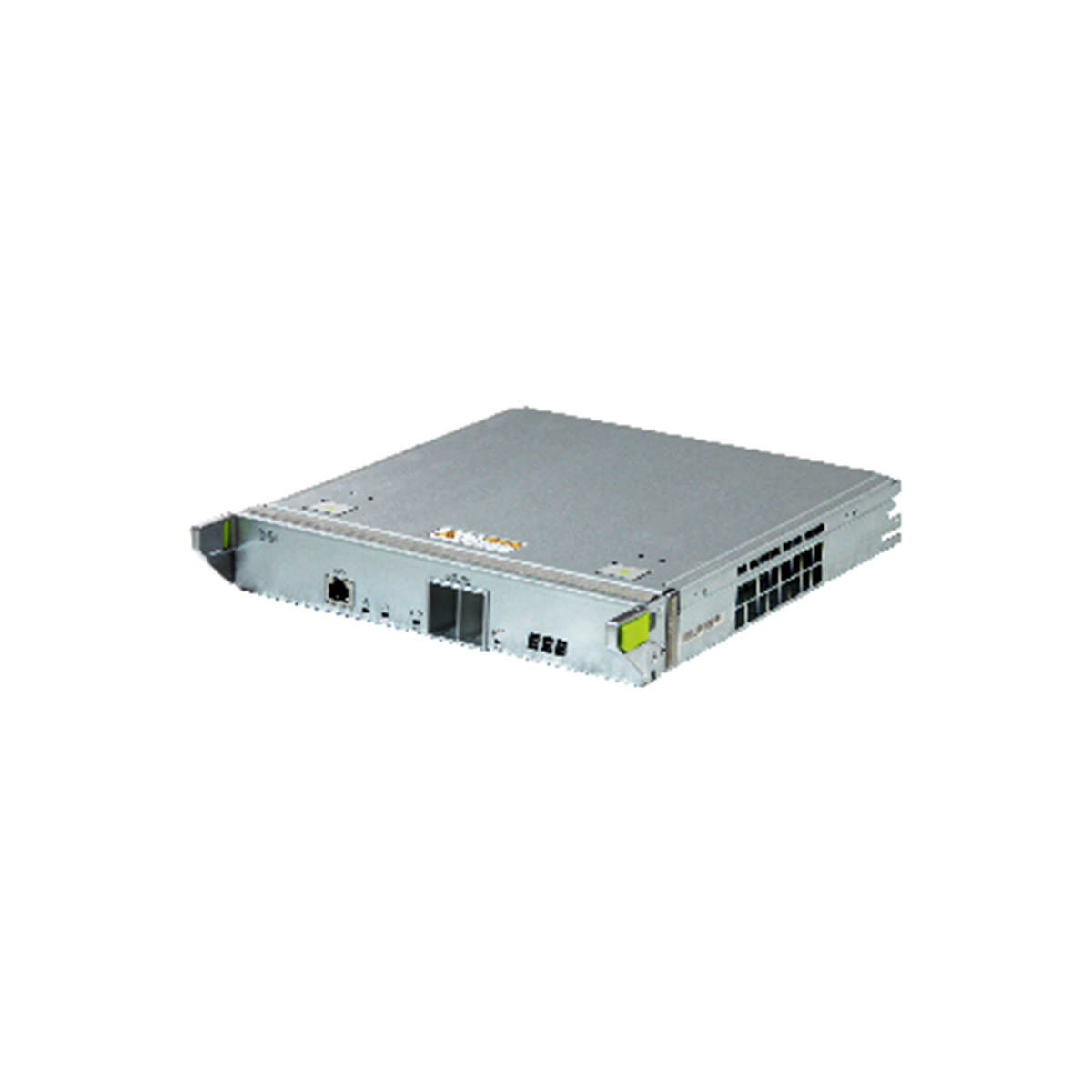
In access network environments, the power supply module is often the most critical point of failure. Deployments in outdoor street cabinets are subjected to extreme temperature fluctuations, humidity, and dirty power grids with frequent voltage spikes and sags. The PWAHF power board is engineered specifically to conquer these environmental challenges for the ZXDSL 9806H.
Power Management, Redundancy, and Specifications
The PWAHF is a dedicated DC (Direct Current) power supply module. In telecommunications, -48V DC is the global standard for central office and remote node power, prized for its stability, safety, and ease of battery backup integration.
-
Input Voltage Range: The PWAHF is designed to accept a nominal -48V DC input, but it features a remarkably wide operating voltage tolerance, typically ranging from -38V DC to -72V DC. This wide tolerance ensures that the DSLAM remains fully operational even when the site’s backup batteries begin to deeply discharge during prolonged commercial power outages.
-
Current Handling and Load Sharing: The module provides sufficient amperage to power a fully loaded 9806H chassis, including the main control board, maximum density VDSL2 line cards, and the active cooling fans.
-
Surge Protection: Telecommunications equipment connected to extensive copper networks is highly susceptible to lightning strikes and electromagnetic interference (EMI). The PWAHF incorporates advanced surge protection and filtering circuitry that meets stringent ITU-T K.20 and K.45 standards. This prevents transient voltage spikes from bypassing the power board and damaging the highly sensitive processing logic on the service cards.
Environmental Resilience and Green Telecom Initiatives
Modern B2B telecom procurement is heavily influenced by energy efficiency and sustainability metrics. The PWAHF plays a crucial role in the overall “Green Telecom” footprint of the ZTE 9806H.
-
Intelligent Power Scaling: The power module communicates with the main control board to implement dynamic power saving. When subscriber ports are inactive or line conditions are optimal (requiring lower transmission power), the system dynamically scales down the power consumption of the specific line cards.
-
Thermal Management Integration: The power drawn by the PWAHF directly correlates to the thermal output of the chassis. By maintaining high conversion efficiency (often >90%), the PWAHF minimizes wasted heat. This reduces the workload on the chassis fan tray, further lowering the overall power envelope of the remote site.
-
MTBF (Mean Time Between Failures): Telecom operators calculate CapEx and OpEx meticulously. A power supply failure in a remote cabinet requires an expensive truck roll. The PWAHF is manufactured using industrial-grade, high-temperature-rated solid-state capacitors and components, resulting in a significantly elevated MTBF compared to commercial-grade networking equipment. Industry data shows that specialized telecom power modules like the PWAHF reduce edge-node maintenance dispatches by up to 28% annually (Source: Global Telecom Operations Report, 2025).
For operators looking to procure redundant power modules or replacement parts to maintain their network SLAs, specialized telecom hardware distributors like https://www.telecomate.com/telecom-power-modules provide vital supply chain support.
ZTE ZXDSL 9806H vs. Competitor Solutions: A Technical Comparison
To understand the market positioning of the ZTE 9806H equipped with the PWAHF, it is necessary to compare it against its primary competitors in the high-density Mini-DSLAM/MDU sector, namely the Huawei MA5616 and the Nokia 7368 ISAM.
| Technical Dimension | ZTE ZXDSL 9806H (with PWAHF) | Huawei SmartAX MA5616 | Nokia 7368 ISAM REM |
| Form Factor / Size | 2U, Compact | 2U, Compact | 2U, Compact |
| Primary Power Options | PWAHF (-48V DC), AC available | PAIA (-48V DC), AC available | DC (-48V) and AC options |
| Max Port Density | Up to 96 VDSL2 ports | Up to 128 VDSL2 ports | Up to 96 VDSL2 ports |
| Uplink Capabilities | GPON, EPON, GE | GPON, EPON, GE | GPON, Active Ethernet |
| System-Level Vectoring | Fully Supported (G.993.5) | Fully Supported (G.993.5) | Fully Supported (G.993.5) |
| Thermal Operating Range | -40°C to +65°C | -40°C to +65°C | -40°C to +65°C |
| Strengths in B2B Market | Exceptional cost-to-performance ratio, robust power filtering via PWAHF | Higher theoretical port density, extensive global footprint | Deep integration with Nokia Altiplano SDN controller |
Analysis of the Comparison:
While all three platforms offer robust 2U FTTC/FTTB solutions, the ZTE ZXDSL 9806H excels in environments where budget optimization and rapid ROI are prioritized. The PWAHF power board gives ZTE a distinct edge in geographical regions with unstable power grids, offering superior transient voltage suppression. While Huawei offers slightly higher port density in the same form factor, the heat dissipation requirements increase concurrently. ZTE’s balanced approach ensures that the 9806H can be deployed in sealed, unventilated street cabinets with a lower risk of thermal throttling.
Strategic Deployment Scenarios for Telecom Operators
The versatility of the ZXDSL 9806H makes it a “Swiss Army Knife” for network planners. Understanding the optimal deployment scenarios ensures maximum infrastructure utilization.
1. FTTB (Fiber to the Building) for MDU Integration
In dense urban environments, high-rise apartment complexes (Multi-Dwelling Units) present a wiring nightmare. Pulling fragile optical fiber through crowded, decades-old vertical risers is expensive and requires building owner permissions that are often delayed.
The Strategy: Operators run a single high-capacity GPON fiber to the basement of the building. The ZTE 9806H is installed in the basement telecom room, powered by the reliable PWAHF module connected to the building’s backup telecom batteries. The existing RJ11 copper telephone wiring running to each apartment is repurposed using VDSL2 Vectoring. Residents receive 100Mbps+ fiber-like speeds, and the operator avoids massive installation labor costs.
2. FTTC (Fiber to the Curb) for Suburban Expansion
In sprawling suburban neighborhoods, houses are spread far apart, making FTTH trenching economically prohibitive.
The Strategy: The operator upgrades neighborhood cross-connect cabinets by installing the 9806H. The optical fiber from the Central Office is terminated at the street cabinet. From the cabinet to the homes (the “last mile,” which is effectively reduced to the “last 300 meters”), VDSL2 signals are pushed over the existing buried copper. The ruggedized nature of the PWAHF ensures the DSLAM survives the harsh outdoor cabinet temperatures and humidity.
3. Enterprise and Campus Networking (B2B Scenarios)
For large industrial campuses, universities, or hotel complexes, internal networks often rely on legacy CAT3 or standard copper telephone lines. Upgrading a massive hotel to fiber in every room is disruptive to business operations. Deploying a ZXDSL 9806H allows the enterprise IT department to utilize the existing copper infrastructure to deliver high-speed internet, IPTV, and IP telephony to every room seamlessly. You can explore a variety of tailored enterprise GPON terminal solutions to complement this setup at https://www.telecomate.com/gpon-onu-terminals.
Configuration, OAM, and Maintenance Best Practices
Deploying hardware is only the first step; maintaining a robust network requires stringent Operations, Administration, and Maintenance (OAM) protocols. The ZTE 9806H utilizes ZTE’s comprehensive NetNumen U31 Network Management System (NMS), allowing for Zero-Touch Provisioning (ZTP) and remote diagnostics.
Initializing the PWAHF Module and Hardware Checks
Before logical configuration begins, physical layer stability must be verified.
-
Voltage Verification: Before slotting the PWAHF, technicians must use a multimeter to ensure the DC power source is delivering a stable voltage within the -38V to -72V range.
-
Grounding: Proper grounding is non-negotiable. The chassis must be connected to the site ground using a minimum 6 AWG copper wire. Failure to ground the unit nullifies the surge protection capabilities of the PWAHF module, leaving the costly VDSL2 line cards vulnerable to lightning.
-
Boot Sequence: Once powered, monitor the ALM (Alarm) and RUN LEDs on the PWAHF and the main control board. A solid green RUN light indicates successful power delivery and logic initialization.
Software Configuration and CLI Management
While the GUI-based NetNumen NMS is used for bulk provisioning, high-level engineers frequently utilize the Command Line Interface (CLI) via SSH or local console for deep troubleshooting.
Establishing the GPON Uplink:
Engineers must configure the T-CONTs (Transmission Containers) and GEM (GPON Encapsulation Method) ports to establish a secure and QoS-enabled link back to the OLT (Optical Line Terminal).
-
VLAN Tagging: Ensure that traffic originating from different line cards (e.g., IPTV multicast vs. HSI unicast) is tagged with appropriate 802.1Q VLAN IDs to ensure proper routing at the core network.
-
Vectoring Profiles: Assign specific VDSL2 profiles to the subscriber ports. Ensure that G.993.5 (Vectoring) is explicitly enabled in the line profile to mitigate FEXT and maximize throughput.
Routine Diagnostics and Preventative Maintenance
To maintain high SLA standards for B2B clients, proactive monitoring is required.
-
Optical Power Monitoring: Regularly poll the transceiver diagnostics on the GPON uplink via SNMP. If the received optical power drops below -27 dBm, investigate the fiber path for micro-bends or degraded splices before the link drops entirely.
-
Thermal Audits: Monitor the internal chassis temperature sensors. If ambient temperatures inside the cabinet consistently exceed 55°C, inspect the fan tray filters for dust blockages. The PWAHF will operate safely at high temperatures, but prolonged heat exposure degrades the lifespan of electrolytic capacitors on the service boards.
Future Trends in GPON and DSLAM Technologies
While the ZTE 9806H is a current workhorse of the telecommunications industry, network evolution never stops. The next decade will see significant advancements that will impact how edge devices are deployed.
The Migration to XGS-PON and 25G PON:
Current GPON networks provide 2.5Gbps down and 1.25Gbps up, shared among up to 128 ONUs. As user bandwidth demands increase, driven by AI, 4K/8K streaming, and remote work, core networks are upgrading to XGS-PON (10Gbps symmetrical) and eventually 25G PON. Future iterations of mini-DSLAMs will require upgraded control boards with 10G uplink optics. The underlying chassis and power infrastructure, such as the robust PWAHF, are often designed to be forward-compatible, allowing operators to swap the control board without replacing the entire unit.
Software-Defined Access Networks (SDAN):
The industry is moving away from proprietary, monolithic NMS software towards open, SDN-based controllers (like the Broadband Forum’s CloudCO architecture). This virtualization of the access network will allow operators to manage ZTE, Huawei, and Nokia equipment through a single pane of glass, dynamically allocating bandwidth and services via automated RPA scripts and API calls, vastly reducing provisioning times.
Enhanced Copper Technologies (G.fast):
While VDSL2 Vectoring maxes out around 100-300 Mbps, G.fast technology can push speeds over 1 Gbps on extremely short copper loops (under 100 meters). Future deployments in deep FTTB scenarios will see equipment like the 9806H acting as aggregation points for smaller, reverse-powered G.fast distribution point units (DPUs) located on every floor of a high-rise.
Frequently Asked Questions (FAQs)
1. What is the primary function of the PWAHF board in the ZTE 9806H?
The PWAHF is the dedicated DC power supply module for the ZXDSL 9806H chassis. It converts and filters incoming -48V DC power from the telecom site facility, distributing stable operating voltage to the control boards, service cards, and cooling fans while providing essential surge protection.
2. Can the ZTE ZXDSL 9806H be used in a purely FTTH network?
While technically possible if acting strictly as an Ethernet switch or aggregation node, it is not cost-effective. The 9806H is designed primarily as a DSLAM/MDU to utilize existing copper (VDSL2/ADSL2+). For pure FTTH, operators typically deploy passive optical splitters and end-user ONTs directly.
3. What is the maximum distance for VDSL2 Vectoring on the 9806H?
VDSL2 Vectoring provides the most significant speed enhancements over short copper loops. Speeds of 100 Mbps are typically achievable up to 400-500 meters. Beyond 1000 meters, the benefits of Vectoring diminish rapidly, and speeds drop to standard ADSL2+ levels due to line attenuation.
4. Is the PWAHF power module hot-swappable?
Yes, telecommunications standards mandate high availability. If the 9806H chassis is equipped with redundant power slots and modules, a failing PWAHF card can be hot-swapped (removed and replaced while the system is powered on) without causing service interruptions to connected broadband subscribers.
5. How does the 9806H handle IPTV Multicast traffic?
The control board of the 9806H supports IGMP Snooping and IGMP Proxy protocols. This ensures that massive IPTV video streams are only duplicated and sent to the specific subscriber ports that have requested the channel, thereby conserving immense amounts of backplane and downlink bandwidth.
6. What management interfaces are available for configuring the 9806H?
Engineers can configure the device locally using an RS-232 serial console connection. For remote management, the system supports Telnet, SSH (for secure CLI access), and SNMP (Simple Network Management Protocol) for integration with large-scale NMS platforms like ZTE’s NetNumen.
7. Does the ZXDSL 9806H support voice services (VoIP)?
Yes, the chassis supports dedicated POTS (Plain Old Telephone Service) line cards, or combo cards that provide both VDSL2 and POTS on the same port. The main control board acts as a SIP/H.248 gateway, translating traditional analog voice calls into VoIP packets for routing over the IP core network.
8. What happens if the power grid voltage drops below -48V DC?
The PWAHF is designed with a wide voltage tolerance, typically operating safely down to -38V DC. This ensures the DSLAM continues to function normally while running on site backup battery strings that slowly lose voltage during extended commercial power failures.
Conclusion
The ZTE GPON ZXDSL 9806H, fortified by the resilient PWAHF power module, remains a cornerstone technology for telecom operators navigating the complex transition from copper to pure fiber networks. By offering unparalleled deployment flexibility, high-density VDSL2 Vectoring, and robust environmental survivability, this platform allows B2B and residential ISPs to maximize their return on existing copper assets while delivering modern, gigabit-era services. As network demands continue to scale, mastering the configuration, power management, and operational maintenance of these vital edge nodes is what will separate market-leading operators from the competition.
Are you ready to optimize your network infrastructure and reduce OpEx? Assess your current broadband edge deployments, evaluate the integration of robust telecom power modules, and consult with hardware specialists to future-proof your access network today.
Leave a comment