
The ZTE ZXR10 8908E represents a pinnacle in modular, high-end switching designed for the “cloud-native” era, where bandwidth demands and low-latency requirements are non-negotiable. As enterprises and service providers migrate toward 100G/400G backbones, the ZXR10 8908E series offers a robust, carrier-class foundation that integrates Terabit switching capacity with advanced virtualization (VSC 2.0) and energy-efficient design. This article explores the technical nuances of the 8908E chassis, its architectural advantages in SDN-ready environments, and why it remains a top-tier choice for campus cores and data center interconnects. Readers will gain a comprehensive understanding of its performance metrics, reliability frameworks, and deployment strategies to future-proof their network infrastructure against the data-heavy demands of 2026 and beyond.
The Evolution of Terabit Switching in the B2B Landscape
The global demand for high-speed Ethernet switching is projected to grow significantly as AI-driven workloads and edge computing become mainstream. According to the IDC Worldwide Quarterly Ethernet Switch Tracker (2025), the shift toward modular, high-port-density switches is accelerating in the enterprise sector. The ZTE ZXR10 8908E sits at the heart of this transition.
In the past, core switches were judged primarily on raw throughput. Today, the criteria have shifted toward “Intelligent Resilience” and “Programmability.” Modern network administrators are no longer just looking for a box that moves packets; they are looking for a platform that can handle multi-tenant isolation, automated provisioning via SDN, and granular security at the hardware level. ZTE’s 8900E series, specifically the 8-slot 8908E model, was engineered to bridge the gap between traditional carrier-grade reliability and the agility required by modern DevOps-centric IT departments.
Technical Architecture: Understanding the ZTE ZXR10 8908E Framework
The ZTE ZXR10 8908E utilizes a fully distributed, non-blocking switching architecture. This design is critical for maintaining performance as the network scales.
Hardware-Level Separation
The system architecture separates the Control Plane, Forwarding Plane, and Management Plane. This tri-planar separation ensures that a surge in management traffic or a localized control plane calculation (such as a massive BGP table update) does not impact the wire-speed forwarding of data packets.
Chassis Layout and Slot Capacity
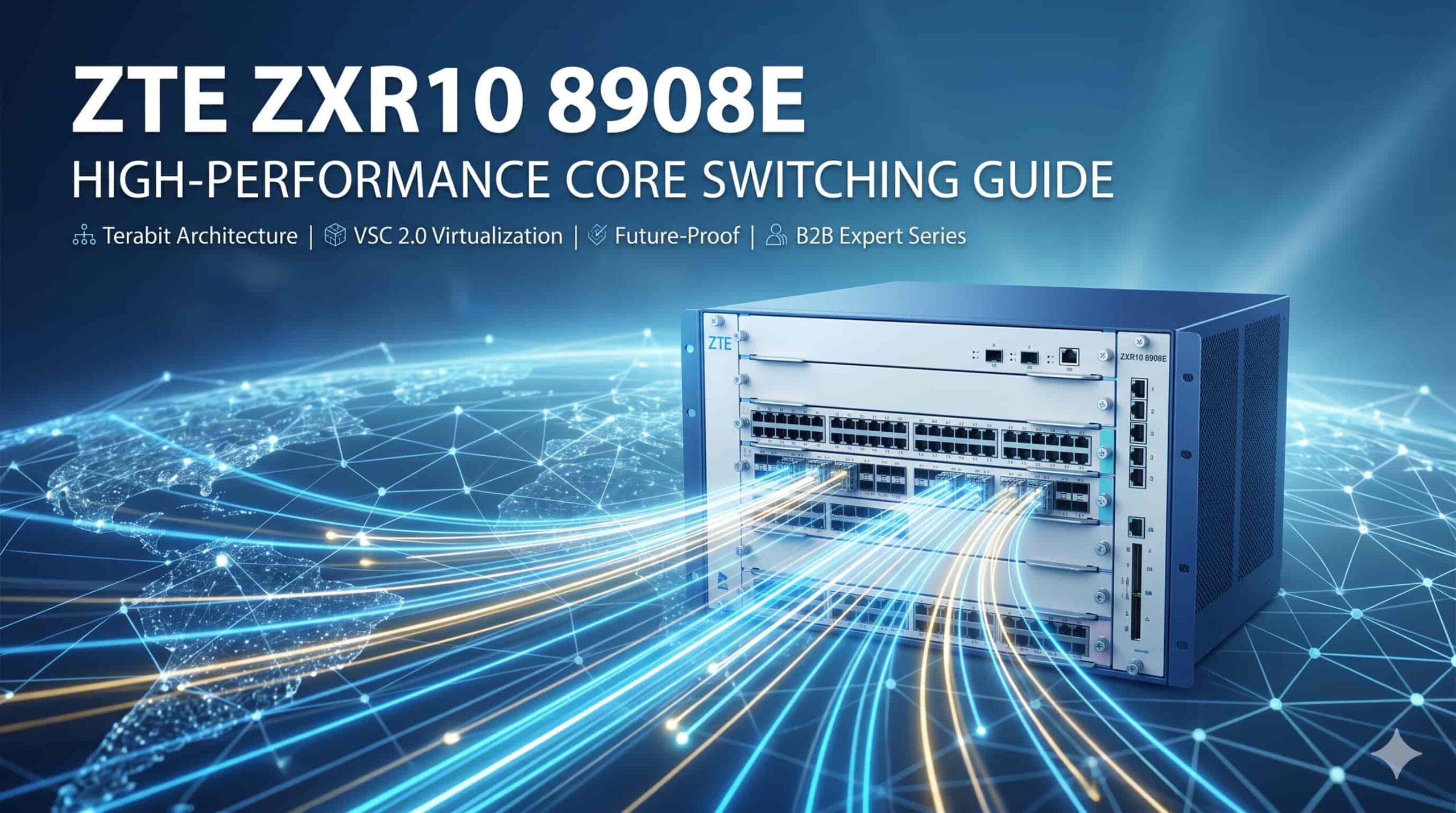
The 8908E is an 8-slot chassis designed for high-density deployment. It typically includes:
-
Two Main Control Card Slots: Providing 1+1 redundancy for the brain of the switch.
-
Eight Business Line Card Slots: Supporting a wide array of interfaces from 1G/10G to 40G and 100G Ethernet.
-
Redundant Power and Fan Modules: Ensuring that there is no single point of failure in the physical environment.
The backplane bandwidth of the 8908E is designed to support multiple generations of line cards, protecting the initial investment for at least 7-10 years. (Source: ZTE Technical White Paper on 8900E Series Architecture).
High-Performance Virtualization with VSC 2.0
One of the standout features of the ZXR10 8908E is VSC 2.0 (Virtual Switch Cluster) technology. In a traditional network, managing multiple core switches involves complex STP (Spanning Tree Protocol) configurations to prevent loops, which often results in underutilized links.
The Benefits of VSC 2.0
VSC 2.0 allows multiple physical switches—such as two 8908E units—to be virtualized into a single logical entity.
-
Simplified Management: A single IP address and a single configuration file manage the entire cluster.
-
Increased Bandwidth: All links between the switches and the downstream devices can be active, utilizing LACP (Link Aggregation Control Protocol) instead of blocking ports with STP.
-
Millisecond-Level Failover: If one chassis in the cluster fails, the other takes over traffic in less than 50ms, meeting carrier-grade High Availability (HA) standards.
According to Gartner’s Magic Quadrant for Data Center and Cloud Networking, virtualization and simplified management are the primary drivers for reducing OpEx in large-scale enterprise networks.
Comprehensive Security and L3 Protocol Support
Security in the 8908E is not an afterthought; it is baked into the silicon. The switch supports a multi-layered security approach:
-
Hardware-Based ACLs: Access Control Lists are processed at wire speed, ensuring that security policies do not bottleneck network performance.
-
Control Plane Prioritization (CPU Protection): The switch employs a dedicated mechanism to prioritize “keep-alive” packets and routing updates. This prevents Distributed Denial of Service (DDoS) attacks from overwhelming the switch’s CPU.
-
Advanced L3 Routing: The 8908E supports a full suite of IPv4 and IPv6 protocols, including BGP4+, OSPFv3, IS-IS, and MPLS VPN. This makes it an ideal candidate for Metropolitan Area Networks (MAN) and large-scale campus backbones.
IPv6 Transition Strategies
As the world fully transitions to IPv6, the 8908E provides dual-stack support and tunneling mechanisms (6to4, ISATAP, etc.), allowing for a seamless migration without hardware replacement.
Energy Efficiency: The “Green” Networking Initiative
Sustainability is a major KPI for B2B procurement in 2026. ZTE has integrated several “Smart” power-saving technologies into the 8908E.
Dynamic Power Management
The switch can detect the traffic load on individual ports. If a port is not in use, it enters a low-power “sleep” mode. Furthermore, the 8908E’s fan system uses infinitely variable speed control based on internal temperature sensors, significantly reducing noise and power consumption in data centers where cooling costs are high.
Research indicates that these “Green” features can reduce the total cost of ownership (TCO) by up to 20% over a five-year lifecycle (Source: IEEE Journal on Selected Areas in Communications: Green Networking, 2024).
Comparison of ZTE ZXR10 8900E Series Models
To better understand where the 8908E fits, we must compare it with its siblings in the 8900E family.
| Feature | ZXR10 8902E | ZXR10 8905E | ZXR10 8908E | ZXR10 8912E |
| Total Slots | 4 | 7 | 10 | 14 |
| Service Slots | 2 | 5 | 8 | 12 |
| Switching Capacity | Up to 1.2 Tbps | Up to 3.2 Tbps | Up to 5.4 Tbps | Up to 7.6 Tbps |
| VSC Support | Yes | Yes | Yes | Yes |
| Power Redundancy | 1+1 | N+1 | N+M | N+M |
| Typical Deployment | Small Campus / Edge | Medium Core | Large Core / DC | Enterprise DC |
Ideal Use Cases for the ZXR10 8908E
1. Enterprise Campus Core
For large university campuses or corporate headquarters, the 8908E acts as the central nervous system. Its high port density allows it to aggregate hundreds of access switches, while VSC 2.0 ensures that the network remains “always-on” for critical applications like VoIP and video conferencing.
2. Data Center Interconnect (DCI)
In a distributed data center model, the 8908E provides the necessary MPLS and VXLAN support to bridge Layer 2 domains across geographic distances. This is essential for VM (Virtual Machine) mobility and disaster recovery.
3. Financial Services Networks
Low latency and strict security are the hallmarks of financial networks. The 8908E’s non-blocking architecture ensures that trade data moves with minimal jitter, and its hardware encryption capabilities protect sensitive financial records.
Frequently Asked Questions (FAQs)
1. What is the maximum switching capacity of the ZTE ZXR10 8908E?
The ZXR10 8908E provides a total switching capacity of up to 5.4 Tbps, depending on the specific supervisor and line cards installed. This ensures it can handle high-density 10G, 40G, and 100G traffic without congestion or packet loss in heavy-load environments.
2. Does the 8908E support SDN (Software-Defined Networking)?
Yes, the 8908E is fully SDN-ready. It supports standard OpenFlow protocols and can be integrated with ZTE’s NetView controller or third-party SDN controllers. This allows for automated network provisioning, traffic engineering, and improved visibility across complex hybrid-cloud infrastructures.
3. How does VSC 2.0 improve network reliability compared to traditional stacking?
Unlike basic stacking, VSC 2.0 (Virtual Switch Cluster) uses standard Ethernet ports for clustering and offers a distributed control plane. This results in faster convergence times (under 50ms), higher scalability, and the ability to span longer distances between clustered switches using fiber links.
4. What type of line cards are available for the 8908E?
ZTE offers a diverse range of line cards for the 8908E, including 48-port 10/100/1000M Base-T, 48-port 10G SFP+, 8-port 40G QSFP+, and 4-port or 8-port 100G QSFP28 modules. This modularity allows for highly customized port configurations based on specific needs.
5. Is the ZTE ZXR10 8908E suitable for IPv6 environments?
Absolutely. The 8908E supports comprehensive IPv6 features, including IPv6 static routing, OSPFv3, IS-ISv6, BGP4+, and MLD snooping. It also provides various transition mechanisms like manually configured tunnels and automatic tunnels to facilitate a smooth migration from IPv4.
6. What are the power redundancy options for the 8908E chassis?
The 8908E supports N+1 or N+M power redundancy with hot-swappable AC or DC power modules. This modular power system ensures that the switch continues to operate even if multiple power supply units fail or if there is a partial power grid outage.
7. How does the 8908E handle multicast traffic for IPTV or surveillance?
The switch features robust multicast support, including IGMP v1/v2/v3, PIM-SM, PIM-DM, and PIM-SSM. It uses hardware-based multicast replication to ensure that high-bandwidth video streams are delivered efficiently to multiple recipients without taxing the main CPU or flooding the network.
8. What management interfaces are supported on the 8908E?
The 8908E supports a wide array of management options, including traditional CLI (Console/Telnet/SSH), SNMP v1/v2/v3, NetConf, and a web-based GUI. It also supports USB-based configuration and Zero-Touch Provisioning (ZTP) for rapid deployment in large-scale environments.
Conclusion: Why the ZXR10 8908E is a Strategic Investment
In the rapidly shifting landscape of B2B networking, the ZTE ZXR10 8908E stands out as a versatile and resilient powerhouse. By combining terabit-scale performance with the operational simplicity of VSC 2.0 and a future-proof SDN-ready architecture, it addresses the core pain points of modern IT departments: scalability, security, and sustainability.
The switch’s ability to provide carrier-grade 99.999% reliability while reducing TCO through intelligent power management makes it more than just a piece of hardware—it is a strategic asset. Whether you are upgrading a university backbone or building a robust data center interconnect, the 8908E offers the balance of performance and price that is rare in the high-end modular switch market.
Ready to upgrade your network core with the ZTE ZXR10 8908E?
Explore detailed technical specifications and procurement options by visiting the official product page.
Click here to view the full ZTE ZXR10 8908E datasheet and pricing details.

Leave a comment