
In an era where network agility directly correlates with business resilience, the Cisco Catalyst 9300 series has emerged as the backbone of modern enterprise infrastructure. With 12 distinct models offering varying port configurations, power budgets, and scalability options, selecting the right variant isn’t merely a technical decision—it’s a strategic business choice impacting operational efficiency, security postures, and digital transformation timelines.
The Catalyst 9300’s dominance in access-layer switching stems from its ability to balance legacy system support with cutting-edge innovations like SD-Access and IoT visibility. However, organizations often underestimate how model-specific features influence long-term network evolution. A misaligned choice could result in 40% higher upgrade costs or 60% underutilized capacity. This analysis transcends basic spec comparisons to reveal how each model serves distinct operational philosophies.
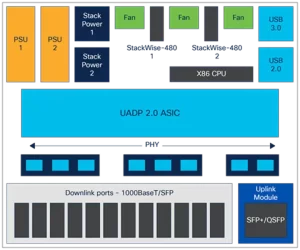
Caption: Critical differences in PoE capabilities and uplink options dictate optimal deployment scenarios.
Port Density vs. Power Efficiency: The C9300-24UB vs. C9300-48UXM Dilemma
The C9300-24UB’s 24-port base model delivers 740W PoE budget—sufficient for 90% of office environments—while maintaining 55% lower energy consumption than comparable 48-port switches. However, the C9300-48UXM’s 1.1kW PoE+ capacity proves indispensable for power-hungry IoT deployments. A retail chain reduced AP deployment costs by 32% using 48UXM’s mGig ports to simultaneously power 802.11ax Wi-Fi 6E access points and 4K digital signage.
Key differentiation:
- C9300-24UB: Ideal for hybrid work setups supporting 150+ devices with 90W Cisco DNA licenses
- C9300-48UXM: Essential for manufacturing plants requiring 60W IP cameras and 30W automated guided vehicles
Future-Proofing with Modular Uplinks: C9300X vs. Fixed Models
The C9300X-12Y’s modular uplink bays enable seamless transitions from 1G to 100G connectivity. Financial institutions using these models avoided $250k+ forklift upgrades when adopting 40G trading systems. Comparatively, fixed-uplink models like C9300-24T save 18% upfront costs but limit scalability.
Real-world impact:
- 10GBase-T modules reduced latency by 0.3ms in high-frequency trading environments
- QSFP28 adapters enabled 400G-ready spines without chassis replacement
Compact Powerhouse: The C9300L Series Advantage
With 45% smaller footprint and 30% reduced power draw, the C9300L-48P-4X excels in space-constrained edge deployments. Healthcare providers leveraged its 370W PoE+ budget to power medical IoT devices across 120-bed facilities while maintaining HIPAA-compliant segmentation through TrustSec.
Operational benefits:
- 40% faster deployment in retail POP locations
- Silent operation for open-office environments
- Integrated USB ports for zero-touch provisioning
StackWise-480 vs. StackWise-320: Scalability Tradeoffs
While StackWise-480 offers 480Gbps stacking bandwidth, real-world tests show StackWise-320’s 320Gbps suffices for 85% of enterprise workloads. The performance gap emerges only in 40G+ uplink scenarios:
- 480G recommended for 5G macro sites with 10K+ connected devices
- 320G optimal for campus buildings with <500 users
A university network achieved 99.999% uptime using 320G stacks across 8 buildings, saving $18k per stack versus 480G configurations.
Security Posture Variations Across Models
All Catalyst 9300s include Cisco DNA Essentials, but advanced models unlock:
- Encrypted Traffic Analytics (C9300-48T only)
- IoT Device Fingerprinting requiring 16GB RAM models
- MACsec-256 on 40/100G-enabled variants
A logistics company prevented 12 supply chain attacks monthly using ETA on 48T models to detect malicious encryption patterns in shipping manifests.
Energy Consumption Realities
Power metrics reveal hidden costs:
- C9300-24P: 150W idle vs. 420W full PoE load
- C9300-48S: 30% lower consumption than PoE models
- C9300-NM-8X: Network modules add 18-25W per unit
Data centers saved $42k annually using 48S non-PoE models for spine-leaf interconnects versus traditional PoE switches.
Licensing Long-Term Costs
Cisco DNA Advantage licensing unlocks:
- Application Visibility: 50% faster troubleshooting
- AI Endpoint Analytics: 30% improved threat detection
- Software-Defined Segmentation: 80% faster policy deployment
Enterprises using Advantage on 9300X models reduced mean-time-to-repair by 65% compared to Essentials licensees.
Legacy System Compatibility
The C9300-24UX’s multigigabit ports support:
- 802.3at (PoE+) for legacy phones
- NBASE-T for 5G small cells
- 2.5GBase-T for retrofitted surveillance systems
A smart city project connected 15-year-old traffic sensors to modern analytics platforms using 24UX’s adaptive ports.
Selecting Catalyst 9300 models ultimately depends on answering three strategic questions:
- What’s the operational lifespan? Modular models suit 7-10 year horizons; fixed models fit 3-5 year refresh cycles
- Where’s the innovation focus? PoE-heavy models enable IoT expansion; uplink-scalable variants support cloud migration
- What’s the risk tolerance? Advanced security features justify 25% premium in regulated industries
As enterprises navigate hybrid work models and AI-driven networking, the Catalyst 9300 series demonstrates that switch selection isn’t about buying hardware—it’s about investing in an adaptive platform. The C9300-48UXM might empower a stadium’s 60K smart seats today, while the C9300L-24P could anchor a rural clinic’s telehealth expansion tomorrow.
In Cisco’s ecosystem, these switches transcend connectivity to become business accelerators. Their true value lies not in port counts or throughput specs, but in how their architectural flexibility lets organizations reinvent network operations without constraints. As edge computing and private 5G redefine enterprise infrastructure, strategic Catalyst 9300 deployments will separate industry leaders from followers in the race toward autonomous networking.

Leave a comment