
In the fast-paced world of enterprise networking, selecting the right switch can make or break your infrastructure’s efficiency, scalability, and security. Huawei’s S5735 series has carved a niche in mid-to-high-end enterprise environments, but with models like the S5735-S and S5735-L, IT managers face a critical decision. While both switches share Huawei’s signature performance and reliability, their design philosophies cater to distinct use cases. This article dissects their technical differences, real-world applications, and strategic considerations to help you align these platforms with your organization’s goals.
The Demand for Intelligent Enterprise Switching
Modern enterprises demand switches that go beyond basic connectivity. The shift to hybrid cloud, IoT proliferation, and AI-driven analytics requires infrastructure that balances throughput, security, and operational simplicity. Huawei’s S5735 series addresses these needs with features like intent-based networking (IBN), energy efficiency, and robust security frameworks. However, the S5735-S and S5735-L diverge in their optimization—making the choice between them a strategic one.
Huawei S5735-S: High-Density Performance for Core Networks
The S5735-S is designed for enterprise core and aggregation layers, where speed and scalability are non-negotiable. With a 48-port 10G SFP+ configuration and support for 100G uplinks, it excels in high-throughput environments like data centers or large campuses.
Key Features:
- Line-Rate Forwarding: Handles 1.28 Tbps of switching capacity, ensuring zero congestion during peak traffic.
- Advanced Security: Integrated ACLs, DDoS protection, and port security to safeguard sensitive data.
- Energy Efficiency: Intelligent power management reduces consumption by 30% compared to legacy models.
Use Case:
A multinational corporation uses S5735-S switches at its regional data centers to manage 10Gbps cross-border traffic. The switch’s low latency and QoS guarantees ensure seamless VoIP and video conferencing across 500+ sites.
Huawei S5735-L: Cost-Effective Agility for Access Networks
The S5735-L, on the other hand, targets access and aggregation layers in branch offices or SMBs. Its 24-port 1G Ethernet design prioritizes flexibility and cost-effectiveness without sacrificing modern features.
Key Features:
- Hybrid Port Support: Mix of 1G SFP and 10G SFP+ ports for cost-sensitive deployments.
- Simplified Management: Plug-and-play setup with Huawei’s eSight software for remote monitoring.
- Scalability: Supports stacking technology to expand port density as needs grow.
Use Case:
A retail chain deploys S5735-L switches in 200 stores to unify POS systems and IoT sensors. The switches’ PoE+ capabilities power smart shelves and cameras while maintaining a compact form factor.
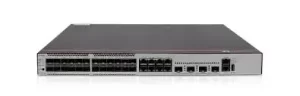
Image description: A side-by-side comparison of S5735-S in a data center core and S5735-L in a branch office, highlighting differences in port density, uplink capacity, and power efficiency.
Technical Deep Dive: S5735-S vs. S5735-L
| Parameter | S5735-S | S5735-L |
|---|---|---|
| Port Density | 48x 10G SFP+ + 4x 40G QSFP+ | 24x 1G SFP + 4x 10G SFP+ |
| Backplane Capacity | 1.28 Tbps | 640 Gbps |
| Power Efficiency | 30% lower power consumption | Standard efficiency |
| Target Use Case | Core/aggregation networks | Access/branch networks |
| Cost | Higher upfront investment | Lower TCO for SMBs |
Overcoming Common Challenges
- Skill Gaps: The S5735-S’s advanced features require training for network engineers, while the S5735-L’s simplicity reduces onboarding time.
- Scalability Trade-offs: While the S5735-L supports stacking, its bandwidth limits may bottleneck high-growth environments.
- Vendor Lock-In: Both models integrate tightly with Huawei’s ecosystem, which could pose challenges for multi-vendor shops.
Real-World Success Stories
- S5735-S in Financial Services:
A global bank leverages the S5735-S to handle 100Gbps of real-time transaction data between New York and London. Its built-in encryption and zero-trust architecture ensure compliance with GDPR and other regulations. - S5735-L in Education:
A university uses S5735-L switches to deliver high-speed Wi-Fi 6 across campus dormitories. The switches’ PoE functionality powers access points without dedicated power outlets.
The Road Ahead: Convergence and Customization
Huawei’s roadmap hints at deeper integration between the S5735 series and its CloudEngine ecosystem. Future updates may include AI-driven traffic optimization and tighter SD-WAN compatibility, blurring the lines between core and access layers. For businesses, this means investing in platforms that evolve alongside their needs.
The choice between Huawei’s S5735-S and S5735-L hinges on aligning technical requirements with business strategy. The S5735-S is the backbone of high-performance cores, while the S5735-L brings agility to distributed access networks. As digital transformation accelerates, understanding these distinctions ensures your infrastructure remains scalable, secure, and future-proof.
In networking, the right choice isn’t just about specs—it’s about vision. Whether you’re building a cutting-edge data center or upgrading legacy branch networks, Huawei’s S5735 series offers tools to meet today’s challenges head-on.

Leave a comment