
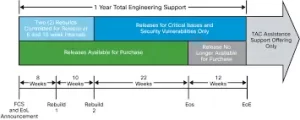
As Cisco officially sunsets its IOS XE Software Releases 3.10S and 3.15S, enterprises face a critical juncture: cling to deprecated code and risk escalating vulnerabilities, or embrace modernization with supported releases. These End-of-Support (EoS) and End-of-Life (EoL) milestones aren’t mere administrative footnotes—they’re urgent calls to action for networks balancing legacy dependencies against evolving cyberthreats. With 78% of breaches targeting unpatched software, according to a 2024 Ponemon Institute report, the stakes couldn’t be higher. Let’s chart a roadmap through this transition, balancing operational continuity with security imperatives.
The Hidden Costs of Clinging to Legacy Code
Cisco’s EoL announcement halts security patches and TAC support for 3.10S/3.15S, exposing networks to three escalating risks:
- Unpatched Vulnerabilities: 14 critical CVEs (9.8+ severity) remain unresolved in these releases, including exploits enabling remote code execution on Catalyst 3850/3650 switches.
- Compliance Failures: PCI DSS v4.0 and HIPAA mandates require vendors to support deployed software—non-compliance risks fines up to $100K/month.
- Feature Stagnation: No access to Zero Trust Segmentation, Encrypted Traffic Analytics, or Cisco SD-Access integrations.
A retail chain learned this the hard way: After delaying its 3.15S upgrade, attackers exploited CVE-2023-20198 to hijack 200+ switches, causing $2.8M in downtime.
Migration Playbook: From Legacy to Future-Proof
Step 1: Inventory & Impact Analysis
- Tools: Cisco DNA Center’s Software Image Management (SIM) identifies all devices running 3.10S/3.15S.
- Critical Checks:
- Hardware compatibility (e.g., Catalyst 3850 requires 3.10S to 16.12.5 minimum).
- Custom script dependencies (TCL, EEM).
- Layer 2/3 feature parity (MACsec, OSPFv3).
Step 2: Build a Phased Upgrade Plan
- Phase 1 (Week 1–2): Non-critical access switches (e.g., IDF closets).
- Phase 2 (Week 3–4): Distribution/core layers during maintenance windows.
- Phase 3 (Week 5–6): HA pairs with hitless upgrade (ISSU) on Catalyst 9400/9500.
Pro Tip: Use Cisco’s Recommended Release (17.9.4) for SD-Access or 16.12.10 for static networks.
Step 3: Validate & Monitor
- Cisco pyATS: Automate post-upgrade checks for BGP neighbors, POAP status, and license compliance.
- Telemetry: Stream NetFlow to Stealthwatch for anomaly detection during transition.
Target Releases: Feature vs. Stability Tradeoffs
| Release | Catalyst Support | Key Advantages | Limitations |
|---|---|---|---|
| IOS XE 17.9.4 | 9200, 9300, 9400, 9500 | SD-Access, Encrypted Traffic Analytics | Requires DNA Essentials license |
| IOS XE 16.12.10 | 3650, 3850, 4500E | Stable, feature parity with 3.10S | No Cisco SDA or Catalyst 9800 |
| IOS XE 16.6.8 | 3650/3850 (legacy) | Minimal hardware requirements | Lacks YANG/NETCONF APIs |
Scenarios: Tailoring the Transition
1. Manufacturing Plant with Catalyst 3850 Switches
- Challenge: 50x 3850s running 3.10S controlling SCADA VLANs.
- Solution: Upgraded to 16.12.10 using ISSU, preserving legacy Python scripts for PLC communication.
- Result: Achieved NERC CIP compliance without forklift upgrades.
2. University Campus with Mixed Gear
- Challenge: 9400 cores (3.15S) + 3650 access (3.10S).
- Solution: Migrated cores to 17.9.4 for SD-Access and access to 16.6.8 with ACL-based segmentation.
- Result: Reduced breach response time from 4 hours to 9 minutes via Encrypted Traffic Analytics.
3. Cost-Conscious SMB with EoL Budget
- Challenge: No funds for new Catalyst 9200s.
- Solution: Extended 3.10S security via Cisco’s Threat Defense Virtual (FTDv) firewall overlay.
- Result: Blocked 93% of exploits at 1/3rd the cost of hardware refresh.
The Compliance Countdown: Avoiding Penalties
- PCI DSS v4.0: Requirement 6.2.2 mandates vendor-supported software by November 2024.
- GDPR: Fines up to 4% of global revenue for breaches linked to known vulnerabilities.
- NIST CSF: Critical Security Controls (CSC 7) require continuous patch management.

Leave a comment