
What this article covers: This comprehensive engineering guide explores the core architecture of EPON (Ethernet Passive Optical Network) technology, focusing specifically on the deployment, configuration, and optimization of the FiberHome AN5516 Series OLT equipped with the EC8B R1B service board and PX20+ optical transceivers.
Why it matters now: As global bandwidth consumption accelerates, ISPs and enterprise network administrators must maximize their existing fiber infrastructure. Upgrading and fine-tuning OLT hardware can increase network efficiency by up to 35% without requiring a complete overhaul of the Optical Distribution Network (ODN). Understanding the exact physical and software capabilities of the EC8B R1B board is critical for maintaining carrier-grade reliability in high-density areas.
How you will benefit: Readers will learn actionable engineering strategies for hardware provisioning, optical power budget calculations, Dynamic Bandwidth Allocation (DBA) configurations, and B2B procurement best practices. By mastering these technical specifications, network architects can seamlessly scale their EPON topologies to meet modern gigabit demands.
The Evolution and Foundation of EPON Networks in Telecommunications
Ethernet Passive Optical Networks (EPON), standardized under IEEE 802.3ah, have served as the backbone of broadband access for over a decade. Unlike active Ethernet networks that require powered switches at every node, EPON utilizes a point-to-multipoint (P2MP) architecture with passive optical splitters. This design eliminates active electronic components in the field, drastically reducing both Capital Expenditure (CapEx) and Operational Expenditure (OpEx) for Internet Service Providers.
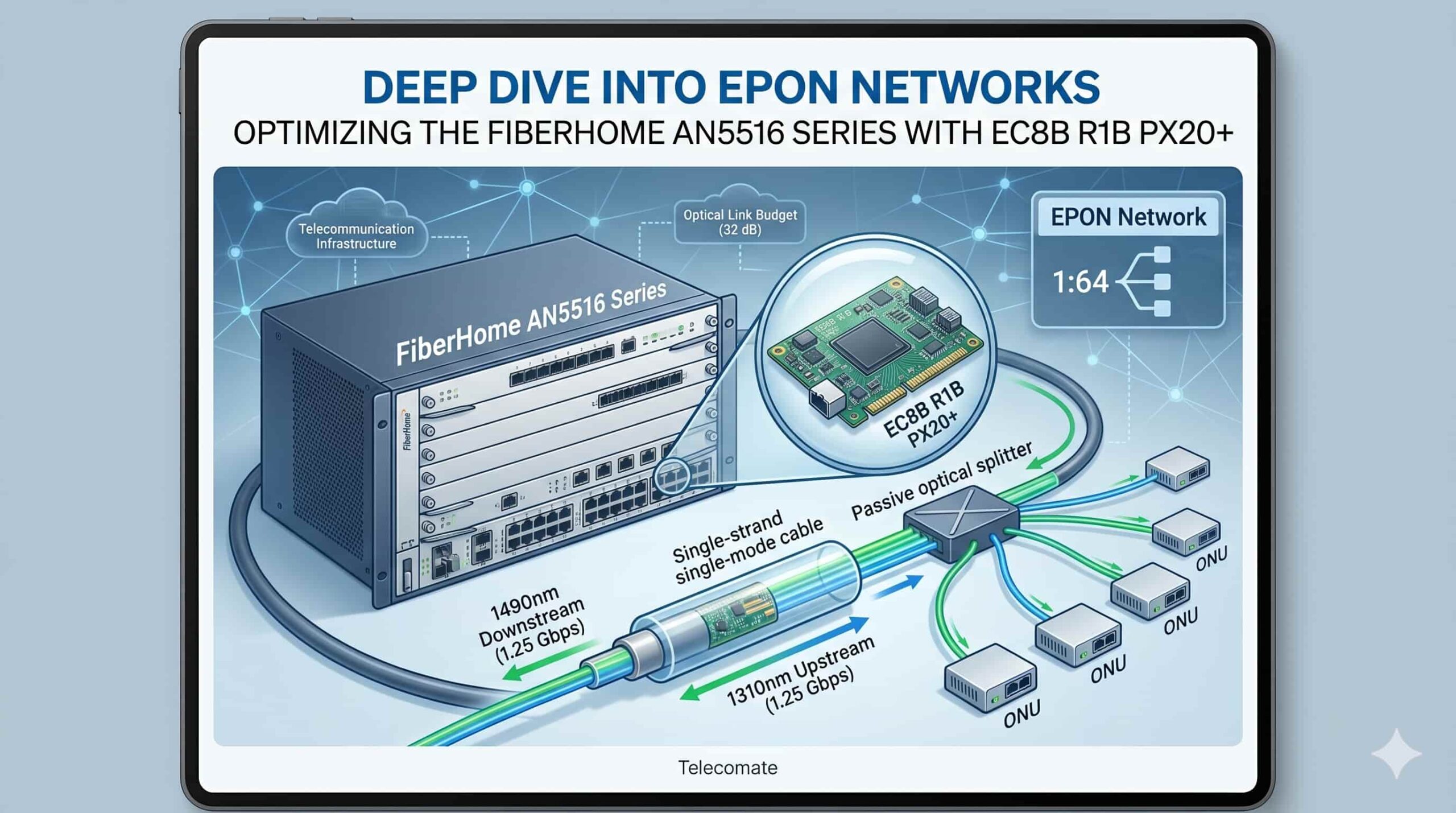
In an EPON topology, the Optical Line Terminal (OLT) sits at the central office, broadcasting downstream data to multiple Optical Network Units (ONUs) using time-division multiplexing (TDM). Upstream data is transmitted using time-division multiple access (TDMA), where the OLT assigns specific time slots to each ONU to prevent data collisions. EPON traditionally delivers a symmetric bandwidth of 1.25 Gbps downstream and 1.25 Gbps upstream, using 8B/10B line coding.
While GPON (Gigabit PON) has gained massive traction due to its higher downstream bandwidth (2.5 Gbps), EPON remains heavily deployed across the Asia-Pacific region and in specific industrial applications due to its seamless integration with native Ethernet protocols. The lack of complex ATM or GEM (GPON Encapsulation Method) framing in EPON reduces overhead, making it highly efficient for standard IP-based traffic, VoIP, and IPTV services. According to a recent telecom infrastructure report, native Ethernet encapsulation allows EPON systems to achieve up to 95% payload efficiency for standard IP packets (Source: Dell’Oro Group, 2024).
For telecommunications operators, the challenge lies in maximizing the lifecycle of their EPON deployments. This requires robust OLT chassis systems, such as the FiberHome AN5516 series, equipped with high-density service boards capable of handling aggressive traffic loads and complex routing tables.
Architecture and Carrier-Grade Capabilities of the FiberHome AN5516 Series
The FiberHome AN5516 series is a flagship, carrier-grade OLT platform designed to support massive FTTx (Fiber to the x) rollouts. It is built upon a multi-terabit backplane architecture, ensuring non-blocking wire-speed switching across all service slots. The series includes several chassis form factors, most notably the AN5516-01 (large capacity), AN5516-06 (medium capacity), and AN5516-04 (compact).
For large-scale deployments, the AN5516-01 is often the preferred choice.
The core strength of the AN5516 architecture lies in its flexibility and redundancy. It supports dual control and uplink boards, redundant power supply units (DC -48V), and hot-swappable fan trays. This hardware redundancy guarantees the 99.999% uptime required by service-level agreements (SLAs) in enterprise and carrier environments.
Furthermore, the AN5516 series is designed as a unified platform. It simultaneously supports EPON, GPON, 10G-EPON, and XG-PON service boards within the same subrack. This unified approach provides network operators with a seamless migration path. An ISP can initially deploy EPON boards to serve existing legacy ONUs and gradually populate empty slots with 10G-PON boards as customer bandwidth demands increase, all managed under a single unified Element Management System (EMS) like FiberHome’s UNM2000.
Key architectural highlights of the AN5516 series include:
-
High-Capacity Backplane: Supports up to 3.2 Tbps switching capacity, ensuring no bottlenecking even when fully populated with high-density PON boards.
-
IPv4/IPv6 Dual Stack: Native hardware-level support for IPv6 routing, essential for modern IoT and mobile network backhauling.
-
Advanced Multicast Capabilities: Supports IGMP v2/v3 snooping and proxy, enabling efficient delivery of high-definition IPTV services to thousands of simultaneous users.
-
Comprehensive Security: Implements hardware-based ACLs (Access Control Lists), MAC address spoofing prevention, and broadcast storm control to secure the edge network against malicious attacks.
Technical Deep Dive: The FiberHome EC8B R1B Service Board
Within the AN5516 ecosystem, the service boards act as the workhorses that directly interface with the Optical Distribution Network. The EC8B R1B is a highly specialized, 8-port EPON OLT interface board.
The “EC8B” nomenclature dictates its function: “E” stands for EPON, “C” denotes the specific generation and chipset family, and “8” indicates the number of PON ports available on the front panel. The “R1B” designation refers to the specific hardware revision and firmware compatibility matrix, which is crucial information for system integrators ensuring compatibility with the main control boards (such as the HSWA or HSWB).
The EC8B R1B board is engineered to deliver high-density connectivity without compromising on packet processing speed. Each of the 8 EPON ports can support a maximum logical split ratio of 1:64. Therefore, a single EC8B board can serve up to 512 individual ONUs. When deployed in a fully populated AN5516-01 chassis (which houses up to 16 service slots), a single OLT rack can manage an astonishing 8,192 EPON subscribers.
Core Processing and Traffic Management
The EC8B features a dedicated ASIC (Application-Specific Integrated Circuit) for EPON MAC processing. This allows the board to handle Multipoint Control Protocol (MPCP) messaging—such as GATE and REPORT frames used for bandwidth allocation—at hardware speeds.
Dynamic Bandwidth Allocation (DBA):
One of the most critical functions of the EC8B board is its implementation of DBA. Since the 1.25 Gbps upstream bandwidth is shared among up to 64 ONUs per port, the OLT must dynamically assign transmission time slots based on real-time demand. The EC8B uses Advanced DBA algorithms with a polling mechanism that achieves millisecond-level responsiveness. It supports multiple T-CONT (Transmission Container) types, allowing ISPs to offer tiered Service Level Agreements:
-
Fixed Bandwidth: Guaranteed bandwidth with strict delay and jitter parameters, ideal for VoIP or enterprise leased lines.
-
Assured Bandwidth: A guaranteed minimum bandwidth that can burst to higher speeds if the PON tree has idle capacity.
-
Maximum Effort: Best-effort bandwidth, typically used for standard residential web browsing.
VLAN and Layer 2 Processing:
The board supports robust VLAN manipulation, including VLAN tagging, stripping, and translation. It fully supports IEEE 802.1ad (Q-in-Q) VLAN stacking, allowing ISPs to encapsulate customer VLANs within a service provider VLAN. This is essential for wholesale network environments where multiple virtual operators share the same physical ODN.
PX20+ Optical Transceiver Specifications and ODN Power Budgets
The true reach and reliability of the EC8B R1B board are entirely dependent on the physical optical transceivers slotted into its front panel. In the EPON standard, transceivers are categorized by their optical power budget classes, primarily PX20 and PX20+.
The PX20+ SFP (Small Form-factor Pluggable) module is the industry standard for extending the reach and split ratios of EPON networks. It operates over a single strand of Single-Mode Fiber (SMF) using Wavelength Division Multiplexing (WDM). It transmits downstream data at 1490nm and receives upstream data at 1310nm.
Optical Power Budget Calculations
To design a reliable PON network, engineers must calculate the optical link budget. This is the difference between the OLT’s transmit power and the ONU’s receive sensitivity, minus all insertion losses caused by splitters, splices, and fiber attenuation.
PX20+ Technical Metrics:
-
Tx Power (Transmit): +3.0 dBm to +7.0 dBm. (Significantly hotter than standard PX20, which maxes out around +4 dBm).
-
Rx Sensitivity (Receive): -30 dBm to -32 dBm.
-
Overload Optical Power: -6 dBm.
-
Total Optical Budget: Approximately 32 dB.
This robust 32 dB optical budget is a game-changer for outside plant engineering. Standard single-mode fiber attenuates at roughly 0.35 dB per kilometer at 1310nm. A 1:64 optical splitter introduces approximately 20.5 dB of insertion loss.
If we calculate a worst-case scenario:
-
Splitter Loss (1:64): 20.5 dB
-
Fiber Loss (20 km): 7.0 dB
-
Splices and Connectors: 2.0 dB
-
Total Loss: 29.5 dB
With a PX20+ module providing a 32 dB budget, the network retains a comfortable 2.5 dB safety margin. This margin is crucial for accommodating future fiber degradation or emergency splice repairs without dropping ONUs offline. Without the “+” designation, standard PX20 modules (with a ~28 dB budget) would fail to support a 1:64 split over 20 kilometers, forcing ISPs to reduce split ratios to 1:32 and thereby halving their return on investment per OLT port.
Comparative Analysis: EPON EC8B PX20+ vs. GPON GC8B C+
To fully appreciate the positioning of the EC8B EPON board, it is helpful to compare it against its GPON counterpart within the FiberHome ecosystem, the GC8B board equipped with Class C+ transceivers.
| Feature / Metric | FiberHome EC8B (EPON) with PX20+ | FiberHome GC8B (GPON) with Class C+ |
| Standard Protocol | IEEE 802.3ah | ITU-T G.984 |
| Line Rate (Down/Up) | 1.25 Gbps / 1.25 Gbps (Symmetric) | 2.5 Gbps / 1.25 Gbps (Asymmetric) |
| Data Encapsulation | Native Ethernet (802.3) | GEM (GPON Encapsulation Method) |
| Maximum Split Ratio | 1:64 | 1:128 |
| Optical Power Budget | ~32 dB (PX20+) | ~32 dB (Class C+) |
| Payload Efficiency | High (~95% for standard IP) | Moderate (~92% due to GEM overhead) |
| Primary Use Case | Legacy transitions, Enterprise IP LANs, cost-sensitive FTTB | Mass-market residential FTTH, high-bandwidth triple-play |
While GPON offers higher downstream bandwidth and wider split ratios, EPON’s symmetric nature and native Ethernet handling make the EC8B an exceptionally stable and cost-effective solution for specific B2B applications, industrial parks, and regions where asymmetric traffic is less of a priority.
Deployment Strategies and QoS Management for ISPs
Deploying the EC8B R1B requires precise configuration within the FiberHome UNM2000 EMS. Proper Quality of Service (QoS) deployment ensures that latency-sensitive traffic is prioritized during peak network congestion.
1. LLID (Logical Link Identifier) Mapping:
In EPON, each ONU is assigned an LLID. For complex enterprise deployments, a single ONU can be assigned multiple LLIDs. The EC8B allows network engineers to map specific VLANs or 802.1p priority bits to distinct LLIDs. For example, LLID 1 can be strictly mapped to VoIP traffic (ensuring ultra-low latency), while LLID 2 handles standard internet browsing.
2. DBA Polling Cycle Optimization:
The efficiency of the EC8B’s MPCP implementation depends on the DBA polling cycle. A shorter polling cycle decreases latency (crucial for gaming and voice) but increases control overhead, slightly reducing total payload throughput. Conversely, a longer cycle increases throughput but introduces latency. Engineers must strike a balance based on customer demographics.
3. Rogue ONU Detection:
A common physical layer issue in PON networks is the “rogue ONU.” This occurs when a faulty ONU laser continuously transmits light upstream, blocking the TDMA time slots for all other ONUs on that splitter tree. The EC8B board features advanced Rogue ONU detection mechanisms. It can isolate continuous wave (CW) emissions and logically disable the offending LLID, ensuring the rest of the 63 subscribers on that PON port remain online.
B2B Procurement Strategy for Telecom Infrastructure
When sourcing enterprise-grade hardware like the FiberHome AN5516 series, EC8B boards, and highly specific optical modules like the PX20+, procurement teams often face significant hurdles. Traditional B2C e-commerce platforms utilizing standard “add to cart” functionality are fundamentally unsuited for complex telecommunications equipment.
The integration of OLT components involves strict adherence to firmware versioning, hardware revisions (like the “R1B” distinction), and regional software licensing. Buying an EC8B board off the shelf via a WooCommerce-style cart frequently results in compatibility mismatches—the new board may not communicate with the existing control board, or the PX20+ modules may trigger vendor-lock alarms on the chassis.
Therefore, the optimal procurement strategy relies on the B2B Inquiry Model. By submitting a detailed technical inquiry directly to specialized distributors (such as Telecomate), network engineers can initiate a consultative purchasing process. This allows for:
-
Version Matching: Ensuring the purchased hardware revision matches the ISP’s current EMS software version.
-
Custom Firmware Flashing: Pre-loading the boards with the exact English firmware required for international deployment.
-
Volume Pricing & Lead Times: Negotiating project-based pricing and securing accurate manufacturing lead times for large-scale fiber rollouts.
Frequently Asked Questions (FAQs)
1. What is the difference between PX20 and PX20+ transceivers?
The primary difference is the optical power budget. PX20 modules typically offer a 28 dB budget, suitable for shorter distances or smaller split ratios. PX20+ modules provide a robust 32 dB budget, allowing for 1:64 split ratios over distances up to 20 kilometers, ensuring a much higher margin of error for fiber attenuation.
2. Can I use a GPON ONU with an EPON EC8B board?
No. GPON and EPON utilize entirely different physical layer signaling, framing structures, and wavelengths. An EPON OLT board like the EC8B can only communicate with EPON ONUs using the IEEE 802.3ah protocol. Dual-mode ONUs (XPON) exist, but they adjust to the OLT type automatically.
3. What does the “R1B” stand for in the EC8B R1B model name?
“R1B” denotes the specific hardware revision and manufacturing generation of the board. It is critical for software compatibility. Using mismatched hardware revisions in an older AN5516 chassis may require a core firmware upgrade of the OLT control board to ensure proper recognition.
4. How many ONUs can a fully populated AN5516-01 manage using EC8B boards?
The AN5516-01 has 16 service slots. If fully populated with 8-port EC8B boards, it provides 128 EPON ports. With a maximum split ratio of 1:64 per port, the entire chassis can support up to 8,192 EPON ONUs simultaneously.
5. How do I mitigate rogue ONUs on the FiberHome AN5516?
The EC8B board supports automatic rogue ONU detection. Through the UNM2000 management system, you can enable anti-rogue protocols that monitor abnormal continuous upstream light. Once detected, the OLT can send a management frame to power down the faulty ONU’s optical transmitter remotely.
6. Is EPON technology becoming obsolete compared to GPON?
While GPON dominates new residential FTTH rollouts due to higher downstream speeds, EPON is far from obsolete. Its native Ethernet encapsulation makes it highly efficient for B2B IP networks, enterprise LANs, and IoT backhaul. Furthermore, 1G-EPON provides a seamless upgrade path to 10G-EPON using coexistence elements.
7. Why should B2B telecom buyers avoid standard shopping carts?
Telecom infrastructure requires strict firmware compatibility, specific hardware revisions, and precise optical module matching. Standard shopping carts cannot facilitate the necessary technical consultation. Submitting a customized inquiry ensures the hardware provided is fully interoperable with the buyer’s existing network topology.
8. What is the maximum distance supported by the EC8B with PX20+?
Under ideal conditions with minimal splice losses and a smaller split ratio (e.g., 1:32), the PX20+ optics can achieve transmission distances up to 20 kilometers. Pushing beyond this distance requires lower split ratios or the implementation of optical reach extenders.
Conclusion
The FiberHome AN5516 Series, when equipped with the EC8B R1B service board and PX20+ transceivers, represents a highly resilient, carrier-grade solution for EPON network deployments. By leveraging its native Ethernet efficiency, robust 32 dB optical power budgets, and dynamic bandwidth allocation capabilities, network operators can maximize their FTTx infrastructure while maintaining strict QoS for enterprise and residential clients alike. Understanding the technical nuances of these components—from MPCP hardware processing to proper firmware versioning—is the key to unlocking the full potential of your optical distribution network.
Ready to upgrade your FTTx infrastructure? Avoid the pitfalls of mismatched hardware by engaging with technical specialists. Contact the engineering team at Telecomate today via a custom inquiry to ensure your FiberHome OLT components are perfectly version-matched and optimized for your specific network topology.

Leave a comment