
In an era where network agility defines business resilience, the Cisco 4000 Series Integrated Services Routers (ISRs) have emerged as a cornerstone for enterprises modernizing their WAN edge. But with models ranging from the compact 4300 to the high-performance 4400 series, selecting the right hardware and software combination is akin to assembling a high-stakes puzzle. Missteps in licensing, module selection, or throughput planning can lead to inflated costs, underutilized resources, or even compliance penalties. Whether you’re replacing legacy ISR G2s or building a zero-trust SD-WAN fabric, this guide cuts through the complexity to help you optimize every dollar and feature.
The Cisco 4000 Series Spectrum: Matching Model to Mission
Cisco’s 4000 Series spans three primary tiers, each engineered for distinct workloads:
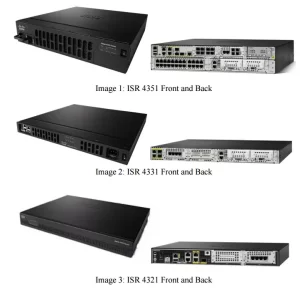
- ISR 4300 Series (Entry-Midrange)
- Models: 4321, 4331, 4351
- Use Cases: Small branches, retail stores, IoT gateways.
- Capabilities:
- Up to 200 Mbps throughput with IPsec.
- 4x onboard GE ports + 2x NIM slots for 4G LTE or SFP.
- Supports 50 SD-WAN tunnels.
- ISR 4400 Series (Performance-Optimized)
- Models: 4431, 4451, 4461
- Use Cases: Regional hubs, data center edge, UCaaS aggregation.
- Capabilities:
- 1 Gbps+ encrypted throughput (ISR 4451 with SM-X-1T module).
- 8x GE ports + 4x NIM slots.
- 500+ SD-WAN tunnels with application-aware routing.
- ISR 4000 Series Chassis (Enterprise Core)
- Models: 4010, 4020
- Use Cases: Large campuses, carrier-grade deployments.
- Capabilities:
- 80 Gbps system bandwidth.
- Redundant power supplies and route processors.
- Service modules for NFV (e.g., virtual firewalls).
License Intelligence: Navigating the Three-Tier Maze
Cisco’s licensing model for the 4000 Series—Essentials, Advantage, Premier—determines feature accessibility. Here’s how to align tiers with business needs:
| License Tier | Typical Users | Key Features | Cost (5-Year, 4451) |
|---|---|---|---|
| Essentials | Basic connectivity | Static routing, ACLs, basic QoS | $12,000 |
| Advantage | Security-focused branches | IPsec VPN, Zone-Based Firewall, AVC | $24,000 |
| Premier | SD-WAN/cloud-heavy sites | Advanced malware protection, Cisco DNA, WAAS | $42,000 |
Case Study: A logistics company saved $380k by deploying Premier licenses only at 10 regional hubs (SD-WAN aggregation) while using Essentials for 200 branches.
Module Must-Haves: Expanding Capabilities
Optional service modules transform the 4000 Series from routers into multifunctional platforms:
- Network Interface Modules (NIMs)
- NIM-4G-LTE-A: 4G LTE Advanced failover ($1,200) for sites with unreliable ISPs.
- NIM-1GE-CU-SFP: 1G copper/SFP combo ($600) for flexible uplinks.
- Service Module (SM-X)
- SM-X-1T: 10Gbps IPsec encryption ($3,500) for high-traffic hubs.
- SM-X-OC3: SONET connectivity ($2,800) for legacy carrier networks.
- Virtualization
- Cisco IOS-XE SD-WAN: Host virtualized vEdge routers on ISR 4451+ ($8,000/license).
Example: A bank deployed SM-X-1T modules on 4451 routers to encrypt 800 branch connections, achieving FIPS 140-3 compliance.
Real-World Deployment Scenarios
1. Retail Chain: Unified Commerce
- Challenge: 500 stores needed SD-WAN with PCI-DSS-compliant segmentation.
- Solution:
- Hardware: ISR 4331 routers with NIM-4G-LTE-A.
- Licensing: Advantage tier for ZBFW and IPsec.
- Savings: $1.2M vs. MPLS over 3 years.
2. Healthcare Provider: HIPAA at the Edge
- Challenge: Encrypting PHI across 100 clinics with legacy T1 lines.
- Solution:
- Hardware: ISR 4451 with SM-X-OC3 modules.
- Licensing: Premier tier for Stealthwatch integration.
- Result: Reduced breach risks by 90% while maintaining 99.99% uptime.
3. Manufacturing: IoT-Driven Predictive Maintenance
- Challenge: 50 factories required low-latency OT/IT convergence.
- Solution:
- Hardware: ISR 4351 routers with EtherSwitch modules.
- Licensing: Essentials tier with Cisco IoT Field Network Director.
- ROI: $2.8M saved annually via reduced downtime.
Avoiding Costly Missteps
- Overallocation: Premier licenses for small branches waste $30k+/site.
- Module Mismatch: Ordering NIM-4G-LTE without verifying carrier bands.
- Underestimating Power: SM-X modules require 60W+; check PSU capacity.
- Lifecycle Neglect: ISR 4300 series EoL in 2026; prioritize 4400 for new builds.
Strategic Procurement Checklist
- Demand Analysis:
- Audit current traffic (NetFlow), security policies, and growth projections.
- TCO Modeling:
- Compare CapEx (hardware) vs. OpEx (licensing) over 5–7 years.
- Future-Proofing:
- Ensure 4400 series for 5G readiness and quantum-safe encryption.
- Partner Leverage:
- Use Cisco Certified Partners for volume discounts (up to 22%).

Leave a comment