

PRODUCT OVERVIEW & TECHNICAL DATASHEET: DIFFERENTIATING POE, POE+, AND POE++
EXECUTIVE SUMMARY
Power over Ethernet (PoE) has evolved from a convenience feature into a carrier‑grade infrastructure enabler. As IoT, high‑throughput wireless access points, PTZ cameras, and digital signage proliferate, understanding the differences between IEEE 802.3af (PoE), 802.3at (PoE+), and 802.3bt (PoE++) is critical for network architects and procurement engineers. This document provides a definitive technical comparison, hardware specification framework, and deployment guidance for selecting the appropriate PoE standard.

ARCHITECTURE & CHASSIS DESIGN
All three standards operate over standard Category 5e or higher cabling using two or four twisted pairs. The fundamental differentiator is the maximum power available at the Powered Device (PD) after cable losses.
– PoE (IEEE 802.3af): Delivers up to 15.4W at the Power Sourcing Equipment (PSE) port, guaranteeing 12.95W to the PD. Utilizes two pairs (Alternative A or B) and supports Class 0‑3 devices.
– PoE+ (IEEE 802.3at): Provides up to 30W from the PSE, with 25.5W available at the PD. Maintains two‑pair powering and introduces Class 4 for higher‑power applications.
– PoE++ (IEEE 802.3bt): Subdivided into Type 3 (up to 60W PSE / 51W PD) and Type 4 (up to 100W PSE / 71W PD). Mandates four‑pair power delivery and introduces Classes 5‑8, plus support for simultaneous data and power on all pairs.
HARDWARE FEATURES
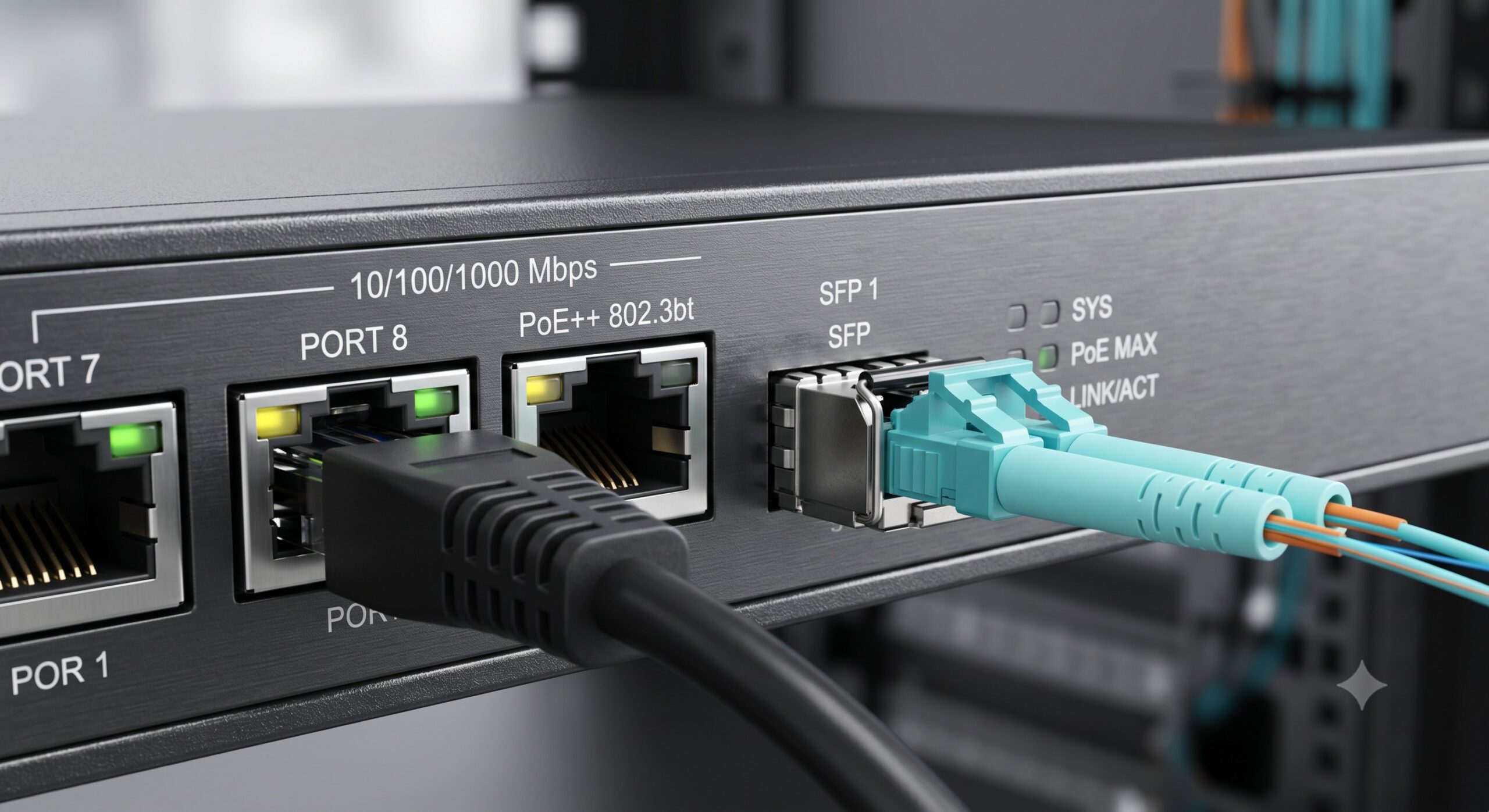
Our enterprise PoE switching platforms implement autoclassification and intelligent power management across all three standards simultaneously. Key hardware differentiators include:
– Power Budget per chassis: Up to 1440W (full 48‑port PoE++ Type 4) with dynamic power allocation.
– Per‑port priority queuing: Guarantees uptime for critical PDs during power oversubscription.
– Fast PoE watchdog: Automatically resets non‑responsive PDs via software configurable power cycling.
– Extended reach mode: Up to 250 meters at reduced power (10Mbps link) for PoE/PoE+ only.
COMPLIANCE & STANDARDS
– IEEE 802.3af-2003 (PoE)
– IEEE 802.3at-2009 (PoE+)
– IEEE 802.3bt-2018 (PoE++) Types 3 & 4
– Energy Efficient Ethernet (EEE) 802.3az
– CSA, UL 60950-1 / 62368-1, CE, FCC Class A
TECHNICAL SPECIFICATIONS
| Parameter | PoE (802.3af) | PoE+ (802.3at) | PoE++ Type 3 | PoE++ Type 4 |
|---|---|---|---|---|
| Max PSE output per port | 15.4W | 30W | 60W | 100W |
| Min PD power available | 12.95W | 25.5W | 51W | 71W |
| Voltage (PSE) | 44–57V DC | 50–57V DC | 50–57V DC | 52–57V DC |
| Powered pairs | 2 | 2 | 4 | 4 |
| Max cable length (standard) | 100m | 100m | 100m | 100m |
| Supported classes | 0,1,2,3 | 0–4 | 5,6 | 7,8 |
| Typical applications | IP phones, basic APs, sensors | PTZ cameras, videophones, 802.11ac APs | Small switches, lighting, digital signage | Laptops, 5G small cells, building controllers |
ORDERING OPTIONS
– PWR‑24P‑AF: 24‑port Gigabit, 24x PoE (15.4W), total budget 180W
– PWR‑48P‑AT: 48‑port Gigabit, 48x PoE+ (30W), total budget 400W
– PWR‑24P‑BT4: 24‑port Multi‑Gig, 24x PoE++ Type 4 (100W), total budget 960W, 2x 160W uplink
– PWR‑CHASSIS‑8SLOT: Modular chassis, up to 48 ports PoE++ Type 4 per line card, redundant 1600W PSUs
📥 Download Technical Specification
Click the button below to view or download the full official PDF datasheet.

Leave a comment