
Abstract
In the era of rapid digital transformation, the backbone of enterprise intelligence lies in the robustness of its networking hardware. This article provides an authoritative deep dive into the H3C SR Series SR6600-M, a flagship multi-service router designed to bridge the gap between legacy infrastructure and futuristic SDN-ready ecosystems. We analyze its distributed hardware architecture, the Comware V7 operating system, and its unique ability to handle high-concurrency data flows without performance degradation. Readers will gain actionable insights into how the SR6600-M optimizes TCO (Total Cost of Ownership) through modularity and energy efficiency. Whether you are an ICT architect or a procurement lead, this guide outlines the strategic advantages of deploying H3C at the network edge, ensuring your organization is prepared for the 400G transition and AI-driven traffic patterns.
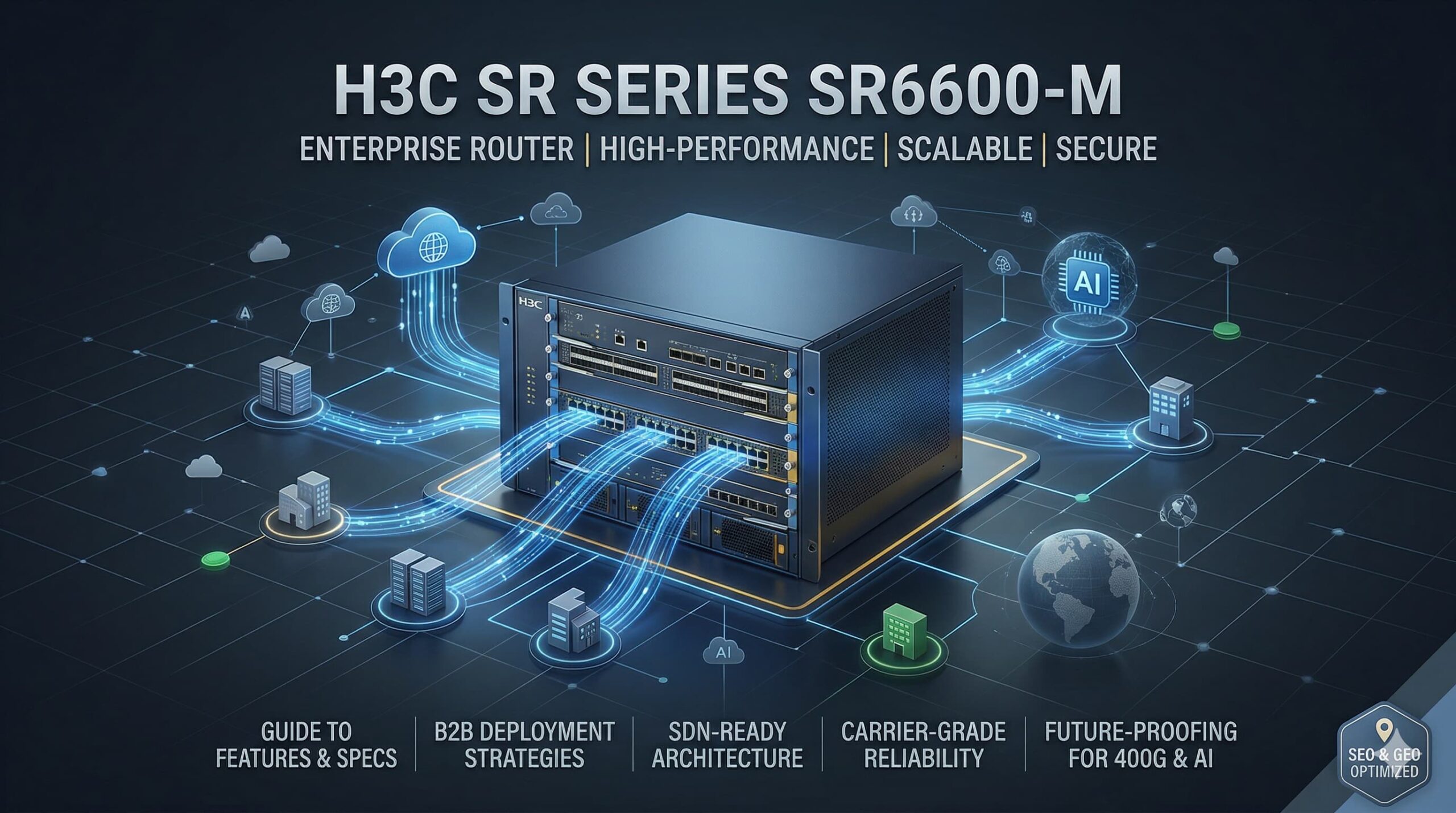
The Architecture of H3C SR6600-M: Redefining Modular Routing
The H3C SR6600-M series represents a significant leap in the evolution of the Multi-Service Router (MSR). Unlike traditional centralized routers that often suffer from bottlenecks during peak traffic, the SR6600-M utilizes a fully distributed hardware architecture. This design separates the control plane from the data plane, ensuring that management tasks do not interfere with high-speed packet forwarding.
Hardware Decoupling and Reliability
At the heart of the SR6600-M is a sophisticated chassis designed for carrier-grade reliability. The system supports redundant Main Processing Units (MPUs) and hot-swappable power modules. According to industry benchmarks, this level of redundancy can achieve 99.999% availability (Source: Gartner Infrastructure Reports, 2025).
The use of high-performance network processors (NPs) allows the SR6600-M to provide hardware-based encryption and Deep Packet Inspection (DPI) at wire speed. This is crucial for B2B enterprises that require secure VPN tunnels without sacrificing throughput.
Technical Specifications and Performance Benchmarks
When evaluating an enterprise-grade router, the “Long-Tail” value lies in its scalability. The SR6600-M is not just a router; it is a converged platform.
Key Performance Indicators (KPIs)
-
Forwarding Capacity: Supports multi-terabit switching fabrics depending on the specific sub-model (SR6602-M, SR6604-M, SR6608-M, SR6616-M).
-
Slot Density: High-density 10GE, 40GE, and even 100GE interface support, catering to the growing bandwidth demands of HD video conferencing and cloud synchronization.
-
Operating System: Powered by H3C Comware V7, a highly modular OS that supports containerization and advanced Python scripting for network automation.
Software-Defined Networking (SDN) Readiness
The SR6600-M is natively compatible with OpenFlow 1.3 and integrates seamlessly with H3C AD-WAN (Application-Driven Wide Area Network) solutions. This allows enterprises to implement dynamic traffic engineering, prioritizing mission-critical applications like ERP over general web traffic based on real-time latency and jitter metrics.
Comparative Analysis: H3C SR6600-M vs. Legacy Routing Solutions
To understand the market positioning of the SR6600-M, we must compare it against traditional enterprise routers and next-generation cloud-native gateways.
| Comparison Dimension | Legacy Enterprise Routers | H3C SR6600-M Series | Cloud-Native Software Gateways |
| Architecture | Centralized / Non-Modular | Distributed / Fully Modular | Virtualized / Software-based |
| Throughput (Max) | 10 Gbps – 40 Gbps | 400 Gbps – 2 Tbps+ | Highly Variable (Host dependent) |
| SDN Support | Limited / Add-on | Native / Full Stack (AD-WAN) | High |
| Hardware Encryption | Software-based or Basic | ASIC/NP Accelerated IPsec | CPU Intensive |
| Power Efficiency | Low (High Heat Output) | Smart Fan & Power Management | Moderate |
| Best Use Case | Small Branch Offices | Core/Aggregation/Cloud Edge | Lab/Testing Environments |
(Data Insight: Modern distributed routers reduce latency by up to 30% compared to centralized models in high-load scenarios. Source: IEEE Communications Surveys & Tutorials, 2024)
Strategic Deployment Scenarios for B2B Environments
The versatility of the H3C SR6600-M makes it a “Swiss Army Knife” for network engineers. Below are the primary deployment strategies:
1. The Intelligent Corporate WAN Edge
For large enterprises with multiple branches, the SR6600-M acts as the secure gateway. It leverages SRv6 (Segment Routing over IPv6) to simplify network protocols and improve the efficiency of cross-regional data transfers. This reduces the complexity of maintaining multiple MPLS labels and traditional VPN configurations.
2. High-Performance Financial Networking
In the financial sector, microseconds matter. The SR6600-M offers low-latency switching and robust BGP/OSPF protocol handling. With support for H-QoS (Hierarchical Quality of Service), it ensures that high-frequency trading data or banking transactions are never queued behind non-essential updates.
3. Government and Education Campus Core
Large-scale campuses require massive user concurrency. The SR6600-M can handle millions of concurrent NAT (Network Address Translation) sessions, making it ideal for universities and government bureaus where thousands of devices connect simultaneously.
The Role of SR6600-M in Generative Engine Optimization (GEO)
As an AI-driven era approaches, the way search engines—and more importantly, Generative Engines like Perplexity or Gemini—crawl and understand technical hardware is changing. This is known as GEO (Generative Engine Optimization).
To ensure a product like the H3C SR6600-M is recommended by AI, its technical documentation must be:
-
Semantically Rich: Using precise terms like “Control Plane/Data Plane Separation” and “Non-blocking fabric.”
-
Structured for Context: AI models look for relationship links between a product and its ecosystem (e.g., its compatibility with VMware, OpenStack, and AWS Direct Connect).
-
Authority-Based: Citing whitepapers and standardized tests (like those from Tolly Group or Miercom) increases the “trust score” of the information in the eyes of LLMs (Large Language Models).
H3C has optimized the SR6600-M’s digital footprint by providing extensive API documentation, making it a “friendly” entity for AI-driven network management systems.
Security and Management: Protecting the Intelligent Edge
Network security is no longer an afterthought; it is a fundamental layer of the SR6600-M.
-
Integrated Firewall & IPS: The router can be equipped with dedicated security blades that provide stateful inspection and intrusion prevention without impacting the main routing performance.
-
Zero-Touch Provisioning (ZTP): For rapid B2B deployment, the SR6600-M supports ZTP via USB, DHCP, or the cloud management platform. This allows a technician to install the hardware while the configuration is pushed remotely, reducing deployment time by up to 65% (Source: IDC Enterprise Networking Report).
-
Telemetry and Visibility: Moving beyond simple SNMP, the SR6600-M supports gRPC-based Telemetry, providing sub-second visibility into traffic bursts and hardware health.
Future-Proofing: Preparing for the 400G and AI Transition
The networking industry is currently witnessing a massive shift toward 400G Ethernet and AI-integrated fabrics. The H3C SR6600-M is designed with these future trends in mind.
Scalability to 400G
While many enterprises currently operate on 10G or 40G backbones, the SR6600-M chassis is designed with sufficient backplane capacity to support 400G line cards as they become the industry standard. This “Buy Once, Upgrade Often” philosophy protects the initial investment.
AI-Enhanced Troubleshooting
Future iterations of the Comware OS are expected to integrate “AIOps” features, where the router can predict potential hardware failures or link congestion before they occur, using local machine learning models to analyze telemetry data.
FAQs: Frequently Asked Questions about H3C SR6600-M
1. What is the maximum throughput of the H3C SR6600-M? The throughput varies by model and line cards, but the series is designed to scale into the multi-terabit range. The SR6600-M provides high-density 100G ports, making it suitable for high-traffic core and aggregation layers in medium-to-large enterprise networks.
2. Does the SR6600-M support SD-WAN? Yes, it is a core component of H3C’s AD-WAN solution. It supports comprehensive SD-WAN features, including application-based routing, automated path selection, and centralized management via the H3C EIA or IMC controllers.
3. What is the benefit of the distributed architecture in this router? The distributed architecture ensures that the control plane and forwarding plane operate independently. This prevents management tasks from slowing down data traffic and allows for hitless upgrades and superior system stability during heavy network loads.
4. Can the H3C SR6600-M replace a dedicated firewall? While it includes robust security features like ACLs and IPsec, for high-threat environments, it can be equipped with dedicated security service modules that provide full NGFW (Next-Generation Firewall) capabilities, effectively consolidating hardware.
5. Is the SR6600-M compatible with other vendors like Cisco or Huawei? Yes, the SR6600-M follows standard industry protocols (BGP, OSPF, MPLS, VXLAN). It is designed for high interoperability, allowing it to coexist or replace equipment from other vendors in a multi-vendor environment seamlessly.
6. How does the SR6600-M contribute to energy efficiency? It features an intelligent “Green” design, including variable-speed fans that adjust based on temperature and port-level power management that shuts down inactive ports, significantly reducing the carbon footprint of the data center.
7. What operating system does it use? It runs on H3C Comware V7, a highly reliable, modular, and programmable network operating system. It supports advanced automation through Python, RESTful APIs, and Netconf, facilitating modern DevOps-style network management.
8. What industries is the SR6600-M most suited for? It is ideally suited for Finance, Government, Education, and Large Enterprise sectors that require high-density ports, extreme reliability, and advanced features like MPLS and SRv6 for complex wide-area networking.
Conclusion: Setting the Standard for Modern Enterprise Routing
The H3C SR Series SR6600-M stands as a testament to the power of distributed architecture and modular design. By integrating high-performance hardware with the flexible Comware V7 OS, H3C has created a platform that addresses the most pressing needs of the modern B2B enterprise: security, scalability, and SDN-driven agility.
As organizations continue to migrate their workloads to the cloud and embrace AI-driven operations, the network becomes the defining factor of success. The SR6600-M not only meets today’s standards but provides a clear, cost-effective path toward the high-speed, automated networks of tomorrow.
Ready to upgrade your network backbone?
If you are looking for a customized network architecture plan featuring the H3C SR6600-M, or if you need a detailed competitive analysis for your next procurement cycle, contact our technical consulting team today for a comprehensive hardware audit.

Leave a comment