

The CapEx and OpEx Squeeze on Modern Core Routing
Network operators face a persistent dual-pressure scenario: bandwidth demand from AI/ML scale-across and DCI traffic grows at double-digit CAGR, while average revenue per bit continues its multi-year decline. The traditional architecture—separate optical transponder shelves, gray optics on router ports, and discrete DWDM line systems—imposes a compounding tax on both capital budgets and operational expenses. Every transponder chassis consumes rack units, every gray optic adds a port pair, and every additional network element increases the mean time to repair (MTTR) and spares inventory burden. 400G ZR and OpenZR+ integration into native routing platforms directly attacks this cost structure by collapsing the IP and optical layers into a single managed entity.

CapEx vs. OpEx: Where the Savings Materialize
Capital Expenditure Reduction Vectors
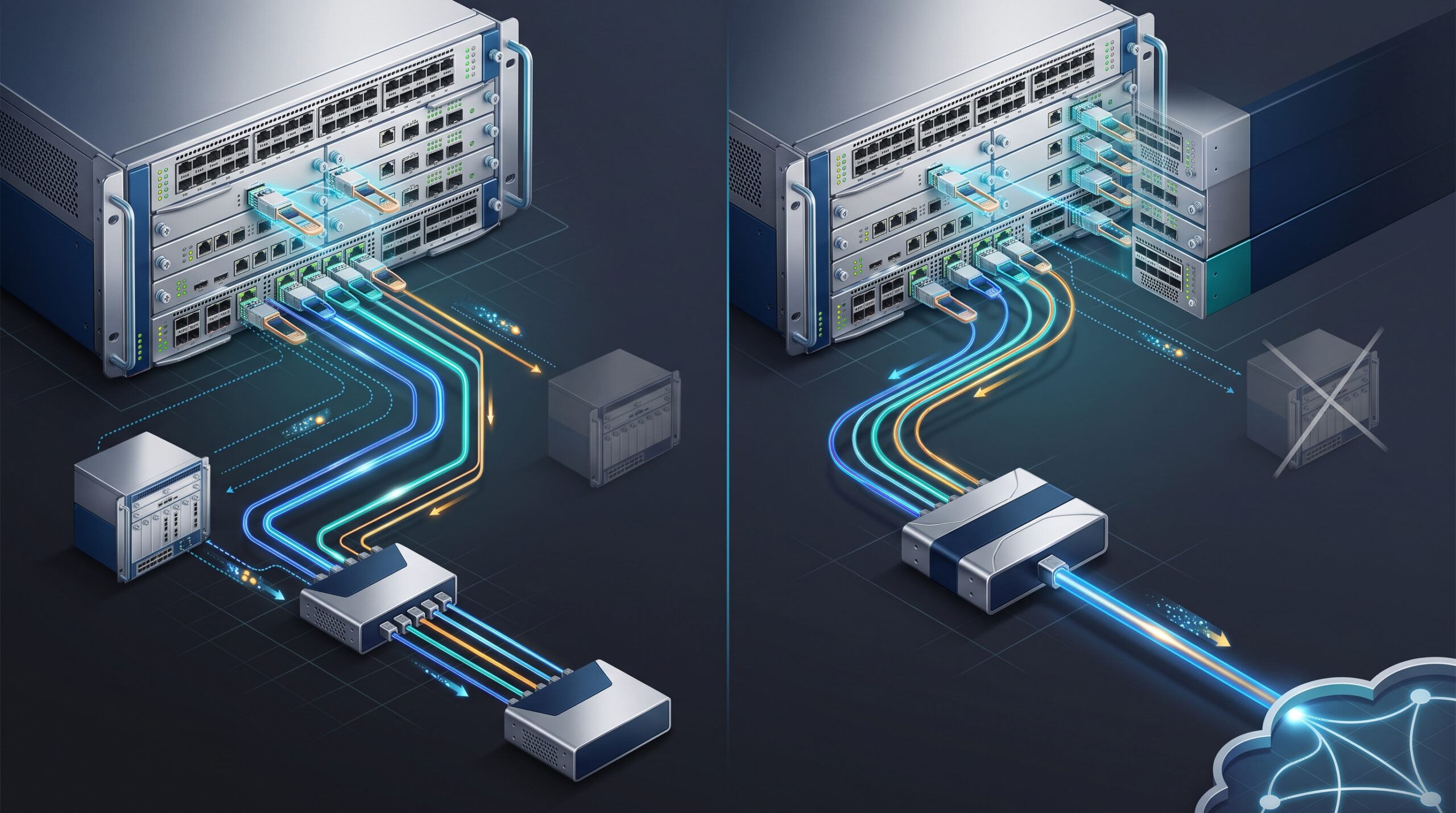
The most immediate CapEx benefit stems from the elimination of standalone transponder and muxponder chassis. In a conventional DCI or metro interconnect deployment, each 400G wavelength requires a gray optic on the router, a client interface on the transponder, a coherent line interface, and the transponder chassis itself—plus the associated license, power supply, and cooling infrastructure. Native QSFP-DD 400G ZR or OpenZR+ pluggables eliminate the transponder layer entirely. A single pluggable inserted into a router line card generates a DWDM-ready wavelength directly from the IP port . For a 36-port 400G deployment, this removes an entire optical shelf from the BOM, representing a CapEx avoidance of 30–45% depending on line system complexity and vendor margins .
Operational Expenditure and Footprint Efficiency
OpEx savings compound over the lifecycle. Each eliminated chassis removes a management endpoint, a set of fans, a power conversion stage, and a failure domain. A Tier-1 carrier-neutral interconnection provider recently reported collapsing IP and optical layers into a unified IPoDWDM design, achieving 14.4 Tbps per system with 18×400G OpenZR+ ports while shrinking data center interconnect footprint and preserving sub-50ms recovery . The floor-space and cooling implications are equally material: coherent pluggables consume between 15W and 23W per QSFP-DD cage depending on ZR versus ZR+ mode and output power , but they displace an entire transponder shelf that would otherwise draw hundreds of watts and require dedicated thermal management.
| Key Parameter | 400G ZR (OIF) | OpenZR+ (MSA) |
|---|---|---|
| Line Rate / Client Interface | 400GE (Ethernet only) | 100GE / 200GE / 300GE / 400GE |
| Modulation Format | DP-16QAM (fixed) | DP-QPSK / 8QAM / 16QAM (selectable) |
| FEC Scheme | C-FEC (concatenated) | oFEC (open FEC) |
| Maximum Reach (Amplified) | ~120 km | ~600–1400 km (rate-dependent) |
| Power Consumption (Typical) | ≤15 W | 19–23 W (standard output); higher for high-power variants |
| ROADM Compatibility | Limited / point-to-point | High-power variants support direct ROADM connection |
| Form Factor | QSFP-DD / OSFP | QSFP-DD / OSFP |
Hardware Efficiency and Performance Boundaries
Power per Bit and Thermal Density
Power consumption is the hidden TCO driver in high-density routing platforms. A 400G ZR module typically dissipates ≤15W in its standard OIF mode, while OpenZR+ variants range from 19W to 23W for standard output power and can reach higher for +0 dBm or +3 dBm high-power variants required for ROADM integration . At the system level, modern router silicon such as Nokia FP5 consumes less than 0.1W per gigabit of forwarding capacity—approximately 40W per 400GE port without optics . The optical pluggable therefore represents roughly 30–35% of total port power in a ZR+ deployment, making cage thermal design and airflow management non-negotiable prerequisites for reliable operation.
Reach and Capacity Trade-offs
400G ZR, standardized by the OIF, delivers 400 Gbps over a single DWDM wavelength using 16QAM modulation with C-FEC, targeting point-to-point DCI links up to approximately 120 km amplified . OpenZR+ extends this envelope to 600–1400 km depending on modulation and amplifier configuration, supporting QPSK, 8QAM, and 16QAM with oFEC, and enabling rate downshift to 300G, 200G, or 100G for impaired spans . This rate flexibility is a direct TCO lever: operators can deploy a common OpenZR+ pluggable across short DCI and longer regional spans, reducing SKU proliferation and sparing complexity.
Datacenter and Metro Integration Topologies
Native routing integration shifts the deployment model from “optics as a separate domain” to “wavelengths as router interfaces.” In point-to-point DCI, two routers connect directly via 400G ZR over an amplified or unamplified span, with no intermediate optical equipment beyond EDFAs if required . In metro and regional topologies, OpenZR+ plugs into the router and interfaces with ROADMs, enabling single-hop IP links over a shared fiber infrastructure . The critical caveat is ROADM passband narrowing: each ROADM hop adds filtering penalty, and the achievable reach of a pluggable DCO depends on ROADM count as much as fiber length . High-output-power OpenZR+ variants (+0 dBm or +3 dBm) are necessary for direct ROADM connection, as standard -10 dBm modules lack the launch power to overcome line system losses .
Lifecycle Verdict: When the Math Works
The TCO case for 400G ZR and OpenZR+ integration is strongest when three conditions align: link distances fall within 120 km (ZR) or 600–1000 km with limited ROADM cascades (ZR+), port density per site is sufficient to amortize router line-card investment, and operational simplicity carries quantifiable value for the organization. Below 120 km in high-density DCI environments, the savings are unambiguous—transponder elimination, reduced sparing, and lower power per bit deliver payback within the first hardware refresh cycle. For regional spans exceeding 600 km or traversing more than five to seven ROADM nodes, the capacity-reach penalty of pluggable DCOs may force rate downshifts or require transponder-based alternatives, eroding the TCO advantage. The practical architecture is hybrid: ZR and OpenZR+ where the reach envelope fits, optimized transponders where it does not, with a unified management plane spanning both domains.
Leave a comment