
In the rapidly evolving landscape of telecommunications, the demand for high-speed, reliable, and scalable broadband connectivity has never been higher. For Internet Service Providers (ISPs) and network operators, delivering gigabit-capable internet directly to the consumer’s premises requires robust infrastructure at both the core and the edge of the network. The cornerstone of this edge deployment is the Optical Network Terminal (ONT).
This authoritative whitepaper-style blog post provides an in-depth technical and operational analysis of the FiberHome AN5506-01-A(S), a high-performance GPON Optical Network Terminal. Designed specifically to meet the rigorous demands of modern FTTH solutions (Fiber to the Home), this device bridges the gap between high-capacity optical fiber networks and the end-user’s local area network (LAN).
Throughout this technical review, we will explore its core specifications, configuration management capabilities, international deployment readiness, and the strategic advantages it offers to network operators aiming to optimize their service delivery architectures.
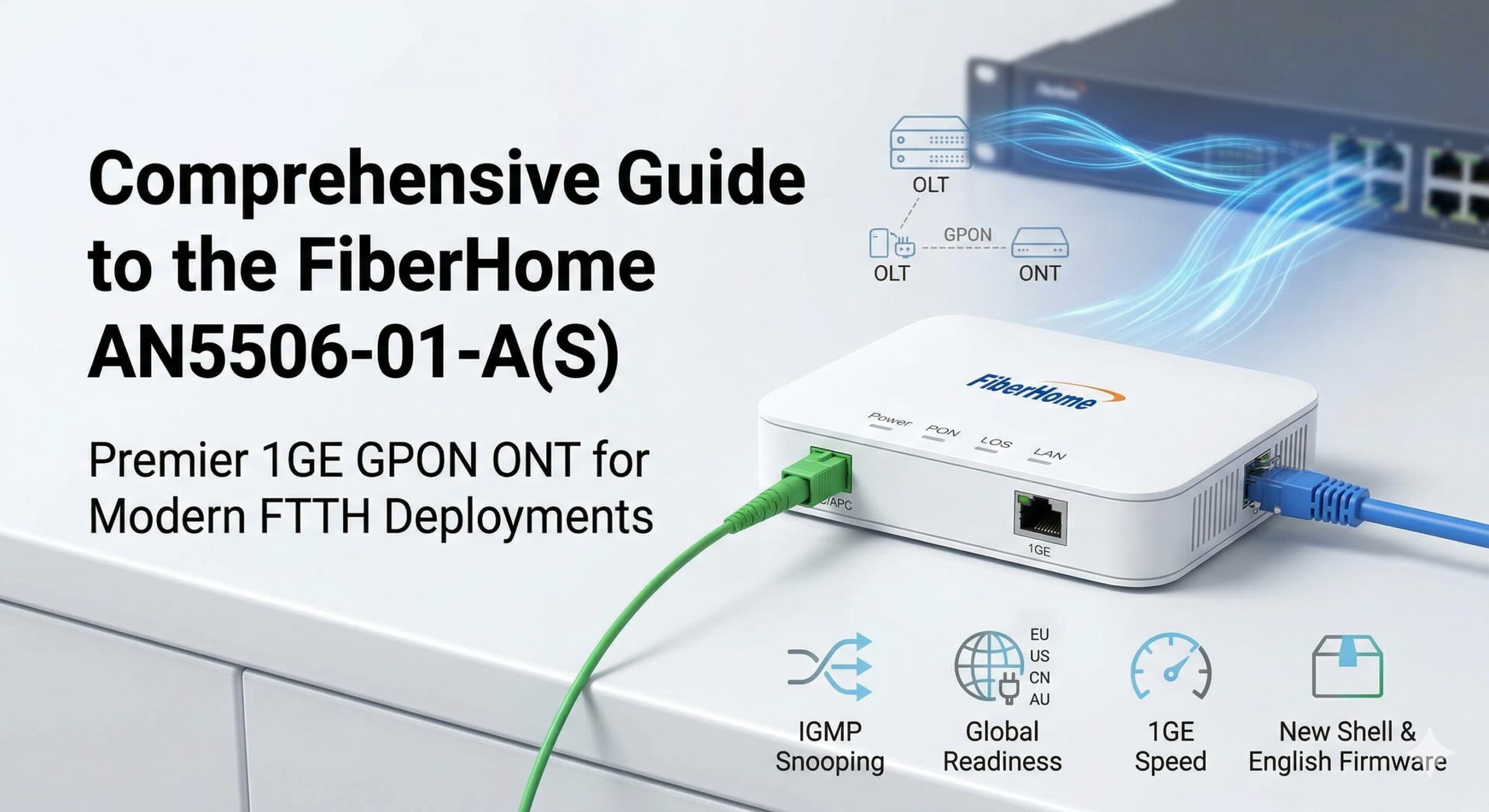
1. The Strategic Role of the ONT in GPON Architecture
Before diving into the specific technical merits of the FiberHome AN5506-01-A(S), it is essential to contextualize its role within a Gigabit Passive Optical Network (GPON).
A standard GPON architecture consists of three primary components:
-
Optical Line Terminal (OLT): Located at the provider’s central office, serving as the endpoint for the provider’s network.
-
Passive Optical Splitter: A non-powered device that divides the optical signal from one fiber into multiple downstream fibers.
-
Optical Network Terminal (ONT) / Optical Network Unit (ONU): Installed at the customer premises, responsible for converting optical signals into electrical signals compatible with user devices.
The ONT acts as the crucial final handshake in the optical network. Its reliability, throughput capacity, and management features directly dictate the Quality of Experience (QoE) for the end-user and the operational expenditure (OpEx) for the service provider. A substandard ONT can lead to network bottlenecks, increased customer support tickets, and difficulties in remote provisioning. Conversely, an enterprise-grade device like the 1GE GPON ONT ensures seamless traffic flow, advanced protocol support, and streamlined remote management.
2. Core Technical Specifications: FiberHome AN5506-01-A(S)
The FiberHome AN5506-01-A(S) is engineered to provide a streamlined, high-efficiency connection point for residential and small-business subscribers. Below is a detailed breakdown of its primary technical and hardware characteristics.
2.1 Single Gigabit Ethernet (1*GE) Interface
At its core, this device is a 1GE GPON ONT. It features a single 10/100/1000Base-T Ethernet port. While some ONTs feature multiple ports or integrated Wi-Fi routing capabilities, the single-port design is a deliberate and highly strategic choice for many ISPs.
-
Bridge Mode Optimization: It functions perfectly as a layer 2 bridge, passing the public IP address directly to the customer’s own router or firewall.
-
Reduced Complexity: Fewer ports mean fewer points of failure, lower heat generation, and a smaller hardware footprint.
-
Cost Efficiency: By stripping away redundant routing features, ISPs can deploy these units at a highly competitive scale, allowing customers to utilize their preferred wireless mesh systems or enterprise firewalls downstream.
2.2 Advanced Multicast Support: IGMP Snooping Protocol
One of the standout features of this ONT is its native support for the IGMP (Internet Group Management Protocol) snooping protocol.
In network environments that deliver IPTV (Internet Protocol Television) or high-definition streaming services, multicast traffic management is critical. Without IGMP snooping, multicast traffic (like a live TV broadcast) is flooded to all ports on a network, consuming massive amounts of bandwidth and causing network congestion.
How the AN5506-01-A(S) handles IGMP Snooping:
-
Traffic Analysis: The ONT actively “snoops” or listens to IGMP network traffic between hosts and routers.
-
Intelligent Routing: It maintains a map of which devices on the LAN require which multicast streams.
-
Bandwidth Conservation: The ONT ensures that heavy IPTV multicast streams are only forwarded to the specific set-top box or device requesting them, rather than broadcasting them blindly. This guarantees a stutter-free IPTV experience while preserving bandwidth for standard web browsing and gaming.
3. Global Deployment Readiness and Hardware Integrity
For telecommunications distributors and international ISPs, hardware standardization and deployment readiness are major logistical concerns. The packaging, power specifications, and localized interfaces heavily influence procurement decisions.
3.1 Brand New Single Box and Packaging Assurance
The supply chain for telecommunications equipment often contains a mix of refurbished, gray-market, and new devices. The FiberHome AN5506-01-A(S) discussed here is specified as a brand new single box and brand new package.
For B2B procurement, this guarantees:
-
Zero Legacy Configurations: No lingering IP configurations or MAC address conflicts from previous network deployments.
-
Maximum Lifespan: Pristine optical sensors and unoxidized Ethernet contacts ensure the maximum possible Mean Time Between Failures (MTBF).
-
Predictable Rollouts: Technicians can rely on standardized unboxing and installation procedures, reducing time-on-site.
3.2 Multi-Standard High-Quality Power Supply (0.5A)
Power delivery is a frequently overlooked aspect of ONT deployment. The AN5506-01-A(S) utilizes a highly efficient 0.5A power supply. More importantly, it offers multi-standard plug configurations to accommodate global markets:
-
EU (European Union)
-
CN (China)
-
US (United States)
-
AU (Australia)
This flexibility allows global telecom distributors to purchase identical core hardware SKUs while only swapping the peripheral power adapter, drastically simplifying inventory management and enabling rapid deployment across different geographical regions.
3.3 English Firmware and Interface Localization
To support international FTTH solutions, localization is paramount. This unit features:
-
New Shell with English Indicators: The physical LED status lights (e.g., Power, PON, LOS, LAN) are clearly labeled in English, allowing technicians globally to instantly diagnose Layer 1 physical connections without consulting translation manuals.
-
English Firmware and Web Interface: The internal software and Web GUI are fully localized in English. This prevents configuration errors that often occur when engineers are forced to navigate proprietary hardware in unsupported languages.
4. Advanced Network Management and Provisioning
Operational efficiency in modern broadband networks relies heavily on zero-touch provisioning and remote management. The FiberHome ONT configuration architecture is highly versatile, supporting three distinct methods of management to suit different network operational models.
4.1 OLT (Optical Line Terminal) Configuration
The most efficient method for large-scale deployments is centralized management via the OLT. By utilizing OMCI (ONT Management and Control Interface) protocols standardized by the ITU-T, the OLT can push configuration profiles directly to the AN5506-01-A(S) the moment it authenticates on the PON network.
-
Zero-Touch Provisioning: Technicians only need to physically connect the fiber and power; the OLT handles VLAN tagging, bandwidth profiling, and service activation automatically.
4.2 Web GUI Configuration
For smaller deployments, lab testing, or specific customer troubleshooting, the ONT features a robust, English-language Web Graphical User Interface.
-
Network administrators can log directly into the device via its local IP address to manually configure PPPoE credentials, static IP addresses, LAN DHCP settings, and firmware upgrades. This provides granular control for bespoke networking setups.
4.3 NMS (Network Management System) Integration
For enterprise-grade ISP operations, the ONT fully integrates with standard Network Management Systems. This allows for:
-
Fleet Monitoring: Bulk monitoring of thousands of ONTs for optical signal degradation (Rx/Tx power levels).
-
Mass Firmware Upgrades: Scheduling remote, off-peak firmware patches to ensure network security and compliance.
-
Fault Management: Proactive alerting when a device goes offline or experiences high error rates, reducing MTTR (Mean Time to Repair).
5. Ideal Application Scenarios for the 1GE GPON ONT
While multi-port ONTs with integrated Wi-Fi (Residential Gateways) have their place, the FiberHome AN5506-01-A(S) is optimized for specific, highly efficient deployment topologies.
5.1 The Two-Box Solution (ONT + Third-Party Router)
The industry is increasingly shifting toward a “two-box” model. ISPs provide a highly stable, single-port bridged ONT (like the AN5506-01-A), while the customer or ISP provides a separate Wi-Fi 6/7 router or mesh network.
-
Advantage: As Wi-Fi standards evolve rapidly (from Wi-Fi 5 to 6, to 6E, to 7), the ISP does not need to replace the optical hardware. They simply upgrade the downstream router, saving massive capital expenditure on optical equipment.
5.2 Small to Medium Business (SMB) Connectivity
Businesses often possess their own advanced IT infrastructure, including enterprise-grade firewalls (e.g., Fortinet, Palo Alto) and managed switches. A multi-port, routing ONT would cause complex “Double NAT” networking issues. The 1GE AN5506-01-A(S) operates transparently, providing a pure gigabit pipeline directly to the enterprise firewall.
5.3 Dedicated IPTV Terminations
Due to its robust IGMP Snooping capabilities, this device is ideal for hospitality deployments (hotels, hospitals) where a single, stable, multicast-optimized line is required for IP-based television services without the need for complex internal routing.
6. Frequently Asked Questions (FAQs)
To assist network engineers, procurement managers, and deployment specialists, we have compiled the most frequently asked questions regarding this hardware.
Q1: What exactly is the FiberHome AN5506-01-A(S)?
The FiberHome AN5506-01-A(S) is an enterprise-grade GPON Optical Network Terminal designed for FTTH (Fiber to the Home) networks. It acts as the customer-premises endpoint, converting the optical fiber signal from the ISP into a standard electrical Gigabit Ethernet connection for use by routers, switches, or computers.
Q2: How does the FiberHome ONT configuration process work?
The device is highly flexible and can be configured in three ways:
-
Remotely and automatically by the central OLT via OMCI protocols.
-
Locally via a user-friendly, English-language Web interface.
-
Centrally through an enterprise Network Management System (NMS).
Q3: Does this 1GE GPON ONT support IPTV and multicast streaming?
Yes. The AN5506-01-A(S) features native support for the IGMP snooping protocol. This allows it to efficiently manage and route multicast traffic, making it highly optimized for delivering stutter-free IPTV and high-definition video services without congesting the local network.
Q4: Is this device suitable for international network deployments?
Absolutely. It is designed with global markets in mind. It comes with a 0.5A multi-standard high-quality power supply with options for EU, CN, US, and AU outlets. Furthermore, the physical shell indicators, firmware, and user interfaces are entirely in English.
Q5: What is the benefit of a single-port (1*GE) ONT compared to a multi-port model?
A single-port ONT is ideal for “bridge mode” deployments. It is more cost-effective, generates less heat, and reduces network complexity. It allows ISPs to deliver a pure gigabit connection directly to a customer’s high-end third-party wireless router or an enterprise firewall, preventing Double-NAT issues.
Q6: Can I use this ONT with any brand of OLT?
While the GPON standard (ITU-T G.984) is designed to be interoperable, maximum stability, zero-touch provisioning, and advanced OMCI management are typically guaranteed when paired with FiberHome OLTs. However, many modern third-party OLTs support interoperability with FiberHome edge devices depending on the firmware and network configuration.
Q7: What is the significance of the “brand new single box” and “brand new package” designation?
In the B2B telecommunications hardware market, distinguishing between new and refurbished stock is vital. “Brand new” guarantees pristine hardware, unoxidized optical components, zero legacy configuration data, and maximum operational lifespan (MTBF), ensuring reliable ISP rollouts.
Q8: What does the physical interface look like?
The device features a clean, modernized shell. The front panel includes English-labeled LED indicators for Power, PON (Passive Optical Network sync), LOS (Loss of Signal), and LAN connectivity. The rear panel houses the SC/APC or SC/UPC optical port, one Gigabit Ethernet RJ45 port, the power input, and a reset button.
7. Conclusion
Deploying highly reliable, scalable, and manageable FTTH solutions requires hardware that operators can trust. The FiberHome AN5506-01-A(S) proves to be a formidable asset in the telecommunications toolkit. By combining a streamlined 1*GE interface, robust IPTV management via IGMP snooping, and highly versatile configuration options (OLT, Web, NMS), it meets the strict technical demands of modern gigabit networks.
Furthermore, its commitment to global deployment readiness—evidenced by multi-region power supplies and comprehensive English localization—makes it a logistically sound choice for distributors and international ISPs alike. Whether serving as a transparent bridge for enterprise firewalls or the backbone of a residential two-box internet solution, this GPON Optical Network Terminal delivers operational efficiency and uncompromised end-user performance.

Leave a comment