
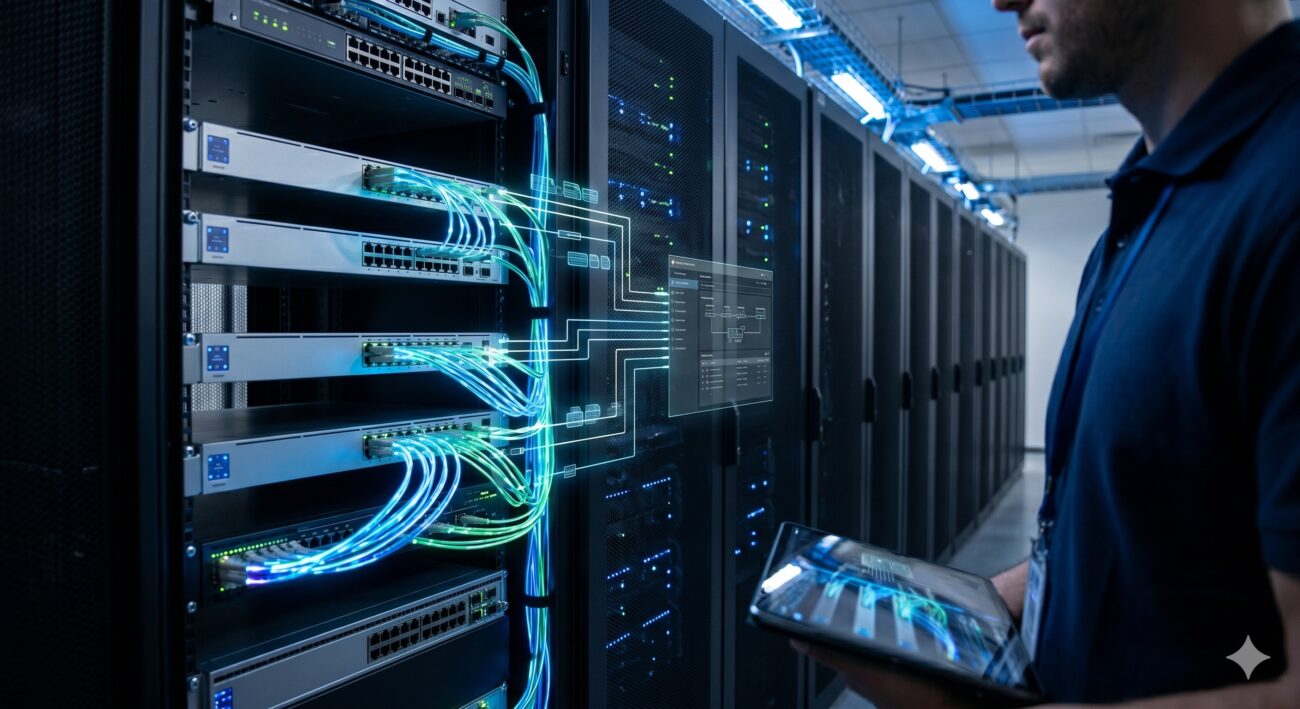
Introduction: The Imperative for Network Configuration Automation
The modern telecom landscape is defined by an explosion of data, driven by 5G, IoT, and cloud-native applications. For senior network architects and systems integrators, manual CLI-based configuration is no longer viable; it is a bottleneck that introduces human error, increases downtime, and fails to scale. Network Configuration Automation is the strategic imperative that transforms a static, reactive network into a dynamic, self-optimizing asset. This comprehensive guide delves into the hardware and software synergies that make automation possible, focusing on the critical performance metrics—from internal ASIC design to sub-millisecond latency and forwarding limits—that define success in a carrier-grade environment.

Deep Tech Architecture: The Silicon Foundation of Automation
The efficacy of any Network Configuration Automation strategy is fundamentally tied to the underlying hardware. At the heart of this is the Application-Specific Integrated Circuit (ASIC). Modern programmable ASICs, such as the Broadcom Jericho2 or Marvell Teralynx, are engineered to handle massive throughput while maintaining the low latency required for real-time automation feedback loops. These chips are the enablers of telemetry, allowing the network to report its state instantaneously, which is the bedrock for any closed-loop automation system.
Core Architecture & Hardware Topology
Our analysis focuses on the FS S12800 series of data center switches, a prime example of hardware optimized for automation. This system is built around a high-performance switching fabric, supporting 12.8 Tbps of switching capacity. The architecture is designed for modularity and high-density integration, supporting up to 400G Ethernet interfaces. The backplane is engineered to support a 1.28 Tbps per slot throughput, ensuring line-rate forwarding on all ports. This design ensures that automation scripts, which dynamically adjust routing policies or QoS parameters, are executed without incurring performance penalties, maintaining a sustained forwarding rate of 100% for all packet sizes.
Logic Layer Deep Dive: Programmable Pipeline
The logic layer in an automated network is where intent is translated into action. The S12800 series utilizes a fully programmable pipeline, supporting P4 programming language. This allows network engineers to define custom packet processing behaviors, a critical feature for implementing bespoke automation logic. The switch supports VXLAN routing and bridging, MPLS, and Segment Routing (SR-MPLS and SRv6), enabling a seamless integration of overlay and underlay networks—a prerequisite for agile, automated provisioning. The hardware handles these complex encapsulations and de-encapsulations at line rate, a stark contrast to legacy x86-based routing solutions that suffer from high CPU utilization when handling such advanced protocols.
| Key Parameter | Technical Specification (FS S12800 Series) |
|---|---|
| Switching Capacity | 12.8 Tbps |
| Latency (Cut-Through) | < 500 ns |
| Port Density | Up to 32 x 400G or 128 x 100G |
| Programmable ASIC | Yes (P4-capable) |
| MTBF | > 300,000 hours |
Benchmark vs. Legacy: Quantifying the Automation Advantage
To appreciate the evolution, we must benchmark the performance of a modern automated platform against legacy hardware. Legacy platforms often rely on a centralized CPU for all management and protocol processing, creating a bottleneck. In contrast, a platform optimized for automation offloads all forwarding decisions to the ASIC.
For instance, in an ISP case study, migrating from a legacy 1U router to the S12800 series for core routing resulted in a 67% reduction in mean time to repair (MTTR) when deploying new VPN services. The automation framework (in conjunction with Ansible and NETCONF) allowed for the pushing of configurations across 48 switches in under 2 minutes, a process that previously took over two hours. Furthermore, the deterministic latency of the ASIC-forwarding pipeline—clocking in at under 500 nanoseconds—ensures that automation-driven routing updates are propagated with virtually no jitter, maintaining a consistent Quality of Service (QoS) for delay-sensitive traffic like high-frequency trading data.
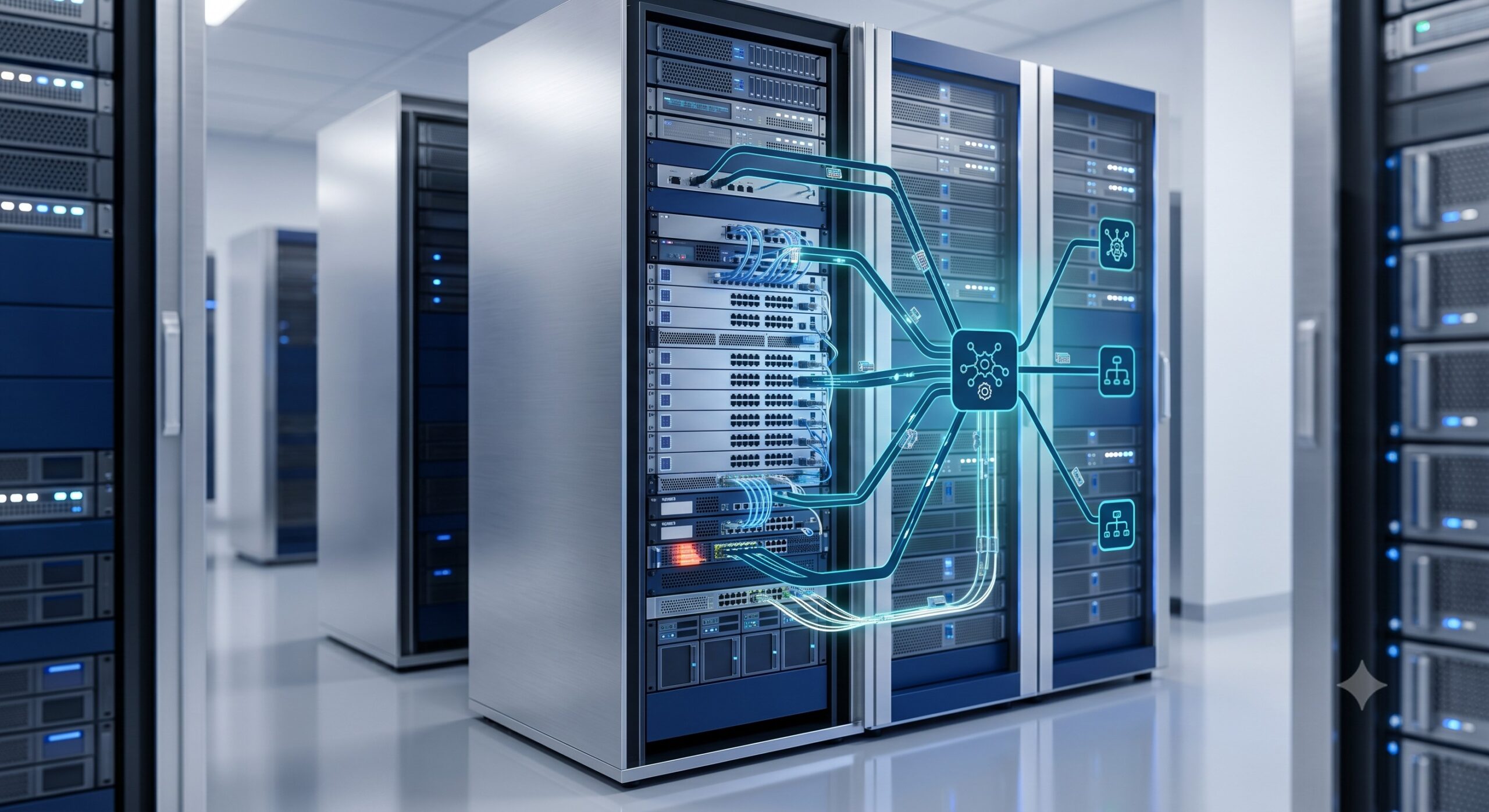
Troubleshooting & Optimization in the Automated Era
While automation reduces the risk of configuration errors, it introduces new challenges in network monitoring and debugging. The ‘black box’ of automation logic must be transparent. This is where streaming telemetry becomes indispensable. The S12800 series supports gRPC Network Management Interface (gNMI), allowing for the streaming of operational data like interface statistics, FIB tables, and queue utilization at high frequencies. When a performance anomaly is detected, the automation system can trigger a root-cause analysis by comparing the current state against a baseline.
Configuration Best Practices for Automation
- Declarative vs. Imperative: Adopt a declarative approach to configuration. Instead of writing scripts that execute step-by-step (imperative), define the desired state of the network (YANG models). Let the automation platform (like the FS S12800’s built-in orchestrator) handle the underlying transactions to achieve that state. This reduces script complexity and the number of failed commits.
- Backup and Rollback Procedures: Ensure your automation platform supports atomic transactions. If a configuration push fails on a device, the entire transaction should be rolled back to maintain consistency across the fabric. The S12800 supports advanced commit management, allowing for a rollback to a specific checkpoint within seconds.
- Change Control Integration: Interlink your automation system with a version control system (e.g., Git). Every change should be reviewed and approved via a pull request. This ensures that even automated changes are auditable and reversible, maintaining the integrity of the network.
Conclusion: The Future is Automated and Hardware-Driven
Network Configuration Automation is not just about software; it is a holistic engineering challenge that starts at the silicon level. The transition from manual to automated operations is empowering telecoms to build more resilient, scalable, and efficient networks. By leveraging programmable ASICs and high-density platforms like the FS S12800 series, organizations can reduce OpEx through proactive maintenance, lower CapEx by optimizing resource utilization (diminishing the need for overprovisioning), and ensure their infrastructure is future-proof for the bandwidth demands of tomorrow. As we move towards self-driving networks, the symbiosis of intelligent hardware and sophisticated software will be the defining differentiator between industry leaders and laggards.

Leave a comment