
Overview & Thematic Scope
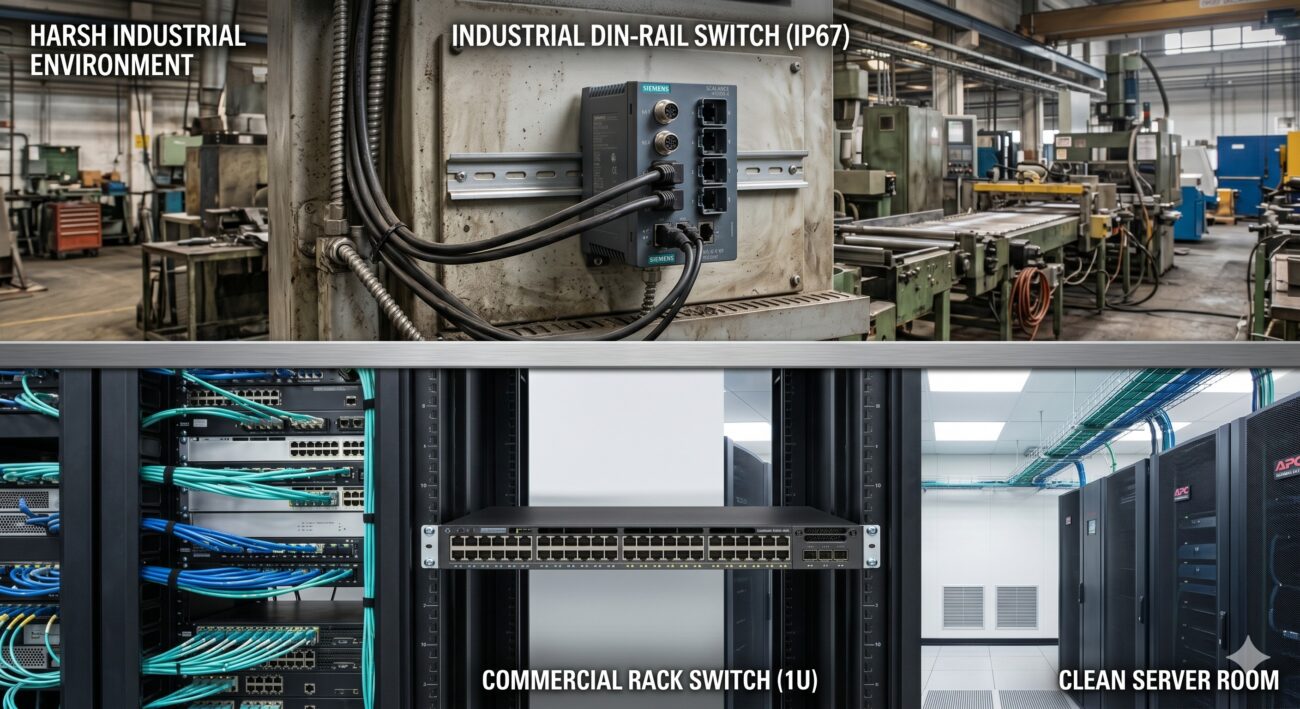
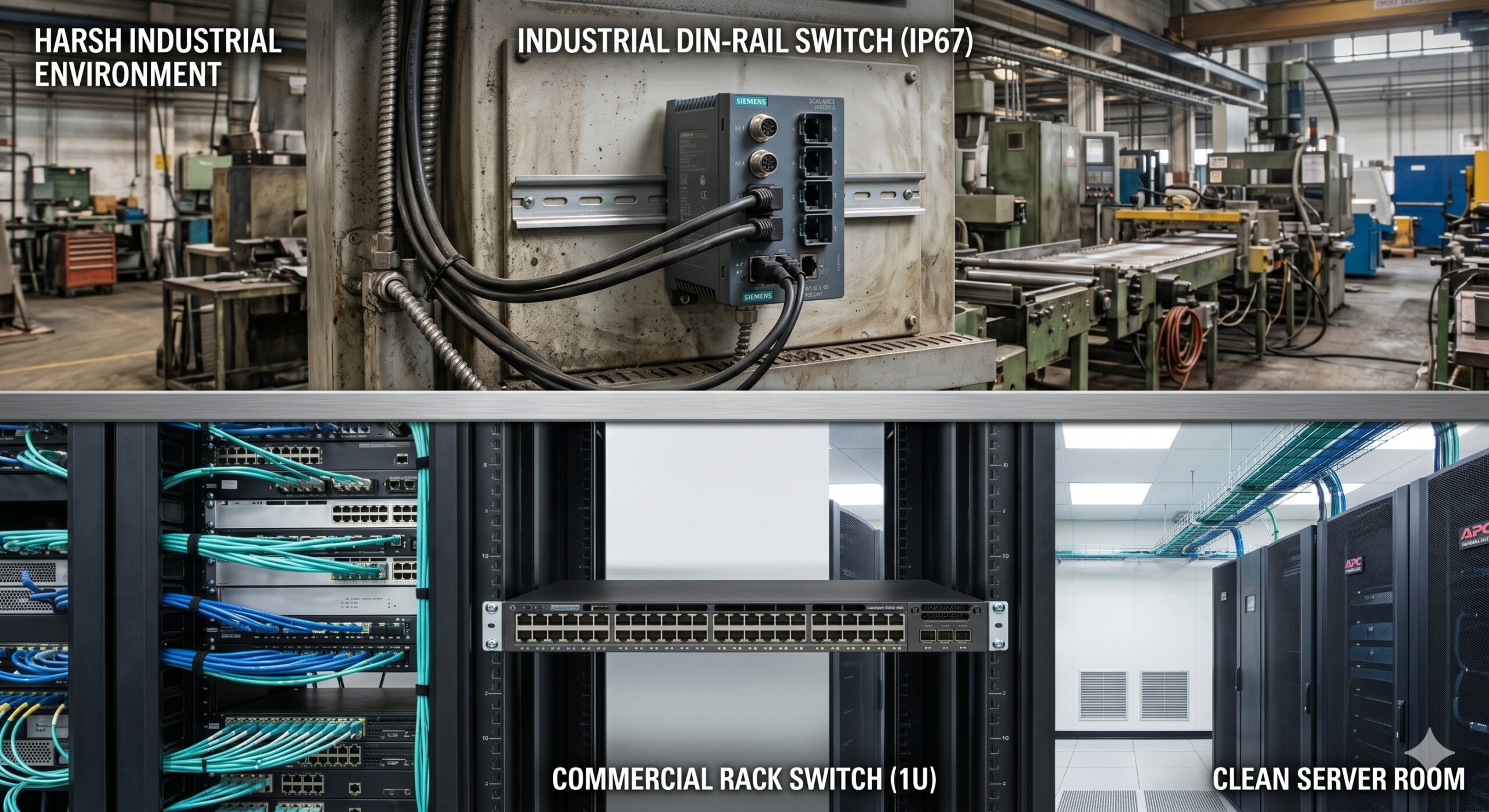
Industrial Ethernet and Commercial Ethernet share the same foundational protocols, but they are engineered for entirely different operating realities. Commercial Ethernet is designed for climate-controlled, electrically quiet office environments, prioritizing high bandwidth for data and media streaming. In contrast, Industrial Ethernet is built for the factory floor, emphasizing deterministic communication, extreme temperature resilience, vibration resistance, and high immunity to electromagnetic interference (EMI). Making the correct choice between them is critical for ensuring uptime, safety, and reliable automation control. This FAQ addresses the core technical, deployment, and troubleshooting questions engineers and procurement specialists ask when evaluating these two networking paradigms.
Frequently Asked Questions
- Q1: What is the single most important technical difference between Industrial Ethernet and Commercial Ethernet?
- The most critical technical difference is determinism. Commercial Ethernet is a non-deterministic network that uses Carrier Sense Multiple Access with Collision Detection (CSMA/CD), which can cause unpredictable delays when packets collide and must be resent . In contrast, Industrial Ethernet is designed to be deterministic, ensuring that data packets arrive at a guaranteed time, which is essential for real-time control applications like robotics and motion control where communication delays can lead to production stoppages .
- Q2: How do the physical environmental requirements (M.I.C.E.) differ for Industrial Ethernet components?
- Industrial Ethernet components are designed to withstand harsh environments classified by the M.I.C.E. standard—Mechanical (vibration, flexing), Ingress (dust, moisture), Climatic (extreme temperatures), and Electromagnetic (noise) . Unlike Commercial Ethernet equipment, which is limited to controlled conditions, Industrial Ethernet cables feature high strand counts and robust jackets (like PUR or TPE) for flexibility and chemical resistance, and switches often support extended temperature ranges from -40°C to 75°C .
- Q3: Why can’t I use a standard office-grade RJ45 connector in an industrial setting?
- Standard commercial RJ45 connectors lack the durability to survive industrial environments. While both types use the 8P8C interface, industrial RJ45 connectors are built with reinforced metal or high-impact thermoplastic housings, feature IP67 or IP68 ratings for dust and water resistance, and are fully shielded to protect against electromagnetic interference (EMI) from heavy machinery . They are also designed to operate in extreme temperatures and resist oils and solvents that would degrade standard plastic connectors .
- Q4: What are the key differences in network topology between commercial and industrial networks?
- Commercial Ethernet networks typically use a hierarchical star topology, which is ideal for office environments. Industrial Ethernet, however, often utilizes ring or hybrid star-ring topologies to provide redundancy . This ensures that if a single cable or switch fails, the network can recover in milliseconds (often via protocols like RSTP or HSR) to prevent costly downtime, whereas commercial networks may take several seconds to re-route traffic, which is unacceptable for automated processes .
- Q5: If I have a climate-controlled cabinet on the factory floor, can I use a Commercial Ethernet switch?
- While a Commercial switch might function temporarily in a climate-controlled cabinet, it is not recommended for long-term industrial use. Commercial switches often rely on fans for cooling, which can draw in dust and moisture, and they typically lack redundant power supplies . Industrial switches are fanless (to prevent failure points), feature ruggedized steel enclosures for DIN-rail mounting to withstand vibration, and include dual power inputs to ensure high availability—features absent on commercial office switches .
- Q6: What protocols are typically associated with Industrial Ethernet, and why are they important?
- Industrial Ethernet relies on specific protocols that run on standard Ethernet hardware to achieve real-time performance. Common protocols include EtherNet/IP, PROFINET, EtherCAT, and Modbus TCP . These protocols manage data traffic to ensure determinism and low latency. For instance, EtherCAT uses a master/slave topology for high-speed data transfer, while PROFINET offers both real-time and standard IT communication, making them critical for integrating PLCs, HMIs, and sensors in a production environment .
- Q7: What is the typical lifespan difference between Industrial and Commercial Ethernet hardware?
- Industrial Ethernet switches are engineered for a significantly longer lifespan and higher Mean Time Between Failures (MTBF) than commercial switches. Due to their ruggedized components, fanless designs, and wide thermal tolerances, industrial switches can operate reliably for 10 years or more in harsh conditions . In contrast, commercial Ethernet equipment, designed for rapid technology refresh cycles, often has a lifespan of only 3 to 5 years, even in optimum office conditions .
- Q8: How should I troubleshoot cabling issues specific to Industrial Ethernet networks?
- More than half of Industrial Ethernet problems are caused by cabling. Troubleshooting requires specialized tools that look beyond basic continuity. In industrial settings, cables are subject to flexing, vibration, and corrosion that can cause poor connections. Technicians should use cable analyzers capable of testing for DC Resistance Unbalance to find poor connections and Transverse Conversion Loss (TCL) to detect electromagnetic interference (EMI) susceptibility . Additionally, testers often require special adapters (e.g., M12) to test point-to-point links terminated with industrial connectors .

Leave a comment