
The telecommunications landscape is undergoing a massive transformation, demanding higher bandwidth, ultra-low latency, and seamless edge-to-core connectivity. This comprehensive guide explores the ZTE GPON and ZXDSL 9806H architecture, focusing specifically on the technical mechanics of the main control board. As operators face the dual challenge of maximizing existing copper infrastructure while migrating to fiber-optic backbones, understanding the deployment capabilities of these integrated access devices becomes critical.
Why is this important now? With the exponential growth of high-definition streaming, IoT integration, and enterprise cloud computing, last-mile bottlenecks remain a significant hurdle for Internet Service Providers (ISPs). The ZTE ZXDSL 9806H, acting as a versatile Multi-Dwelling Unit (MDU), bridges this gap efficiently. In this article, network engineers and telecom strategists will learn actionable deployment strategies, deep architectural principles of the control and uplink modules, and diagnostic protocols to optimize their FTTx (Fiber to the x) networks. By leveraging these insights, operators can significantly reduce Capital Expenditure (CapEx) while delivering Gigabit-era broadband access to end-users.
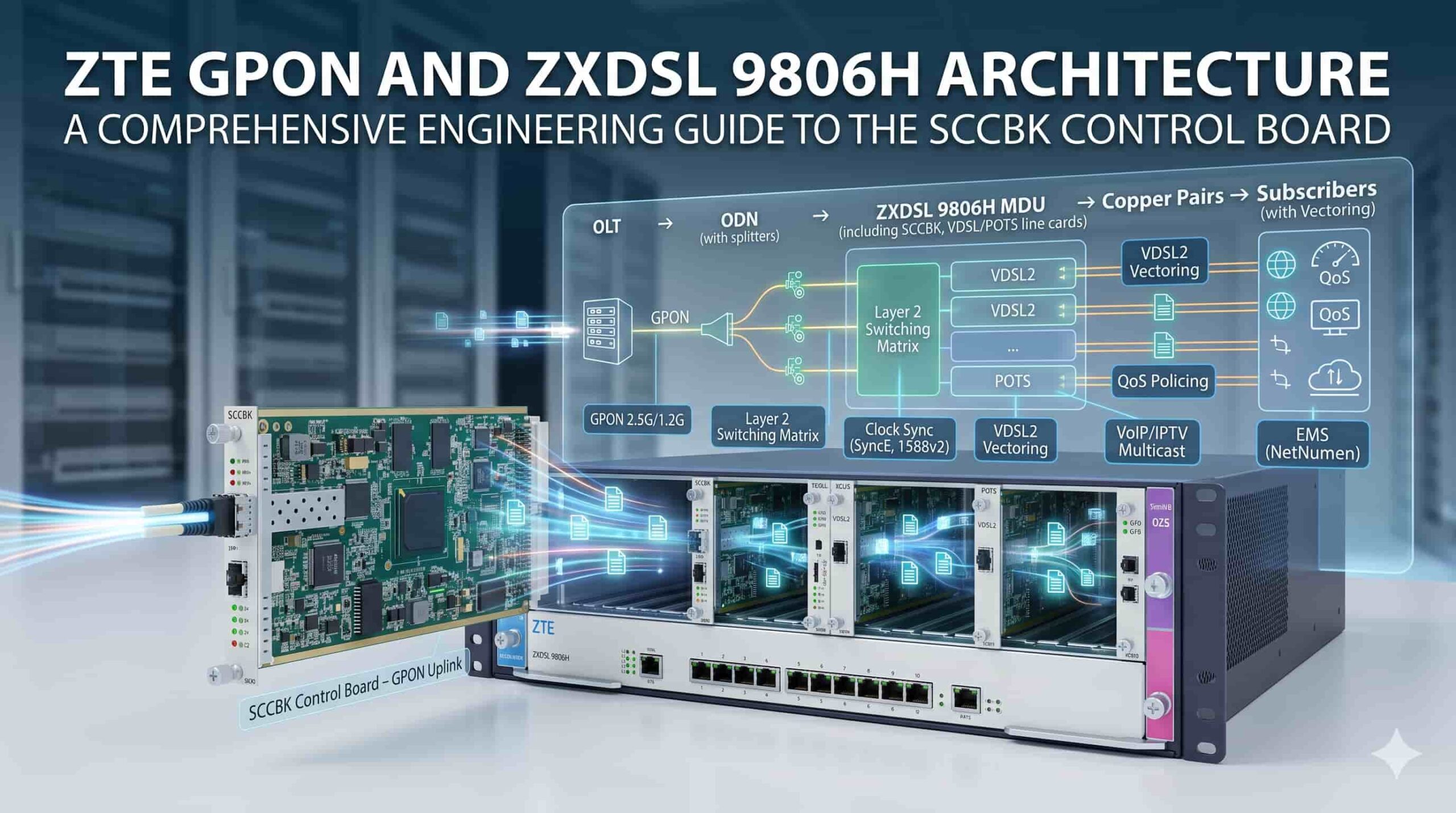
Understanding the ZTE ZXDSL 9806H in Modern FTTx Architecture
The global push toward Gigabit society connectivity has accelerated the deployment of FTTB (Fiber to the Building) and FTTC (Fiber to the Curb) architectures. In scenarios where deploying pure FTTH (Fiber to the Home) is economically unviable or physically restricted—such as in historically protected buildings or dense urban high-rises—telecom operators rely on advanced MDU platforms. The ZTE ZXDSL 9806H stands out as a highly compact, unified broadband access platform designed precisely for these hybrid copper-fiber edge environments.
The Role of the MDU in Broadband Access
The ZXDSL 9806H functions as a high-performance DSLAM (Digital Subscriber Line Access Multiplexer) and an MDU. Measuring at just 2U in height, it is engineered for space-constrained outdoor cabinets and indoor telecom closets. The chassis typically features four service slots, supporting a heterogeneous mix of subscriber interfaces, including ADSL2+, VDSL2, SHDSL, and standard analog telephony (POTS) interfaces.
By pushing the optical termination point closer to the subscriber (FTTB/FTTC), operators can deliver ultra-fast broadband over short copper loops. This architecture minimizes signal attenuation and crosstalk, unlocking the full potential of VDSL2 vectoring technologies. According to industry analysis, utilizing advanced copper enhancement technologies in MDU architectures can defer FTTH CapEx by up to 40% while still meeting 100-300 Mbps bandwidth demands per user (Source: Dell’Oro Group Broadband Access Report, 2025).
System Architecture and Backplane Capacity
At the heart of the 9806H’s performance is its non-blocking switching backplane. Designed to handle continuous, heavy-load traffic without packet loss, the system utilizes a star-topology backplane architecture connecting the line cards to the central control module. This ensures that every subscriber port has dedicated bandwidth, eliminating the oversubscription issues commonly found in legacy edge devices. Layer 2 aggregation, multicast processing for IPTV delivery, and rigorous Quality of Service (QoS) enforcement are all handled natively within the chassis.
Deep Dive into the SCCBK Main Control Board: Principles and Specifications
For the ZXDSL 9806H to communicate effectively with the central Optical Line Terminal (OLT), it requires a robust, high-capacity central processing and uplink module. This is where the SCCBK control board becomes indispensable.
The SCCBK (Switching, Control, and Clock Board with GPON Uplink) is the foundational “brain” of the 9806H system. It consolidates management, layer 2 switching, and external optical uplinks into a single, hot-swappable module.
Core Processing and Switching Capabilities
The SCCBK operates as the central switching matrix for the entire chassis. It manages all internal data flows between the subscriber line cards (such as the ASTEC VDSL boards or ATLC POTS boards) and the external network. Operating purely at wire-speed, the board executes MAC address learning, VLAN tagging, and STP (Spanning Tree Protocol) computations without utilizing CPU cycles, thanks to its dedicated Application-Specific Integrated Circuits (ASICs).
The board is responsible for maintaining the system’s operational integrity. It houses the primary microprocessor that runs the system’s embedded operating system, managing configuration files, alarm processing, and environmental monitoring (temperature, fan speed, and power supply status).
Uplink Architecture: The Power of GPON
What distinguishes the SCCBK from legacy control boards is its integrated GPON (Gigabit Passive Optical Network) uplink interface. Compliant with ITU-T G.984.x standards, the GPON uplink provides 2.488 Gbps downstream and 1.244 Gbps upstream bandwidth.
When deployed in a PON network, the board acts as an ONU (Optical Network Unit). It supports dynamic bandwidth allocation (DBA), ensuring that mission-critical VoIP and IPTV traffic receive priority transmission across the optical distribution network (ODN), even during peak congestion periods. The GPON interface utilizes standard SC/PC or SC/APC optical transceivers, supporting split ratios of up to 1:128 and optical reach distances of 20 kilometers, making it ideal for sprawling urban and suburban network topologies.
Clock Synchronization and Timing
In modern telecommunications, particularly when integrating voice services (POTS/VoIP) or providing backhaul for micro-cell mobile networks, precise clock synchronization is non-negotiable. The SCCBK board integrates a high-precision stratum-3 local oscillator. It supports synchronous Ethernet (SyncE) and IEEE 1588v2 Precision Time Protocol (PTP) phase synchronization, extracting timing signals directly from the GPON line or external clock interfaces to ensure absolute network harmony.
Comparison Matrix: SCCBK vs. Legacy Uplink Boards
To understand the evolutionary leap the SCCBK represents, telecom engineers must compare it against legacy and alternative control boards used within the ZTE 9806H ecosystem. The following table highlights the critical differentiators.
| Specification / Feature | SCCBK Board (GPON) | SCCT Board (GE) | SCCE Board (EPON) | Legacy SCCB (FE/GE) |
| Primary Uplink Interface | 1x GPON (ITU-T G.984) | 2x Gigabit Ethernet (SFP) | 1x EPON (IEEE 802.3ah) | 1x GE / 1x FE |
| Uplink Bandwidth | 2.5 Gbps (DS) / 1.2 Gbps (US) | 2.0 Gbps (Symmetric) | 1.25 Gbps (Symmetric) | 1.0 Gbps / 100 Mbps |
| System Switching Capacity | Non-blocking Wire-speed | Non-blocking Wire-speed | Wire-speed | Wire-speed |
| OAM Protocol Support | OMCI & SNMP | SNMP & Telnet | OAM & SNMP | SNMP |
| Target Deployment Scenario | FTTB/FTTC (GPON ODN) | Cascaded FTTx / Direct Metro | FTTB/FTTC (EPON ODN) | Legacy access networks |
Note: System performance metrics assume optimal firmware conditions and compliant SFP module integration.
Strategic Deployment Models for ZTE 9806H in FTTB/FTTC Scenarios
Successful deployment of broadband access equipment requires more than just installing hardware; it requires a strategic alignment of physical infrastructure, logical provisioning, and localized traffic engineering.
High-Density VDSL2 and Vectoring Implementation
As copper loops are shortened in FTTB deployments (typically under 300 meters), the primary limiting factor for bandwidth is no longer signal attenuation, but rather Far-End Crosstalk (FEXT) between adjacent copper pairs in the same binder. The ZTE 9806H combats this through advanced VDSL2 vectoring (ITU-T G.993.5).
When paired with a modern control module, the system processes the noise profiles of all lines simultaneously, generating an anti-noise signal that effectively cancels out FEXT. This allows operators to deliver near-fiber speeds (up to 100 Mbps symmetric or 200 Mbps asymmetric) over existing copper. Engineers must ensure that all lines within a binder group terminate on the same vectoring group within the 9806H chassis to maximize the noise-cancellation efficiency.
QoS Strategy for Multi-Play Services
The delivery of Triple-Play services (Data, Voice, and Video) necessitates rigid QoS policies. The ZTE 9806H categorizes traffic at the edge.
-
VoIP (Voice): Assigned the highest priority queue (Strict Priority – SP). It is tagged with 802.1p priority 6 or 7 to guarantee negligible latency and jitter.
-
IPTV (Video): Handled via IGMP Snooping and Proxy mechanisms. The chassis identifies multicast traffic and replicates it only to the specific subscriber ports requesting the channel. It utilizes Weighted Round Robin (WRR) scheduling to balance bandwidth.
-
High-Speed Internet (HSI): Treated as best-effort traffic, subjected to dynamic bandwidth shaping and policing at the port level to ensure users do not exceed their subscribed SLA (Service Level Agreement).
Integrating these logical policies seamlessly requires a high-performance processing core, which is heavily reliant on the advanced architecture of the SCCBK to prevent CPU overloads during massive multicast channel zapping events by subscribers.
Network Modernization: Upgrading Legacy Infrastructure with ZTE GPON
Telecommunications providers are constantly balancing the need for network modernization against the realities of infrastructure economics. Total FTTH overbuilds require massive civil works—trenching streets, navigating right-of-way legalities, and drilling into customer premises.
The Cost-Benefit Economics of GPON-Fed MDUs
By deploying ZTE 9806H units equipped with GPON uplinks in building basements or street cabinets, operators achieve a “Fiber-to-the-Basement” topology. The optical feed connects to the GPON control board, and the last 100 meters are delivered via pre-existing Cat3/Cat5 wiring using VDSL2.
Research indicates that deploying an FTTB model utilizing existing internal wiring reduces cost-per-subscriber by approximately 55% to 65% compared to greenfield FTTH deployments (Source: TeleGeography Global Broadband Analysis, 2024). This approach accelerates Time-to-Market (TTM) and allows ISPs to launch Gigabit marketing campaigns much faster than their competitors who are bogged down by civil construction delays.
Migration Best Practices
When upgrading an active network, minimal subscriber downtime is critical.
-
Pre-provisioning: Network operators should utilize OMCI (ONT Management and Control Interface) protocols from the central OLT to pre-provision the virtual ports and VLAN configurations before the physical 9806H chassis is installed.
-
Cutover Strategy: A “flash cut” strategy is often employed. Technicians disconnect the multi-pair copper trunk from the legacy central office exchange and splice it directly into the MDF (Main Distribution Frame) attached to the 9806H line cards. Because the unit boots rapidly and syncs configuration via the PON network automatically, subscriber downtime can be limited to mere minutes.
Diagnostic Tools and Troubleshooting Protocols for ZXDSL 9806H
Even the most robustly engineered networks experience anomalies. For Tier 2 and Tier 3 network operations center (NOC) engineers, mastering the diagnostic capabilities of the 9806H is vital for maintaining high Service Level Agreements (SLAs).
OMCI and NetNumen Network Management System
The primary method for monitoring the device health is through ZTE’s proprietary EMS (Element Management System), NetNumen U31. NetNumen provides a graphical interface for fault, configuration, accounting, performance, and security (FCAPS) management. Because the SCCBK acts as a GPON ONU, it communicates upstream via OMCI. This allows the central NOC to monitor optical Rx/Tx power levels, CPU utilization, and ambient temperature of the chassis remotely.
Command Line Interface (CLI) Mastery
For deep, on-the-ground troubleshooting, engineers interface directly with the CLI via local console or secure SSH. Key diagnostic commands include:
-
show card: Displays the real-time operational status, hardware version, and CPU load of all installed boards, including line cards and the main control module. -
show gpon onu state: Crucial for validating the optical link. This command verifies if the GPON uplink has successfully ranged and registered with the OLT. An O5 (Operation State) indicates a healthy, fully provisioned connection. -
show pon transceiver rx-power: Fiber degradation is a common fault. This command reads the Digital Diagnostics Monitoring (DDM) data from the optical transceiver. An Rx power reading worse than -27 dBm typically indicates a dirty fiber connector, macro-bend in the cable, or a failing optical splitter in the ODN. -
show mac-address-table: Essential for Layer 2 troubleshooting. If a user cannot access the internet, engineers check if the chassis is successfully learning the MAC address of the customer’s home router.
Hardware Alarm Handling
The device features hardware-level contact closures to interface with external cabinet alarms. When deployed in a street cabinet, the control board can monitor door open/close states, external battery backup voltage, and water ingress sensors, sending immediate SNMP traps back to the NOC if physical security or environmental thresholds are breached.
Future Trends in Broadband Access and Next-Generation PON
As we look toward the remainder of the decade, the broadband edge is becoming highly virtualized and substantially faster. While the GPON standard provides an excellent foundation today, the architectural design of modular MDUs like the ZTE 9806H ensures they remain relevant through future upgrade cycles.
Transitioning to XGS-PON and 10G PON
The immediate evolution path for FTTx networks is the overlay of 10G-capable PON networks (such as XGS-PON) onto the existing optical distribution network. Because XGS-PON and GPON operate on different optical wavelengths, they can co-exist on the same physical fiber. Operators can upgrade backhaul capacity by simply replacing the legacy control modules with next-generation 10G uplink boards, instantly quadrupling the aggregate bandwidth available to the VDSL2 subscribers connected to the chassis, completely avoiding a rip-and-replace scenario for the line cards and chassis itself.
Software-Defined Access Networks (SDAN)
The industry is rapidly shifting away from proprietary, black-box hardware toward Software-Defined Networking (SDN) and Network Function Virtualization (NFV). In future iterations, we will see the management plane completely decoupled from the local hardware. By upgrading the firmware on intelligent modules like SCCBK control boards, operators can integrate these physical devices into open, cloud-native orchestration platforms (such as the ONF’s VOLTHA project). This allows for intent-based provisioning, where AI-driven network controllers automatically allocate bandwidth and push QoS profiles to the edge dynamically based on real-time traffic analytics.
Frequently Asked Questions (FAQs)
What is the primary function of the ZTE SCCBK board?
It serves as the central brain of the ZTE ZXDSL 9806H chassis. It provides the core switching matrix for all internal data traffic, houses the main operating system for device management, and provides the GPON optical uplink interface to connect the system to the central office OLT.
How many service slots does the ZTE ZXDSL 9806H support?
The compact 2U chassis features a total of four dedicated service slots. These slots can be populated with various combinations of subscriber line cards, supporting VDSL2, ADSL2+, SHDSL, and POTS (analog voice) interfaces, depending on the operator’s specific deployment requirements.
Can the ZXDSL 9806H support VDSL2 vectoring?
Yes. When equipped with compatible VDSL2 service boards and the appropriate system firmware, the 9806H fully supports system-level VDSL2 vectoring (G.993.5). This technology cancels out Far-End Crosstalk (FEXT) in copper bundles, dramatically increasing downstream and upstream bandwidth capabilities.
What is the maximum GPON uplink bandwidth provided by SCCBK?
The GPON uplink interface strictly adheres to ITU-T G.984 standards. It delivers an aggregate network capacity of 2.488 Gbps for downstream traffic (OLT to the MDU) and 1.244 Gbps for upstream traffic (MDU to the OLT).
How do I configure a management IP on the ZTE 9806H?
Through the Command Line Interface (CLI), engineers access the global configuration mode and configure a management VLAN. They then create a Layer 3 out-of-band or in-band virtual interface (interface vlan <id>), assign the IP address with its corresponding subnet mask, and configure a default gateway pointing back to the core routing network.
What is the difference between FTTB and FTTC deployments using this MDU?
In an FTTB (Fiber to the Building) scenario, the 9806H is installed inside the basement or telecom room of an apartment complex, using internal wiring for the final connection. In FTTC (Fiber to the Curb), the unit is placed in a weatherproof outdoor street cabinet, serving multiple nearby residential homes over the local loop copper network.
Does the ZTE 9806H support traditional voice services (POTS)?
Yes, it functions as an integrated Multi-Service Access Node (MSAN). By installing analog POTS line cards, the chassis can provide traditional dial-tone services. The internal processors convert this analog voice traffic into VoIP (SIP or H.248) to be transmitted efficiently over the GPON uplink.
What are the operating temperature limits for the ZXDSL 9806H?
Designed for harsh environmental conditions, especially outdoor FTTC cabinets, the system boasts a robust operating temperature range, typically functioning reliably from -40°C to +65°C (-40°F to +149°F), provided the chassis cooling fans are operational and intake vents remain unobstructed.
Conclusion & Call to Action
The transition to high-speed, fiber-deep networks is a complex engineering challenge, but utilizing robust hybrid access technologies provides a highly effective pathway. The ZTE ZXDSL 9806H, powered by the advanced capabilities of the SCCBK control board, offers telecommunications operators a resilient, cost-effective, and highly scalable solution for maximizing FTTB/FTTC architectures. By leveraging robust layer 2 switching, GPON uplink integration, and sophisticated QoS management, ISPs can deliver next-generation broadband without the prohibitive costs of immediate, universal FTTH overbuilding.
Are you looking to optimize your access network infrastructure, reduce last-mile latency, and extend the profitable lifespan of your copper assets? Upgrade your network architecture today by exploring detailed specifications and procurement options for the SCCBK control board and ZTE 9806H solutions to accelerate your FTTx deployment strategy.

Leave a comment